

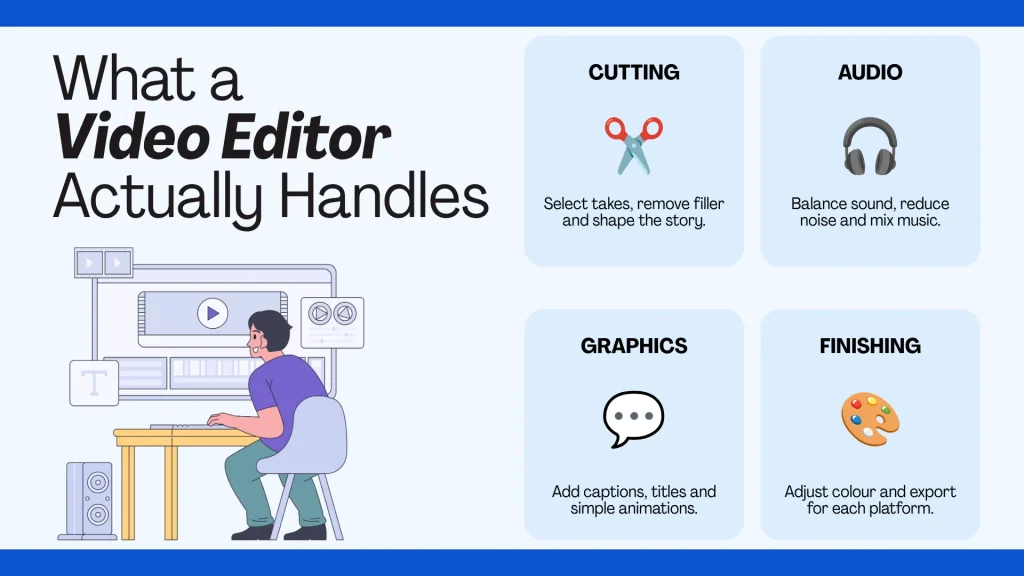
What a Video Editor Actually Handles
Worth defining, because the title spans assembly through to motion design, and the gap matters when you write the brief.
Assembly and cutting. Selecting takes, pacing, removing filler, structuring the piece. The bulk of the work on most content.
Audio. Levelling, noise reduction, music selection and ducking. More responsible for perceived quality than picture is, and routinely under-specified.
Graphics and titles. Lower thirds, captions, simple animated elements. Where a template saves the most time.
Colour and finishing. Correction for consistency, grading for look, export presets per platform.
Motion design and 3D are a separate discipline. An editor who also animates is a bonus rather than an expectation, and asking for both narrows your pool considerably.
Why Output Stays Slow After the Hire
The failure is predictable, and it is a handover failure rather than a skill one.
An editor receives a folder of footage and a sentence about what the video is for. They have no template, so they build titles from scratch. No reference, so they guess at pace and tone. No naming convention, so finding the right take takes longer than cutting it. No defined feedback method, so notes arrive as a paragraph of prose referring to moments without timestamps.
Every one of those is recoverable in an afternoon, and none of them are the editor’s to fix. The first video takes a week. The second takes a week. Nothing compounds, because nothing was systematised.
The Four Things to Set Up First
One. A project template
Not a style guide document. An actual project file with your title cards, lower thirds, caption style, intro and outro, logo placement, and export presets for each platform you publish to.
This single item removes most of the back and forth on early videos, because the look stops being a decision the editor has to make. If you do not have one, the first engagement should be to build it, scoped as its own small project rather than bundled into a video.
Two. A naming and folder convention
Where raw footage lives, how files are named, where exports go, how versions are numbered. Trivial to define, and it compounds immediately.
The version numbering matters more than it sounds. Without it, you end up with final, final2, and finalFINAL, and someone eventually publishes the wrong one. Date plus version is enough.
Three. Three reference videos
Two you want to resemble and one you specifically do not, with a sentence each explaining why. The negative example does more work than the positive ones, because it bounds the space.
This replaces an enormous amount of written direction. Pace, tone, cut rhythm, and music choice are faster to show than to describe, and an editor can match a reference far more reliably than they can interpret an adjective.
Four. A feedback method with timestamps
Prose notes referring to the bit near the start are the single largest source of avoidable rounds. Use a review tool that attaches comments to timecode, or at minimum write notes as a timestamped list.
Set a rule of two rounds. Round one for structure and content. Round two for polish. Anything arriving after round two goes into the next video unless it is factually wrong. Without that rule, revision is unbounded, and the editor cannot plan capacity.
Only Then, Hand Over Footage
With those four in place, the first video should take days rather than a week, and the second should be materially faster because the template and references are doing their job.
Start with one piece of content, not a backlog. Watch where the friction actually lands. If round one comes back structurally wrong, the brief was thin. If it comes back structurally right and visually off, the template or references need work. Diagnosing on one video is cheap. Diagnosing on five is not. Before hiring anyone, check whether video editing should be outsourced at your current volume.
You can search editors and open profiles in the client portal before committing to any of this.
What a Video Editor Costs
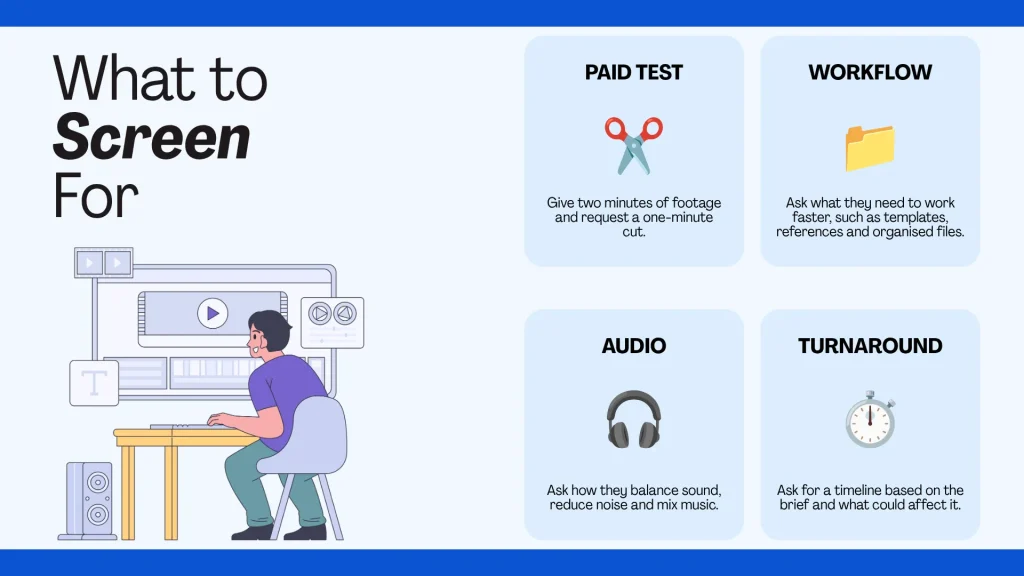
A mid-level U.S. video editor costs around The remote option only pays off if the editor stays and learns your style, which is why the setup above matters more than the rate. Send them two minutes of your actual footage and ask for a one-minute cut. Paid, short, and more informative than any showreel. A reel shows their best work under their own direction. This shows what they do with yours. Ask what they would need from you to go faster. A strong answer names template, references, and file structure without prompting. A weak one says send the footage. Ask how they handle audio. The most common quality gap. Picture is usually fine. Audio is where cheap editing shows, and it is what viewers register first without being able to name it. Ask about turnaround on a defined piece, and what changes it. An editor who quotes a flat number regardless of length or complexity has not thought about capacity. Ask them to walk you through a past timeline on a screen recording. Showreels often include team projects where they handled only part of the edit. Someone who did the work can show you how. Ask what they would change about one of your clips to keep viewers watching. Good editors have opinions about retention, not just technical skill. Speak to one past client. Five minutes tells you more about reliability and deadlines than any portfolio. Pavago is a self-serve hiring marketplace. Search vetted editors through the offshore video editor role, or the wider product and creative talent pool for motion design and graphics. You get matched in under a minute, watch video intros and hire directly, with no sales call and no recruiter in the middle. Search, messaging and interviews are free, and placement is 3% of first-year salary. Terms on the pricing page. Three cases where per-project is correct, and a hire would sit idle. Above roughly four pieces a month with a consistent format, the system pays for itself, and a dedicated editor starts compounding. Our comparison of design roles covers the same diagnostic question applied to visual work. OneNine engaged creative talent directly rather than through an agency; the OneNine case study covers how it was scoped. A project template with your titles and export presets, a file naming and version convention, three reference videos including one negative example, and a timestamped feedback method. Handing over footage without these means the editor reconstructs your style by guessing on every project. Usually because nothing was systematised. Without a template, they rebuild titles each time, without references, they guess at pace and tone, and without timestamped feedback, each round costs more than it should. Output that does not speed up by the third video is a handover problem rather than a skill problem. Two. Round one for structure and content, round two for polish. Anything after that goes into the next video unless it is factually wrong. Unbounded revision makes capacity impossible to plan and is the most common source of missed deadlines. Per project, below roughly two or three pieces a month. A dedicated editor once you are above four with a consistent format, because that is where the template and accumulated context start compounding. Not usually. Assembly, audio, basic graphics, and colour cover most business content. Motion design and 3D are a separate discipline, and requiring both significantly narrows the pool for work that rarely needs it. A mid-level U.S. editor costs about $6,000–$8,000 a month including benefits and taxes. A full-time remote editor from Latin America or Pakistan with agency experience typically costs $2,500–$4,500 a month. Freelancers charge per video, which suits occasional work. Yes, and most prefer to. With a shared project template, a clear folder convention and a review tool that attaches comments to timestamps, remote editing works as well as in-person editing. Set up the system, then search Free to search. Messaging and interviews are free. 3% of first-year salary on placement, 60-day replacement.In-house editor (U.S.) Full-time remote editor Freelancer Monthly cost $6,000–$8,000 $2,500–$4,500 Per video Commitment Full-time Full-time, dedicated to your brand Project by project Knows your style Yes Yes, after the first few videos Starts from zero each time Best for Editing that needs to happen in your office Four or more pieces a month in a consistent format Occasional or one-off projects What to Screen For
When Not to Hire
Frequently Asked Questions
What should I prepare before hiring a video editor?
Why is my video editor slow?
How many revision rounds are reasonable?
Should I hire an editor or use freelancers per project?
Does a video editor need motion design skills?
How much does it cost to hire a video editor?
Can a video editor work remotely?