

What Each One Actually Does
Definitions first, because the overlap in job titles is where most mis-hires start.
A web designer works on appearance and structure. Layout, typography, colour, hierarchy, how a page guides attention, and increasingly the prototype itself in Figma. Many produce front-end code. Many do not, and that is not a deficiency, it is a different job.
A web developer builds and maintains the thing. Templates, functionality, integrations, performance, the CMS, the parts that break when a plugin updates. Some have reasonable visual judgement. Most would rather be handed a design.
An agency supplies both, plus a project manager who coordinates them, plus a strategist who decides what the site should do. You pay for the coordination layer whether or not you need it.
According to the U.S. Bureau of Labor Statistics occupational profile, web developers and digital designers are tracked as related but distinct occupations, with designers focused on the look and feel and developers on the technical construction. The distinction is formal, not semantic.
Diagnosing Which Problem You Have
Say the complaint out loud, and it usually sorts itself.
| What you actually said | What the problem is | Who you need |
|---|---|---|
| It looks dated | Visual | Designer |
| People land and leave without doing anything | Visual and structural, sometimes functional | Designer first, then measure |
| The forms break, and nobody fixes them | Functional | Developer |
| It takes six seconds to load | Functional | Developer |
| We need a new section, and nobody can build it | Functional | Developer |
| We do not know what the site should even do | Strategic | Agency, or a strategist before either hire |
| Different people have touched it, and it is a mess | Ownership | Developer, ongoing rather than per project |
Row two is where most of the confusion lives. Poor conversion is usually a design and structure problem, occasionally a speed problem, and almost never fixed by rebuilding in a different framework. Teams reach for a developer because rebuilding feels like progress, and ship a faster version of a page that still does not persuade anyone.
When the Agency Premium Is Worth It
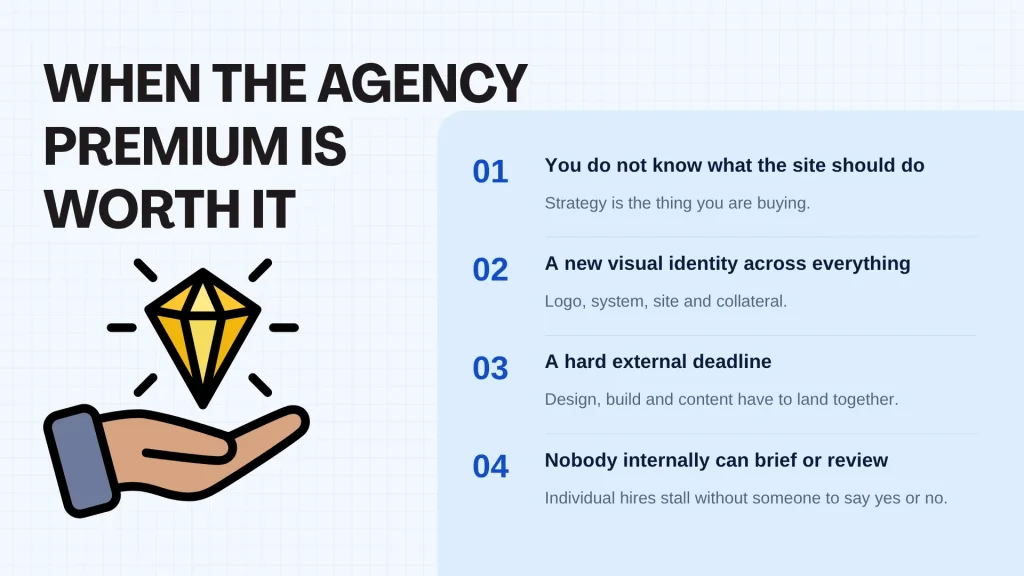
This section exists because a comparison that always lands on the cheapest option is not a comparison.
- You genuinely do not know what the site should do. Strategy is the thing you are buying, and it is the one piece neither individual hire supplies. A designer will make your unclear proposition look better. They will not fix the fact that it is unclear.
- A brand-new visual identity applied across everything. Logo, system, site, collateral. That is studio work, and coordinating it yourself is a job.
- A hard external deadline with multiple workstreams. A funding announcement or a product launch where design, build, and content have to land together. The project manager is the product.
- Nobody internally can brief or review. If there is no one to say yes or no to work, individual hires stall, and the agency’s account manager becomes necessary.
Outside those four, you are paying thirty to fifty percent for coordination between two people you could engage directly. Our analysis of what outsourced web development costs after launch covers the ongoing side of that arithmetic.
The Sequencing Most Sites Get Wrong
Where both a designer and a developer are needed, the order is not negotiable, and it is routinely inverted.
Design first, always. A developer handed a finished design builds it. A developer asked to build and design simultaneously produces something that works and looks like a developer designed it, and then a designer is brought in to fix the surface, which means rebuilding.
One exception. If the site is functionally broken, fix function first. There is no point designing a beautiful checkout on a platform that drops sessions.
For the threshold question of when ongoing web work justifies employing someone rather than buying projects, our guide to hiring a WordPress developer covers where that line sits.
What to Screen a Designer For
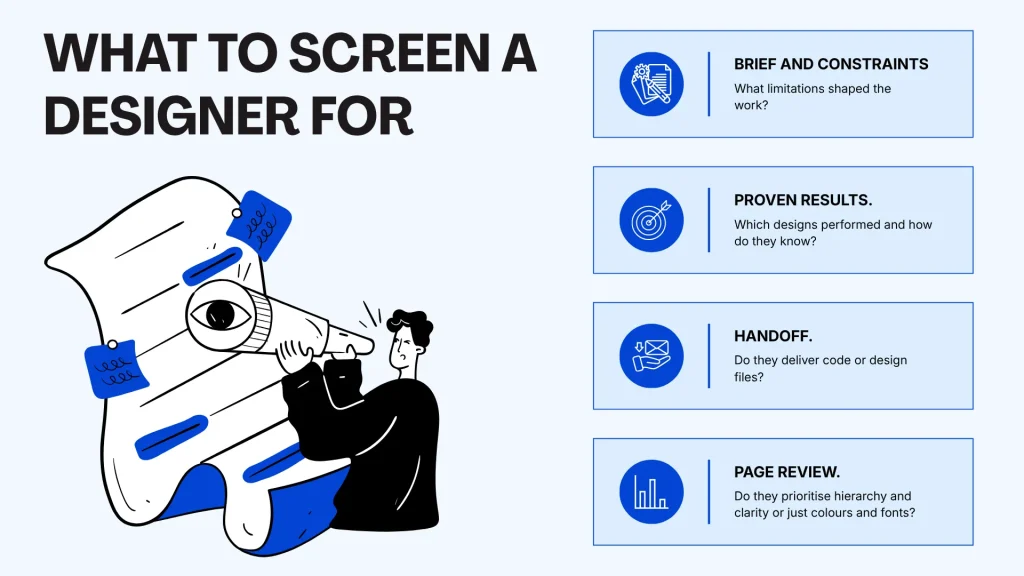
Portfolios are the weakest signal in this category, because a portfolio shows outcomes without context.
- Ask what the brief was and what constraints applied. Beautiful work produced with no constraints tells you nothing about working with yours.
- Ask which of their designs performed, and how they know. A designer who has never seen a result from their own work is designing on taste alone.
- Ask whether they hand over code or files. This determines whether you also need a developer. Get the answer before the engagement, not during it.
- Give them one real page and ask what they would change first. The most useful fifteen minutes available. Strong answers name hierarchy and clarity problems. Weak ones name colours and fonts.
Pavago places designers through the offshore web designer role, with the broader engineering talent pool covering the developer side.
Search, messaging and interviews are free, and placement is 3% of first-year salary. Terms on the pricing page.
The client portal lets you search and open profiles before deciding which of the three you need.
OneNine engaged design talent directly rather than through an agency arrangement, and the OneNine case study covers how it was structured.
Frequently Asked Questions
What is the difference between a web designer and a web developer?
A designer decides how the site looks and how pages are structured. A developer builds and maintains how it works, including templates, integrations, performance, and the CMS. Some designers hand over code and some hand over files, which determines whether you need both. For an iOS or Android product the choice is different again; see how to hire a mobile app developer.
Do I need a designer or a developer to improve conversion?
Usually a designer, because poor conversion is most often a hierarchy and clarity problem rather than a technical one. Rebuilding in a different framework produces a faster version of a page that still does not persuade anyone.
Should I hire a designer or use an agency?
An agency when you need strategy, a full visual identity, or coordination across a hard deadline. Individual hires when you know what the site should do and someone internally can brief and review the work. The agency premium is for coordination, which is real but not always needed.
Which comes first, design or development?
Design, unless the site is functionally broken. A developer handed a finished design builds it. A developer asked to design while building produces something that works and then needs redesigning, which means building twice.
Can web design be done remotely?
Yes, and it is among the most remote-compatible roles, since the work happens in Figma and a browser. What matters is enough timezone overlap for review cycles, because design iterates more than most functions.
Search designers and developers in one pool
Free to search. Messaging and interviews are free. 3% of first-year salary on placement, 60-day replacement.
Pavago is a hiring marketplace, so you run the search yourself. Tell it the role, your budget and the region, and you get matched with vetted remote candidates in under a minute. Watch their video intros, message the ones you like, and hire straight from the app. No sales call, no job post, no recruiter in the middle. It’s the most frictionless way we know to hire.