

Why the Per-Task Model Hides Its Own Cost
A single WordPress task looks cheap. A contact form fix, a plugin update that broke the layout, a new landing page for a launch. Each one is a few hundred dollars, and each one is approved in isolation.
The reason nobody notices the total is that these invoices arrive from different people at different times for different reasons. There is no line in the budget called WordPress. There is a line called marketing, and another called operations, and the same site is quietly billing against both.
The second cost is slower and harder to see. Every freelancer who touches the site does so without knowing what the last one did. Plugins accumulate. Custom code gets bolted on in the shortest way that works because nobody expects to maintain it. Two years of that produces a site where a simple change takes three hours because the person making it has to reverse-engineer the last five people first.
Where the Line Actually Sits
The threshold is not a number of projects. It is a frequency.
| Pattern of work | What it means | What to do |
|---|---|---|
| A few tasks a year, unrelated | Genuinely episodic. Nobody needs to hold context. | Pay per task. Hiring would be waste. |
| One project, then silence for months | Project work with a real endpoint | Freelancer or agency for the build |
| Something every month, from different people | Recurring work with no owner | This is the crossover. Consolidate. |
| Weekly changes, plus a backlog you never reach | A product that happens to run on WordPress | Hire. You are already past the line. |
The third row is where most businesses live and the one they misread. Monthly recurring work with no single owner is the expensive state, because you are paying per-task rates for what has become a standing function, and paying again every time someone new has to learn the site.
What Changes Once Someone Owns the Site
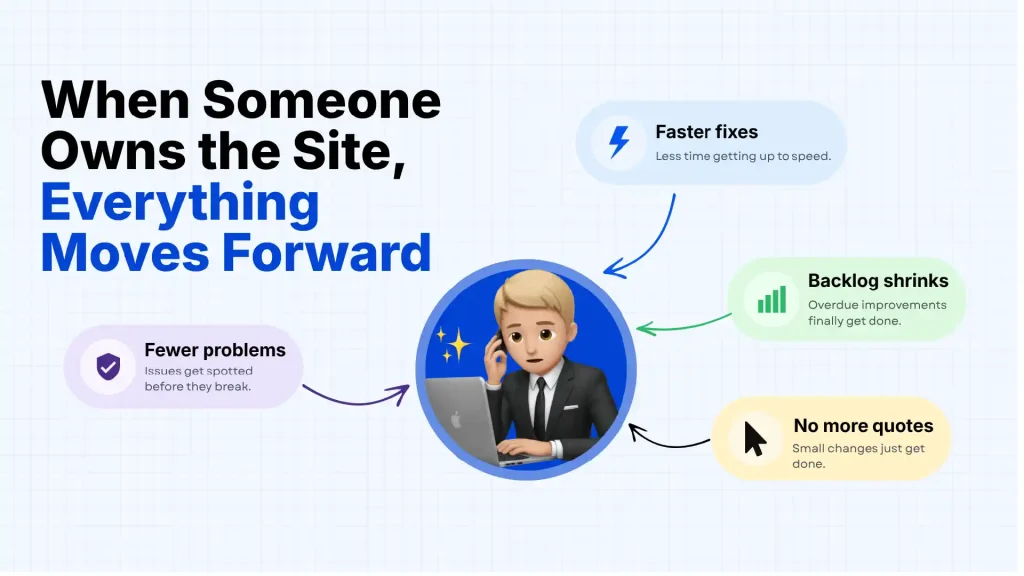
The obvious saving is rate arbitrage, and it is the least interesting part. The real difference is that context stops being rebuilt from scratch.
- Fixes get faster each month. Someone who has worked in the theme for six weeks does in twenty minutes what a new freelancer needs two hours to understand.
- Problems get prevented. A dedicated developer notices the plugin that is about to break on the next core update. Per-task freelancers are only ever called after something is already broken.
- The backlog moves. Every site has a list of things nobody has got to: speed, accessibility, the forms that half work. That list only shrinks when someone owns it.
- Nobody is quoting you. A small change stops requiring a scope, an estimate and an approval. It just gets done.
Before committing either way, it is worth seeing what the hire would actually cost. You can browse engineering talent and open profiles without creating anything.
What a WordPress Developer Should Actually Be Able to Do
The title covers a wide range of abilities, and the gap between the ends of it is large. Screen for the work you actually have.
| Level | Can do | Cannot do |
|---|---|---|
| Configurator | Install themes and plugins, change settings, edit content | Fix what breaks. Reaches for another plugin instead. |
| Theme developer | Child themes, template files, custom fields, PHP within the theme | Write a plugin. Debug a conflict outside the theme layer. |
| WordPress engineer | Custom plugins, hooks and filters, REST API, query optimisation, staging and deployment | Little. This is the level that maintains a site long term. |
The distinction matters most when something breaks. A configurator responds to a plugin conflict by trying a different plugin, which is how sites accumulate twenty-eight of them. An engineer reads the error and fixes the cause. If you have monthly recurring work, you need the third row, and paying configurator rates repeatedly is how sites end up needing a rebuild.
Ride the Wave made a senior hire rather than continuing to buy the work in pieces, and the Ride the Wave case study covers how that placement was structured.
The Cost Comparison, Once You Include the Invisible Part
Employer costs sit well above salary when hiring domestically. According to the U.S. Bureau of Labor Statistics, benefits account for roughly 30 percent of total employer compensation costs, meaning the real cost of a domestic hire is materially higher than the advertised salary.
That figure is the reason the per-task model survives longer than it should. Compared against a domestic salary plus 30 percent, paying per task looks reasonable for a long time. Compared against a remote hire, the arithmetic moves considerably earlier.
Placement through Pavago is 3% of first-year salary, with search, messaging and interviews free. The pricing page has the complete structure, including the 60-day replacement window.
If you want to see who is available before deciding anything, the client portal lets you search the pool and open profiles directly.
When Per-Task Is Genuinely the Right Answer
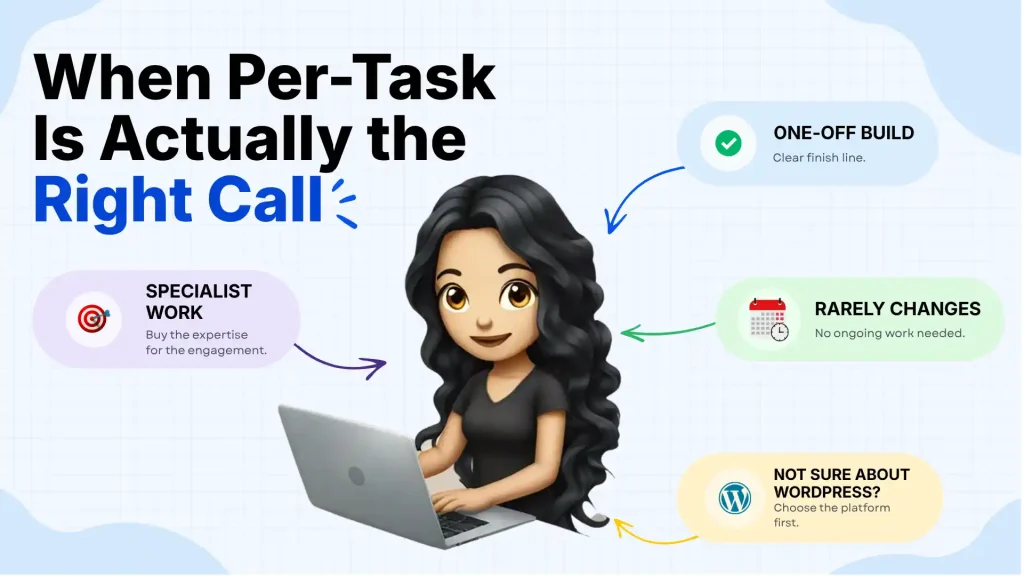
Four cases where hiring would be the wrong call, and they are common enough to matter.
- A one-off build with a real end. A new site, then years of near-silence. Buy the project.
- Genuinely specialist work. A complex migration, a security incident, a performance audit at depth. Buy the expertise for the engagement.
- Your site is a brochure that rarely changes. If nothing has needed doing in six months, nothing will justify a salary.
- You are still deciding whether to stay on WordPress. Do not hire into a platform you may leave. Decide first.
Outside those, if work arrives monthly and different people keep touching the site, the per-task model is costing more than it appears. Our guide to outsourcing web development covers the models in more detail.
Frequently Asked Questions
When should I hire a WordPress developer instead of using freelancers?
When the work recurs monthly and no single person holds context for the site. The trigger is frequency, not project count. Occasional unrelated tasks are genuinely episodic and should be bought per task.
How much does it cost to hire a WordPress developer?
Domestically, salary plus roughly 30 percent in employer costs. Remotely, salary plus a one-time placement fee with no recurring margin. Per-task work varies widely by scope and is usually quoted per project rather than per hour.
What is the difference between a WordPress developer and a designer?
A designer decides how it looks. A developer builds and maintains how it works, including template files, custom functionality, plugin conflicts, and performance. Many sites need both, and hiring one expecting the other is a common mismatch.
Can one developer maintain multiple WordPress sites?
Yes. A single developer typically handles several sites comfortably, provided they are built on similar stacks. The constraint is usually the volume of change requested rather than the number of installations.
Should I hire a WordPress developer or move off WordPress?
Decide the platform question first. Hiring someone to maintain a site you intend to replace wastes the ramp period, which is where most of the value of a dedicated developer comes from.
See who is available before you decide
Search the pool free. Messaging and interviews are free. 3% of first-year salary on placement, 60-day replacement.
Pavago is a hiring marketplace, so you run the search yourself. Tell it the role, your budget and the region, and you get matched with vetted remote candidates in under a minute. Watch their video intros, message the ones you like, and hire straight from the app. No sales call, no job post, no recruiter in the middle. It’s the most frictionless way we know to hire.