

What Outsourcing Web Development Actually Covers
Worth defining, because the phrase spans four different purchases with different economics.
Project build. A defined scope with a launch date. Quoted as a fixed price or a range. Ends at delivery, sometimes with a short warranty period.
Retainer. Ongoing hours from an agency or freelancer, billed monthly. Covers maintenance and a variable amount of new work depending on how the hours are defined.
Staff augmentation. A developer supplied by a vendor, working as part of your team, billed monthly at a markup over their compensation.
Direct hire. A developer who works for you, sourced once, paid a salary. No recurring vendor margin.
The first is priced against a deliverable. The other three are priced against time. That difference is why comparing them on a single number is misleading, and it is the source of most bad decisions in this category.
The Cost the Quote Does Not Include
Here is what arrives after launch, in roughly the order it arrives.
| When | What happens | Who pays for it |
|---|---|---|
| Weeks 1 to 4 | Bugs the launch missed. Browser inconsistencies. Forms that half work. | Usually the warranty, if there is one |
| Months 2 to 6 | Content changes. A campaign landing page. Something the brief did not anticipate. | You, at whatever the change rate is |
| Months 3 onward | Security patches, CMS and plugin updates, dependency upgrades | Nobody, until something breaks |
| Months 6 to 12 | Performance degradation as content and plugins accumulate | You, once it becomes visible |
| Month 12 onward | The backlog. Accessibility, speed, the forms nobody fixed. | Deferred indefinitely |
| Any time | An urgent break on a Friday | Whoever is available, at urgency pricing |
Row three is the one that compounds. Security patching and dependency updates have no owner in a project engagement, because the engagement is over. They get skipped until a vulnerability or a breaking update forces attention, at which point the work is larger than routine maintenance would have been.
This is a supplier risk as much as a technical one. According to GitHub’s Octoverse report, the overwhelming majority of modern applications are assembled from open source dependencies rather than written from scratch, which means a site is only as current as the packages underneath it. A build handed over and never updated inherits every vulnerability disclosed afterwards.
Why Project Pricing Looks Cheaper Than It Is
Not because anyone is being dishonest. Because the unit of comparison is wrong.
A build quote is a number for a deliverable. A salary is a number for a year. Placing them side by side compares a one-time cost against a recurring one, and the one-time cost wins every time on that framing.
The comparison that holds is total cost across a fixed window. Pick twenty-four months. Add the build, the change requests, the maintenance that did or did not happen, and the urgency premiums. Then compare that against what the same period costs with someone who owns the site.
For most SMBs with a site that changes monthly, the totals converge faster than expected, and the owned model wins on everything except the first invoice. Our guide to hiring a WordPress developer covers where that crossover sits for WordPress specifically.
The Costs That Are Not Money
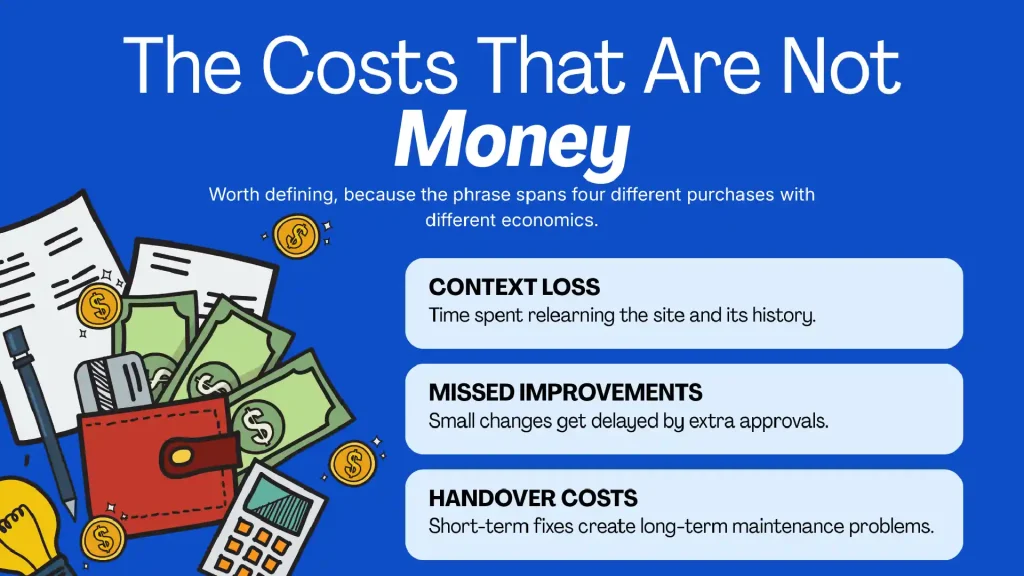
Three that never appear in any comparison and matter more than some that do.
- Context rebuilt every time. Each new freelancer or agency starts by reverse-engineering what the last one did. On a two-year-old site with three previous contributors, that is hours before any work begins.
- Change requests that never get made. When every small change requires a scope, a quote, and an approval, small changes stop being requested. The site quietly stops improving, and nobody logs that as a cost.
- Decisions optimised for handover, not for maintenance. A developer who will not maintain the site builds for delivery. The shortest path that passes acceptance is rational for them and expensive for whoever comes next.
When Project Pricing Is Genuinely Correct
Four cases, and they are common enough that this is not a rhetorical section.
- A genuine one-off with a real end. A rebuild, then years of near-silence. Buy the project.
- Specialist work outside your stack. A migration, a complex integration, an accessibility audit. Buy the expertise for the engagement.
- You are still deciding on the platform. Do not hire into a stack you may leave inside a year.
- Design-led work. A brand-new visual identity applied to a site is closer to design than development and often belongs with a studio.
Outside those, if the site changes monthly and different people keep touching it, project pricing is charging you build rates for what has become a standing function. Our comparison of offshore staffing models covers the same structure applied to hiring generally.
What to Establish Before Signing Anything
Who owns security patching after launch, and at what cost? If the answer is nobody, that work is coming to you regardless.
What is the change rate, and is there a minimum? A $150 hourly rate with a two-hour minimum makes a ten-minute change cost $300.
Who holds the credentials and the code? Hosting, domain, repository, CMS admin. If the agency holds them, leaving is harder than it looks.
What does the twenty-four month total look like on your own numbers? No provider will volunteer this calculation. Do it before the first invoice, not after the fourth.
Pavago is a self-serve hiring marketplace. Search vetted developers yourself through the offshore web developer role, with the broader engineering talent pool covering adjacent stacks. You get matched in under a minute, watch video intros and hire directly, with no sales call and no recruiter in the middle.
Search, messaging and interviews are free, and placement is 3% of first-year salary. Terms on the pricing page.
The client portal lets you search the pool and open profiles before running the comparison.
Eversite assembled a performance-focused engineering team rather than buying the work in project increments; the Eversite case study covers how it was structured.
Frequently Asked Questions
How much does it cost to outsource web development?
The build is quoted as a project and varies by scope. The more useful number is the twenty-four-month total, which adds change requests, maintenance, security patching, and urgency premiums to the build. For sites that change monthly, that total usually exceeds what an owned developer costs over the same period.
What is not included in a web development quote?
Post-launch maintenance, security patching, dependency and CMS updates, content changes, performance work as the site grows, and anything the brief did not anticipate. Warranty periods cover launch bugs, not the two years afterwards.
Is a retainer better than a project quote?
For ongoing work, usually, because it assigns an owner to maintenance. Check what the hours actually cover, whether unused hours roll over, and whether maintenance comes out of the same pool as new work. If it does, new work will consistently displace patching.
Who should own hosting and code access?
You. Hosting, domain, repository, and CMS admin credentials should sit with you regardless of who builds the site. If the agency holds them, switching providers becomes a negotiation rather than a decision.
When should I hire a developer instead of outsourcing projects?
When the site changes monthly, and multiple people keep touching it. The trigger is frequency, not project count. Occasional unrelated work is genuinely episodic and should be bought as projects.
Run the twenty-four-month comparison
Search the pool for free. Messaging and interviews are free. 3% of first-year salary on placement, 60-day replacement.