

I recently watched a video from Hector, who built the content team at Wispr Flow, laying out exactly who to hire if you had 30 days to build a content team from scratch (watch it here). It’s the clearest breakdown of a content team I’ve seen, and I agree with almost all of it.
There’s one catch. That team costs $28,000 to $46,000 a month. If you have VC money, it’s the right way to build. Most companies don’t, and that’s fine. You can build the same team with global talent for about half the cost.
Below are both versions: the VC-funded build, role by role, and how to put the same team together with global hires. I’ve also added the two roles most breakdowns skip, a writer and a social media manager.
Content marketing team structure (with an org chart)
A content team has three jobs: decide what to make, make it, and get it seen. Structure it around those jobs, with one person on top who owns the strategy.
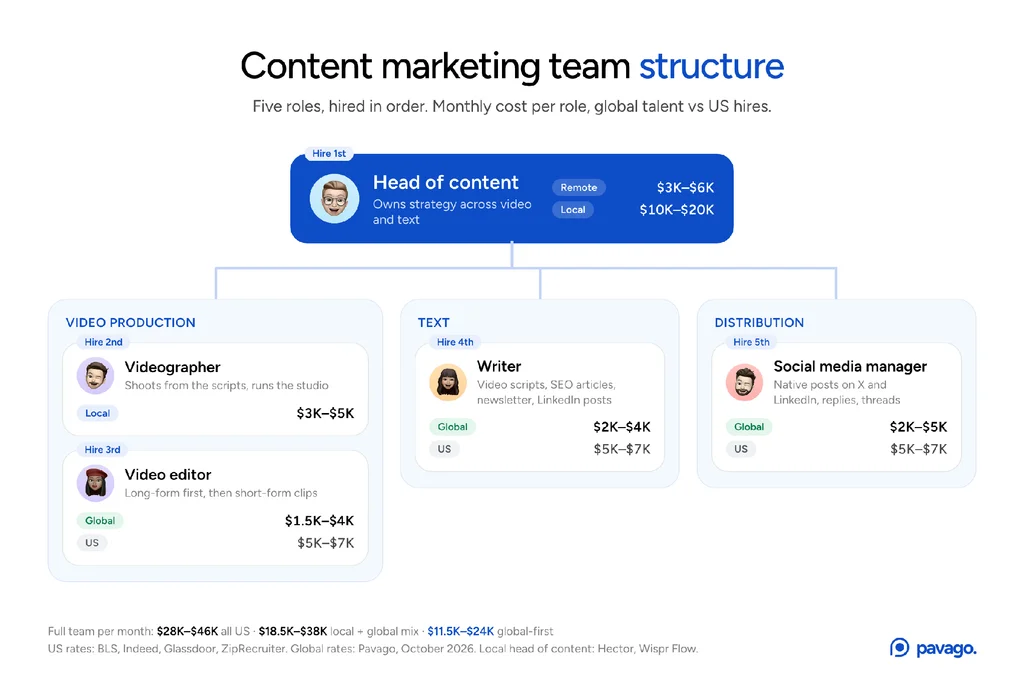
- Strategy: the head of content.
- Video production: a videographer and a video editor.
- Text production: a writer, who also co-writes the video scripts.
- Distribution: a social media manager.
Everyone reports to the head of content. When strategy is split across three people, nobody makes the call on what to double down on and what to cut, so the team ships a lot and learns nothing.
Takeaway: If one person is planning, filming, editing and posting, you don’t have a content team yet. You have a bottleneck with a job title. Handing all of it to one freelance content creator hits the same wall.
Content team roles, in the order to hire them
Your content strategy team decides what to make and whether it worked. At most companies, that’s one person: the head of content. Your content creation team makes it: the videographer, the editor, and the writer. The social media manager connects the two, getting the work seen and bringing back what the audience responds to.
Hire in this order. Each hire frees the person before them to focus on what they’re best at.
1. Head of content
This is the pillar of the team. They pick the channels, decide which concepts to test, read the results and hire everyone below them. They also drive the strategy across every format, so video, articles, and social all roll up to one plan.
Hector’s bar for this role is high:
- at least 100 million views generated across platforms
- at least 100,000 followers on one profile
- knows how to run a UGC (user-generated content) program for paid and organic
- has built a team of editors, videographers, and creatives before
With VC money: $10,000 to $20,000 a month, per Hector.
2. Videographer
The videographer lets your head of content think about the big picture instead of capturing footage and setting up the studio. Skip this hire and the team can’t scale, because people end up doing work outside their role.
Hector budgets $8,000 to $15,000 a month here. You don’t need that at the start, even with VC money: $3,000 to $5,000 gets you a solid local videographer, or $3,000 to $4,000 for someone starting out. This role stays local either way, because they need to be in the room with your founder and your product.
3. Video editor (long-form and short-form)
You don’t want your videographer editing, for the same reason you don’t want your head of content filming. Hector splits editing into a long-form editor and short-form editors. When you’re starting out, one good editor can handle both.
Have them cut the long-form video first, usually for YouTube, then clip the best moments into short-form. Long-form is the harder game (thumbnails, titles, watch time, pacing), but YouTube videos have one of the longest half-lives of any platform and keep bringing in customers for years.
The hard part is finding a good one. Hector tested 50 to 60 short-form editors in two or three months. Two or three met expectations. One was a killer. When hiring a remote video editor, hire for hooks in the first two seconds, tight pacing and captions that look like your brand.
With VC money: about $5,000 to $7,000 a month for a US editor.
4. Writer (scripts, articles and posts)
Hector’s breakdown stops at video. I’d add a writer, because your buyers still read. They search Google, get answers from ChatGPT, open newsletters, and scroll LinkedIn.
A good writer does two jobs. First, they co-write the video scripts with your head of content, so every shoot starts with a plan instead of a blank stare at the camera. Second, they turn every topic into an SEO article, a newsletter issue and LinkedIn posts in your founder’s voice.
With VC money: about $5,000 to $7,000 a month for a US writer.
5. Social media manager
Making great content isn’t enough. Someone has to own getting it seen, whether you hire for it or outsource social media management. A good social media manager doesn’t cross-post the same clip everywhere. They find what works natively on each platform, like threads and replies on X, or text posts and carousels on LinkedIn. Then they feed what’s getting traction back to the head of content.
With VC money: about the same as a writer, roughly $5,000 to $7,000 a month in the US.
What it costs: VC money vs global talent
Here’s the same five-role team priced three ways: all-US hires on VC money, a mix of local and global, and global-first (everyone remote except the videographer).
| Role | VC money (all US) | Local + global mix | Global-first |
|---|---|---|---|
| Head of content | $10,000–$20,000 | $10,000–$20,000 (local) | $3,000–$6,000 (remote) |
| Videographer | $3,000–$5,000 | $3,000–$5,000 (local) | $3,000–$5,000 (local) |
| Video editor | $5,000–$7,000 | $1,500–$4,000 | $1,500–$4,000 |
| Writer | $5,000–$7,000 | $2,000–$4,000 | $2,000–$4,000 |
| Social media manager | $5,000–$7,000 | $2,000–$5,000 | $2,000–$5,000 |
| Total | $28,000–$46,000 | $18,500–$38,000 | $11,500–$24,000 |
US rates: BLS, Indeed, Glassdoor and ZipRecruiter salary data. Global rates: what strong candidates on Pavago charge.
The videographer costs the same in every column, because that role stays local. The savings come from the editor, the writer, the social media manager and, if you choose, the head of content.
How to build a remote content marketing team with global talent
Most companies aren’t funded startups. If you run an SMB, $46,000 a month on content isn’t realistic. Global talent is how you get the same structure without the same bill.
I learned this running my property management company in San Diego. I couldn’t afford a $250,000-a-year killer, so I started hiring globally and found people at that level for around $40,000 a year. It changed the business. Pavago started as me solving that problem for myself.
The setup I’d recommend for most teams is the mix: head of content and videographer local, everyone else global. Your strategy and your shoots stay close to the founder. Editing, writing and posting happen from footage, docs and browser tabs, so they work just as well from another time zone. Often better, because the edits are waiting for you in the morning.
If you want to stretch the budget further, make the head of content remote too. $3,000 to $6,000 a month gets you someone senior who has built a team before, and places like Mexico and Pakistan have great creative talent at that level.
The hard part is the one Hector described: getting from 60 editors to the one killer without burning three months. That’s where Pavago fits. It’s a self-serve hiring marketplace: you search vetted remote talent yourself, get matched in under a minute and hire directly, with no sales call and no recruiter in the middle.
Faster. Describe the role the way you’d say it out loud, like “video editor who has cut founder content for a B2B SaaS brand, one YouTube video a week plus clips,” and you get matched candidates in under a minute. There’s no job post, and no waiting a week for applications.
Frictionless. Browsing is free. Profiles show experience, skills, and rates, plus a short intro video, so you can size someone up before you get on a call. Messaging and interviews are free. When you pick someone, you send a locally compliant contract for e-signature inside Pavago, and payroll runs through Plane, free for the first 60 days. There’s one placement fee when they sign: 3% of their first-year salary.
Global. You get the best person for the job, not the best one within commuting distance. Every profile goes through skills verification and reference checks before it’s searchable, and roughly 1 in 300 applicants makes it onto the platform.
That changes the trial math for editors. Instead of paying 50 people for test edits, review profiles and intro videos for free, then send the same raw footage to your top five as a paid 48-hour test. Compare the hooks, pacing and captions side by side, give one round of notes, and keep the best one on a 30-day trial.
Browse global video editors, content writers, and social media managers on Pavago for free.
Content team workflow: one plan, a month of content
A good content team workflow starts from one plan and one long-form recording, and turns them into everything else.
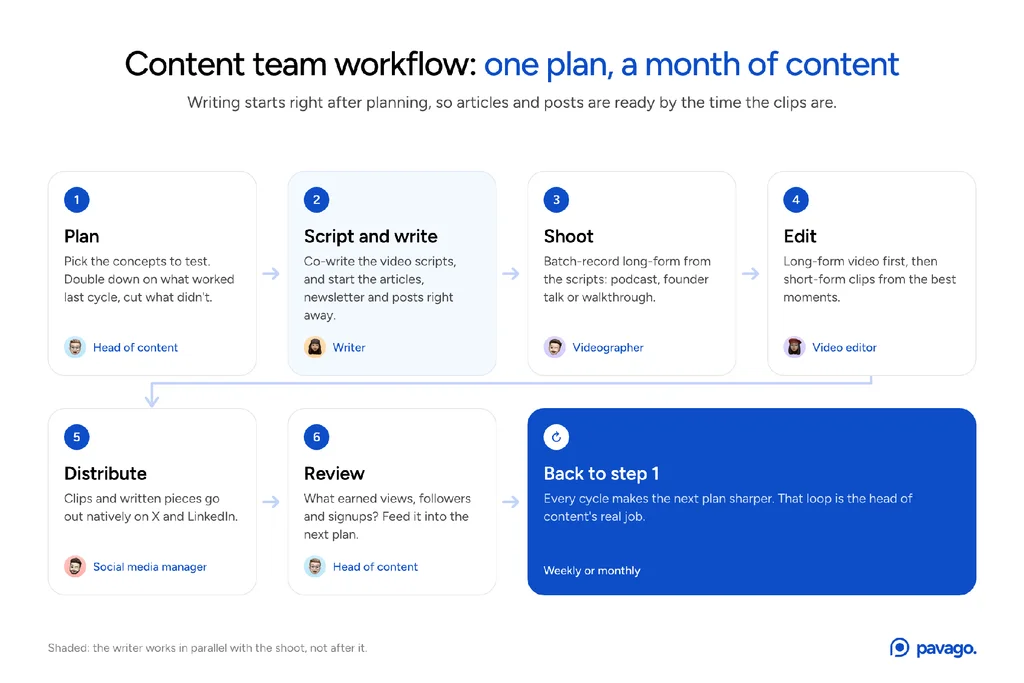
- Plan. The head of content picks the concepts to test, based on what worked last cycle.
- Script and write. The writer co-writes the video scripts and starts the articles, newsletter, and LinkedIn posts on the same topics right away. No need to wait for the footage.
- Shoot. The videographer batch-records the long-form from those scripts: a podcast, a founder talk, or a product walkthrough.
- Edit. The editor cuts the long-form video first, then the short-form clips.
- Distribute. The social media manager publishes the clips and written pieces natively on X and LinkedIn.
- Review. The head of content decides what to double down on and what to cut, and the loop starts again.
With a global team, keep every piece on one shared board, give your editor notes on the exact frame in a tool like Frame.io, and set turnaround times up front, for example, 48 hours for a batch of clips.
Takeaway: Writing starts the moment the plan is set, so your articles and posts are ready by the time the clips are.
In-house vs agency vs remote: which content team model fits
| In-house (local) | Agency | Remote (hired directly) | |
|---|---|---|---|
| Cost | Highest: local salaries | Monthly retainer | The person’s own rate |
| Control | Full | Shared with their other clients | Full |
| Brand voice | Strongest | Hardest to get right | Strong once onboarded |
| Best for | Head of content, videographer | Testing content for a quarter | Editor, writer, social media |
You don’t have to pick one. An agency makes sense when you want to test content for a quarter without hiring. Once it works, building an in-house content marketing team, with global hires for the editor, writer, and social, gives you more control for the money.
How to scale your content marketing team
Scale when something is working, and a person is the bottleneck, not before. Signs it’s time to hire:
- Your head of content is editing or filming. Hire the missing production role.
- Your editor can’t keep up with long-form and clips. Split the role: one long-form editor, plus short-form editors who each handle 30 or more clips a month.
- YouTube is working, but search isn’t. Add a second writer.
- You post consistently but aren’t growing on X or LinkedIn. Hire a social media manager, or free up the one you have.
Short-form editors are usually the first extra hire, because their output grows almost one-for-one with headcount.
FAQ
How many people do you need on a content marketing team?
The full build is five roles: head of content, videographer, video editor, writer and social media manager. On a tight budget, start with three global hires (a head of content, an editor and a writer) for about $6,500 to $14,000 a month, and add the rest as content starts working. Here is where to find content marketing professionals for each of those roles.
How much does a content marketing team cost per month?
With VC money and all-US hires, about $28,000 to $46,000 a month. With a local head of content and videographer and the rest global, $18,500 to $38,000. Global-first, with only the videographer local, $11,500 to $24,000.
How do you structure a social media team?
Give it one owner, usually a social media manager who reports to the head of content. The editor and writer supply the raw material, and the social media manager adapts it to each platform.
What is the 70-20-10 rule in content marketing?
It’s a way to split your output: about 70% proven formats, 20% variations on what already works and 10% new experiments. It keeps a team consistent without letting the content go stale.
Should I build an in-house content team or hire an agency?
Use an agency if you want to test content for a quarter without hiring. If content is already working, build your own team: keep strategy and filming local and hire the rest globally.
Where to start
Write down who at your company is planning, filming, editing, writing and posting content right now. Wherever the same name shows up twice, that’s your next hire. If it’s an editor, a writer, a social media manager or a head of content, you can browse candidates on Pavago for free.