

What Medical Billing Outsourcing Covers
Worth separating, because what is included varies enormously between providers describing themselves identically.
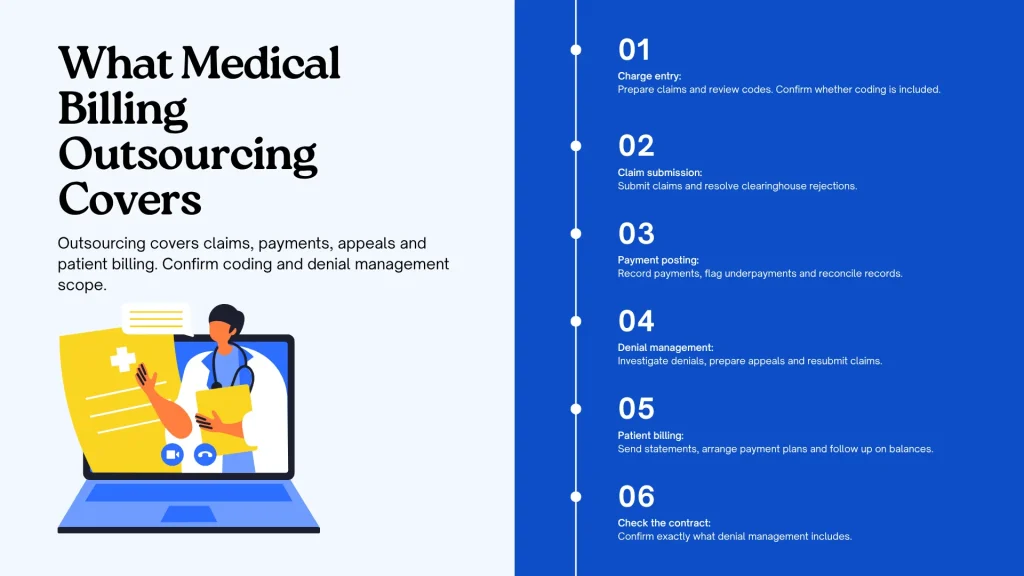
Charge entry and coding review. Taking clinical documentation and producing a clean claim. Some providers include coding, many do not and assume you supply codes.
Claim submission and clearinghouse management. Getting claims to payers and handling the rejections that bounce before adjudication.
Payment posting and reconciliation. Applying remittances, identifying underpayments, reconciling to your practice management system.
Denial management and appeals. Working rejected claims, writing appeals, resubmitting. This is the expensive half and the one most likely to be scoped thinly.
Patient billing and collections. Statements, payment plans, the balance after insurance.
Read the contract for denial management specifically. It is where the money is and where scope is quietly narrow.
Why Percentage-of-Collections Pricing Creates the Problem
Most billing companies charge a percentage of what they collect. On the surface, that aligns incentives. Underneath, it aligns them only partially.
A clean claim that pays on first submission costs the billing company almost nothing to process. A denied claim requiring documentation review, an appeal letter, a phone call to the payer, and a resubmission costs them real labour for the same percentage.
So the rational behaviour under that pricing is to work the easy claims thoroughly and the hard ones lightly. Not fraudulently. Just by triage, the way any business allocates effort against return. The claims that get written off are the ones that would have taken the most work to recover, which are frequently the largest.
This is why two practices can use the same billing company and have very different experiences. The one with clean documentation and a low denial rate gets excellent service. The one generating complex denials finds that its hardest money quietly disappears into adjustments.
Where the Threshold Sits
Denial rate is the variable. Know yours before you talk to anyone.
| Your situation | What outsourcing does | What to do |
|---|---|---|
| Low denial rate, clean documentation | Works well. You are mostly buying throughput. | Outsource. Compare on price, it is a fair comparison here. |
| Moderate denial rate, mixed causes | Depends entirely on denial scope in the contract | Outsource only with denial management explicitly scoped and reported |
| High denial rate, cause unknown | Hides the problem rather than fixing it | Diagnose first. Outsourcing an unexamined denial rate buys silence. |
| High denial rate, cause known and upstream | Does not touch it. The cause is in documentation or at the front desk. | Fix upstream. Billing cannot repair what intake broke. |
Rows three and four are where practices lose the most. A denial rate driven by eligibility not being verified at the front desk, or by documentation that does not support the code, is not a billing problem. Handing it to a billing company moves the symptom out of sight and leaves the cause running. A virtual medical assistant who verifies eligibility before each visit fixes that cause at the source.
Diagnose Before You Outsource
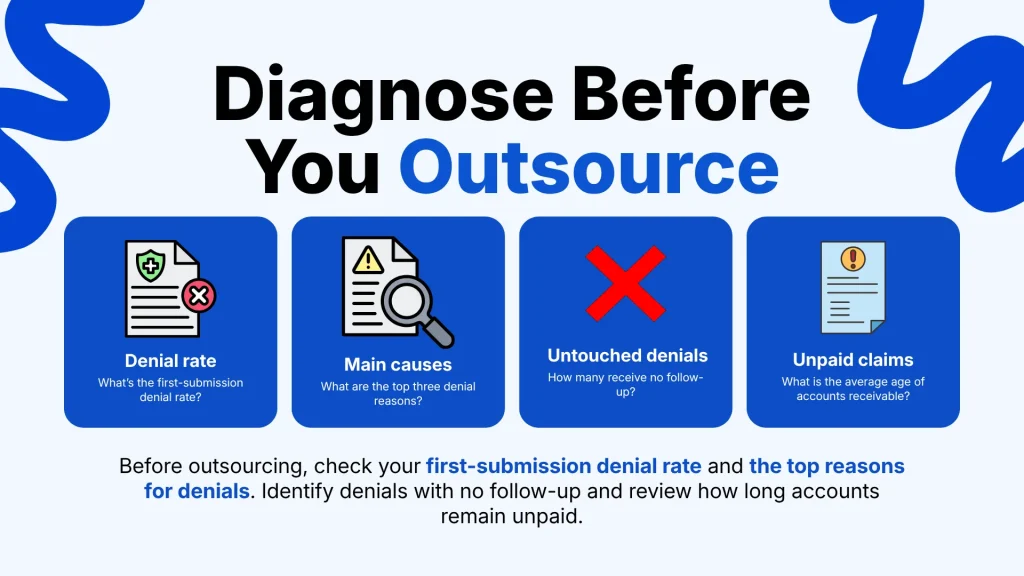
Four questions, answerable from your own system in an afternoon.
- What percentage of claims are denied on first submission? Not the final write-off rate. First-pass denial rate, which is the one that reveals process problems.
- What are the top three denial reasons by volume? Eligibility, authorisation, coding, documentation, timely filing. The distribution tells you whether the problem is front desk, clinical or billing.
- How many denials are never worked at all? Most practices cannot answer this, and the answer is usually higher than expected.
- What is the average age of your accounts receivable? Aging reveals whether claims are being followed or filed and forgotten.
Coding accuracy sits underneath most of this. AAPC publishes its certification standards and code set requirements directly, and denial patterns traceable to coding usually indicate a credentialing gap rather than a billing one.
The Option Between Outsourcing and In-House
The framing is usually binary, and there is a third structure that fits practices in rows two and three above: a dedicated remote billing specialist working inside your systems, paid a salary rather than a percentage.
The pricing difference is the point. Someone on salary has no reason to triage denials by recoverability. A hard claim and an easy claim cost them the same effort either way, so the incentive that produces selective effort disappears.
They also stay. A billing company rotates staff across clients; a dedicated person accumulates knowledge of your payers, your common denial reasons and your documentation patterns, which is exactly the knowledge that makes denial work efficient.
At Pavago, placement is 3% of first-year salary. Searching, messaging and interviews are free. The pricing page has the 60-day replacement terms.
You can search billing specialists and open profiles in the client portal, or look at the remote medical billing specialist role directly.
For the candidate side of this role and what certification actually changes, our breakdown of medical billing pay covers which credentials employers screen on.
What to Ask a Billing Company
What is your first-pass clean claim rate, and how is it calculated? Definitions vary enough that the number is meaningless without the method.
Is denial management included or billed separately? If separate, the incentive problem above applies in full.
At what point do you stop working a claim? Every provider has a threshold. Most will not volunteer it. Ask for it in writing.
What reporting do I get on denials specifically? Collections reporting shows what came in. Denial reporting shows what did not, and that is the report that reveals whether the arrangement is working.
Frequently Asked Questions
How much does medical billing outsourcing cost?
Most providers charge a percentage of collections. Some charge per claim or a flat monthly fee. The percentage is the most common and the least informative comparison point, because it says nothing about how aggressively denials get worked.
Does outsourcing medical billing reduce denials?
Only if the denials originate in billing. Denials caused by eligibility not being verified at intake, missing authorisations, or documentation that does not support the code are upstream problems that a billing company cannot fix and will not surface.
What should be included in a medical billing contract?
Denial management and appeals explicitly, with a stated point at which claims stop being worked, plus denial reporting separate from collections reporting. Scope on denials is where contracts are most often thin and where the most revenue is lost.
Is in-house or outsourced medical billing better?
It depends on your denial rate. Low denial rates outsource well, since you are mostly buying throughput. High or unexamined denial rates are better diagnosed first, because percentage-of-collections pricing gives nobody an incentive to chase the hardest money.
Can medical billing be done remotely?
Yes, and it commonly is. Claims are submitted electronically, payer portals are web-based, and practice management systems are cloud-hosted. What is required is HIPAA-compliant access and usually a business associate agreement, which is an arrangement rather than a barrier.
Know your denial rate before you compare anyone
Search the pool free. Messaging and interviews are free. 3% of first-year salary on placement, 60-day replacement.