

What a Medical Billing Specialist Actually Does
Worth separating, because billing and coding are routinely treated as one job and are paid differently.
Coding translates what happened clinically into standardised codes. Diagnosis codes describing the condition, procedure codes describing what was done. It requires reading clinical documentation and knowing the code sets.
Billing takes those codes and turns them into a claim, submits it to the payer, tracks it, works the denials, handles appeals, posts payments, and manages what the patient owes.
Many roles combine both, and those pay above either alone. Job titles are inconsistent across employers, so read the responsibilities rather than the title when comparing offers.
Why the Published Average Misleads
Aggregating populations that do not overlap produces a number describing none of them.
| Variable | Why it splits the population | Direction |
|---|---|---|
| Certification | Certified and uncertified staff do overlapping work at different pay | Largest single factor |
| Specialty | Surgical, radiology, anaesthesia and behavioural health differ in coding complexity | Complex specialties pay above general |
| Setting | Hospital systems, large groups and solo practices have different pay structures | Larger organisations generally pay more |
| In-house or remote | Remote roles for US practices are priced differently from on-site staff | Varies by employer |
| Experience | Matters, but less than certification or specialty | Moderate |
The first row is the one worth acting on. Certification is the largest mover and the only variable on that list you can change in a matter of months. Specialty is changeable over a longer horizon. Setting and location mostly are not.
The Certification That Changes the Number
Unlike most of the roles covered on this blog, this field has formal credentials that employers screen on directly, and they are not optional at the upper end.
AAPC issues the Certified Professional Coder credential and a Certified Professional Biller credential, alongside specialty-specific certifications in areas such as surgical and anaesthesia coding.
AHIMA issues credentials weighted toward hospital and inpatient settings, including Certified Coding Specialist.
Which body matters depends on where you want to work. AAPC credentials dominate outpatient and physician practice settings, which is where most remote work sits. AHIMA weights toward facility and inpatient coding. AAPC publishes its certification paths and requirements directly, and reading the requirements before choosing a study route is worth an hour.
These are not free, unlike the certifications in most remote roles. That is a real cost and it is the main reason people delay. It is also why the credential moves pay: a paid barrier that most people do not cross is exactly the kind that produces a pay gap.
What Moves the Number After Certification
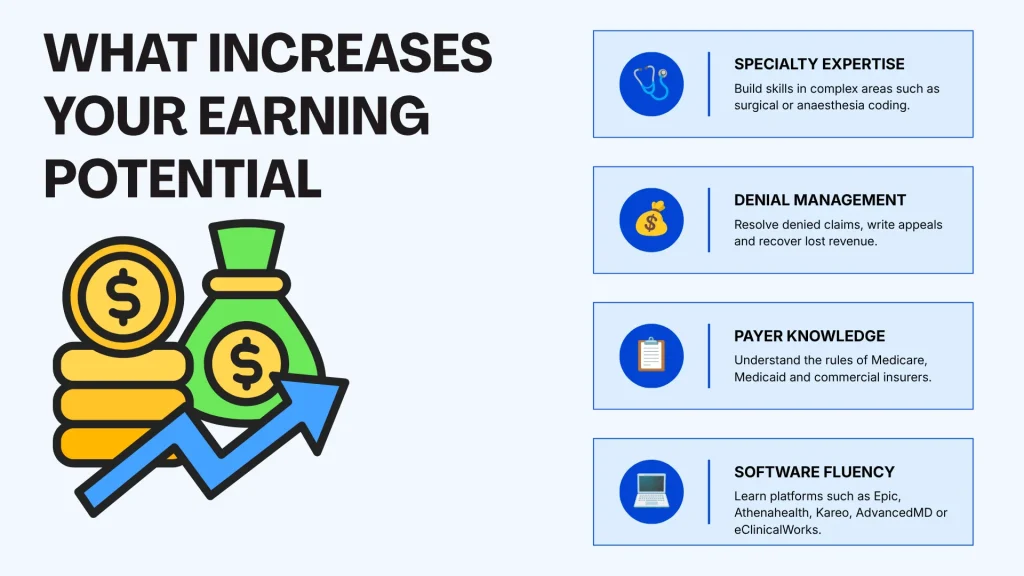
- Specialty depth. Surgical, anaesthesia, interventional radiology and behavioural health coding carry complexity that general outpatient work does not, and the pool able to do them is smaller.
- Denial management rather than claim submission. Submitting clean claims is the baseline. Working denials, writing appeals and recovering revenue a practice had written off is where billing stops being administrative.
- Payer-specific knowledge. Medicare, Medicaid and commercial payers behave differently. Someone who knows a specific payer’s rules deeply is worth more to practices exposed to that payer.
- Software fluency. Epic, Athenahealth, Kareo, AdvancedMD and eClinicalWorks all appear in job specs. Naming the one a practice uses moves you past a filter.
The pattern is the same as in other remote finance roles: most of what determines pay is acquirable, and the acquirable things outrank the fixed ones. Our guide to becoming a bookkeeper covers the same structure in a field without the certification cost.
Reading an Offer Correctly
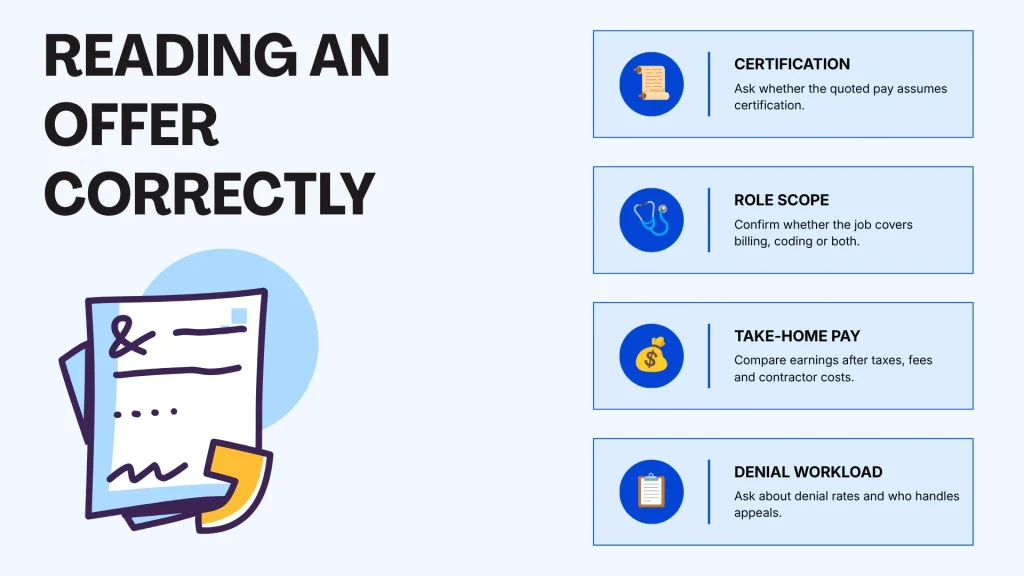
Ask whether the range quoted assumes certification. Many listings publish a band covering both, and the difference between the ends is often the credential rather than the experience.
Check whether it is billing, coding, or both. Combined roles pay above either, and titles do not reliably indicate which you are being offered.
For remote contract work, compare gross against your local net. Most cross-border arrangements are contractor relationships where you receive gross and handle tax locally. Comparing a foreign gross to a local gross overstates the difference.
Ask what the denial rate is and who works it. A practice with a high denial rate and nobody working appeals is offering a harder job than the title suggests, which is either a reason to negotiate or a reason to decline.
You can see which software and certifications appear in current listings on the candidate portal, which is more current than any salary aggregator.
Why Remote Demand Exists Here
Medical billing is almost entirely software-based. Claims are submitted electronically, payer portals are web-based, and practice management systems are cloud-hosted. Nothing about the work requires physical presence in the practice.
What the work does require is HIPAA-compliant handling of patient information, which means secure access, defined permissions and often a signed business associate agreement. That is an arrangement question rather than a barrier, and practices hiring remotely are already set up for it.
Pavago is free for candidates permanently and you keep your full rate, with nothing deducted from what the company pays you. Browse open roles, or your region: South Asia, Southeast Asia, Africa, LATAM, Europe. You can also search by country: Cameroon, Ethiopia, Malawi or Rwanda.
Frequently Asked Questions
What is the average medical billing specialist salary?
Published averages blend certified and uncertified staff, hospital and small practice, in-house and remote, entry and senior. Those populations earn differently enough that the average describes almost nobody. Certification status is the largest single variable, which makes any figure quoted without it close to meaningless.
Does certification increase medical billing pay?
It is the largest controllable factor. AAPC and AHIMA credentials are screened on directly by employers, and unlike certifications in most remote roles they carry a real cost, which is part of why the pay gap exists.
Is medical billing the same as medical coding?
No. Coding translates clinical documentation into standardised codes. Billing turns codes into claims, submits them, and works denials and appeals. Many roles combine both and pay above either alone, but job titles are inconsistent so read the responsibilities.
Which certification should I get, AAPC or AHIMA?
AAPC credentials dominate outpatient and physician practice settings, which is where most remote work sits. AHIMA weights toward hospital and inpatient coding. Choose based on the setting you want to work in rather than on which is better regarded in general.
Can medical billing be done remotely from outside the US?
Yes, and it commonly is. The work is entirely software-based and practices hiring remotely are generally set up for HIPAA-compliant access. What matters is credential recognition, software familiarity, and sufficient timezone overlap for payer calls where the role requires them.
See what certifications employers are asking for
Free for candidates, always. You keep your full rate, with nothing deducted from what the company pays you. Companies search the pool and message you directly.