

What Customer Success Actually Covers
Onboarding. Getting a new customer to first value quickly, before enthusiasm fades.
Adoption. Making sure the features they paid for are actually in use.
Account health. Watching usage, sentiment, and engagement for early signs of churn.
Renewal and expansion. Keeping the account and growing it where it genuinely makes sense.
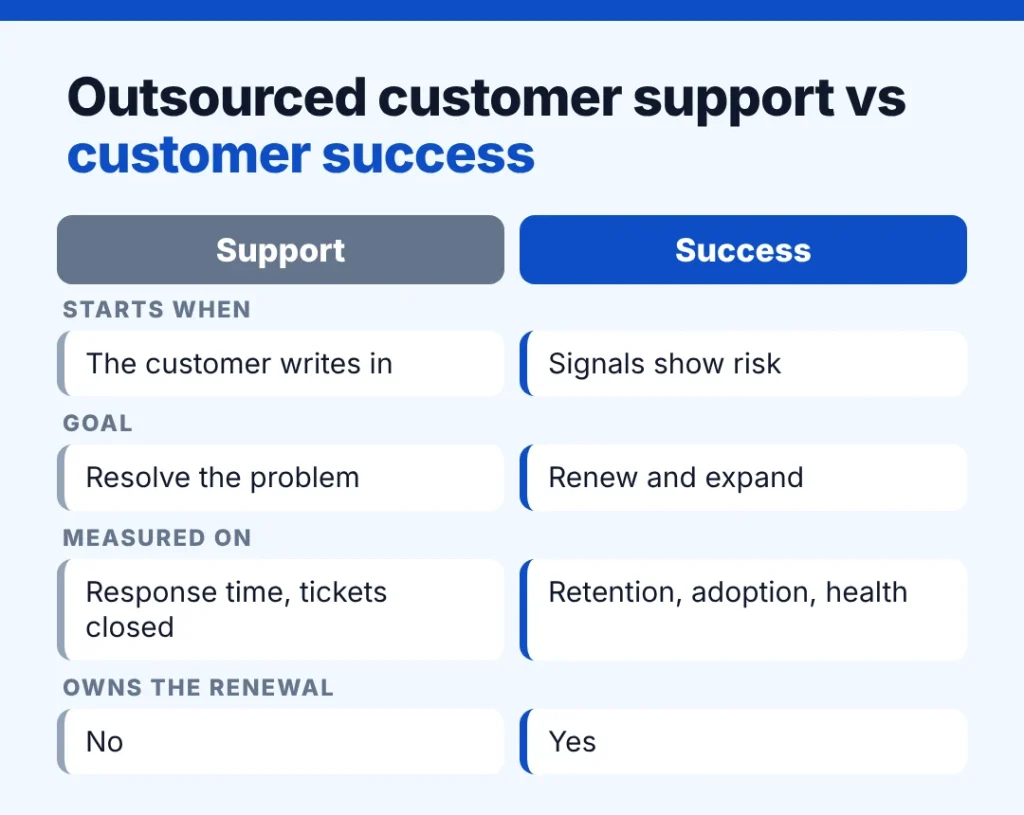
Support reacts to problems. Success acts before problems surface. That one difference decides how it can be outsourced.
The Three Options
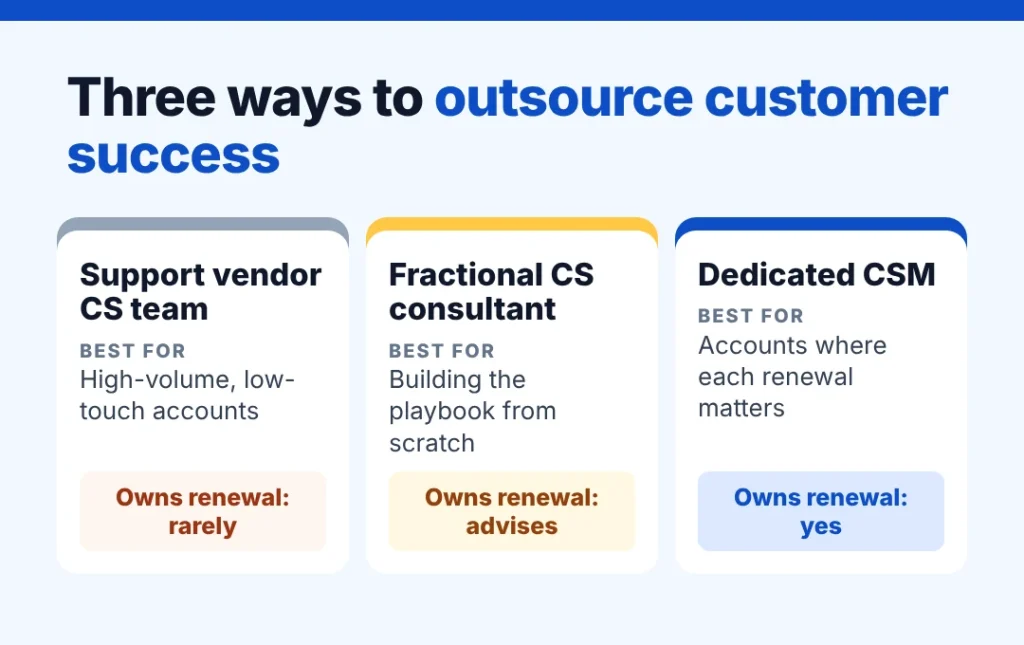
| BPO or support vendor CS team | Fractional CS consultant | Dedicated customer success manager | |
|---|---|---|---|
| What you get | Agents handling CS tasks across many clients | Strategy, playbooks, and part-time oversight | One person owning a book of accounts |
| Owns renewal outcome | Rarely | Advises on it | Yes |
| Product knowledge | Shallow, shared across clients | Varies | Deep and growing |
| Proactive outreach | Scripted, if at all | Designs it, may not run it | Runs it daily |
| Best for | High-volume, low-touch accounts | Building the CS function from scratch | Mid-market accounts where each renewal matters |
Ownership is the row that decides it. A vendor paid per seat or per ticket is not measured on your renewals, so renewals are not what it optimises. That is not bad faith. It is what the contract rewards.
The underlying reason this matters is cost of effort. Gartner’s customer service research consistently finds that reducing customer effort drives loyalty more than speed alone, which is exactly the proactive work a support-shaped vendor is least set up to do.
Where Each Option Wins
- Support vendor CS team: thousands of small accounts where success means automated onboarding, help content and occasional check-ins. Scale matters more than depth here, and a BPO delivers scale.
- Fractional consultant: you have no CS function, no playbook and no metrics. Pay for the design before staffing it.
- Dedicated CSM: accounts large enough that losing one is noticeable, where someone needs to know each customer’s goals and usage by name.
Many companies need two of these in sequence: a consultant to design the playbook, then a dedicated CSM to run it. Our guide to outsourcing customer support covers the support side so the two functions stay separate.
Signs Your Outsourced CS Is Really Support
- Reports show tickets closed, not accounts at risk. If nobody reports on usage drops or health scores, nobody is doing success.
- Renewals surprise you. Churn arriving without warning means no one was watching the signals.
- Outreach only happens when the customer writes in. Reactive contact is support by definition.
What a Dedicated CSM Costs
At Pavago, searching, messaging and interviews are free, and placement is 3% of first-year salary. Terms on the pricing page.
The customer success manager role covers account ownership after the sale.
It sits within the sales talent pool, alongside the roles that hand accounts over at close.
You can open CSM profiles in the client portal before deciding which model fits your accounts.
OPW Commercial Services placed a dedicated client-facing hire rather than using a shared team, and the OPW Commercial Services case study covers the arrangement.
For the top of the same funnel, our guide to outsourcing lead generation covers how pipeline gets built.
Questions to Ask a CS Vendor
What are you measured on? If the answer is response time and tickets closed, you are buying support.
Who owns an account at risk? A named person or a queue. The answer tells you everything.
What do you report weekly? Health and usage trends, or ticket counts.
What a Customer Success Manager Does Week to Week
The work is proactive by design. A typical week includes reviewing account health signals such as login frequency and feature usage, reaching out to customers whose usage has dropped, running onboarding sessions for new accounts, holding check-ins with key customers, and feeding product issues back to the team. Around renewal dates the focus shifts to confirming value delivered and identifying where the account could grow.
Very little of this starts with a customer writing in. That is the clearest difference from support, and the reason support-shaped vendors struggle to deliver it.
The Metrics That Matter
| Metric | What it tells you |
|---|---|
| Gross revenue retention | How much revenue you keep before any expansion |
| Net revenue retention | Whether existing customers grow over time |
| Time to first value | How quickly new customers get a result |
| Product adoption | Whether paid features are actually used |
| Account health score | An early warning of churn risk |
If an outsourced provider reports only ticket volumes and response times, none of these are being managed.
How Many Accounts One CSM Can Handle
It depends on account size and complexity. High-value accounts with complex products need deep attention, so one person may own a small number of them. Smaller, simpler accounts can be handled in much larger books, often with automated onboarding and help content doing much of the work. The right number is the one where the CSM can spot and act on every at-risk account before it reaches renewal.
Build the Playbook Before Outsourcing
Customer success outsources well only when the playbook exists. That means a defined onboarding sequence, agreed health signals, a schedule of check-ins by account tier, and a clear escalation path for at-risk customers. Without it, any person or vendor will default to reacting to tickets.
If you do not have a playbook yet, building one is often the first task for an experienced CSM or a short consulting engagement.
Handing Over From Founder-Led Success
In many early companies the founder has been the customer success function without calling it that. Before handing over, write down which customers matter most, what each one bought the product to achieve, and any promises made along the way. Then introduce the new CSM personally rather than by email. Relationships transfer far better with a warm handover.
More on how hiring works is on the Pavago homepage.
Signs a Customer Is at Risk
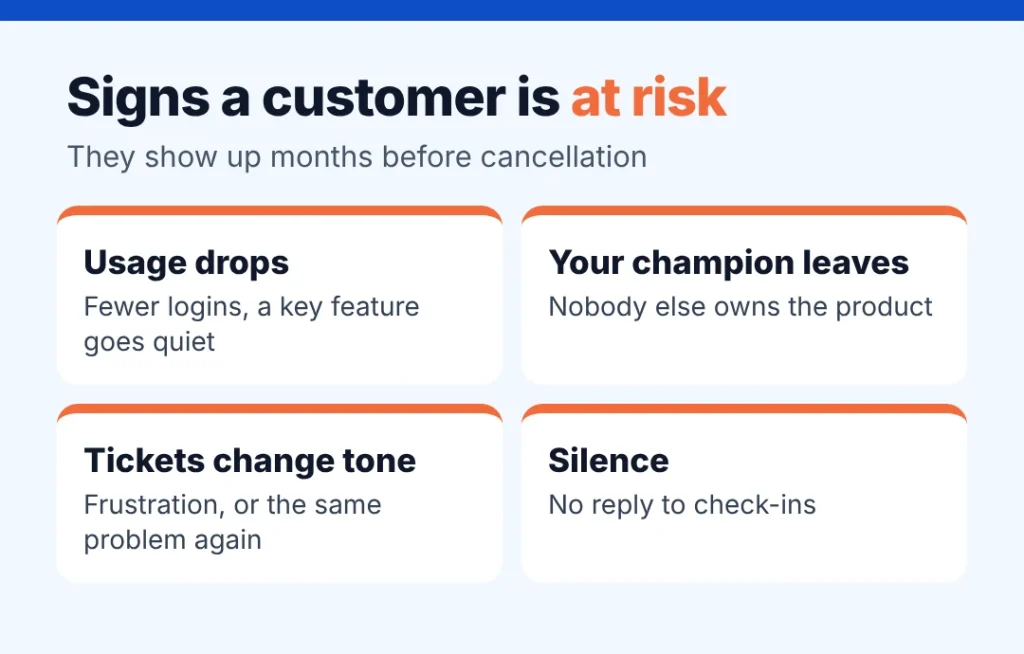
The value of customer success is acting before a customer decides to leave. The warning signs usually appear months before cancellation.
Usage drops. Fewer logins, fewer active users or a key feature going quiet.
Your champion leaves. The person who bought the product moves on and nobody else owns it.
Support tickets change tone. Frustration repeats, or the same problem keeps coming back.
Silence. A customer who stops responding to check-ins is often already evaluating alternatives.
A CSM who owns these signals and acts on them is the reason customer success pays for itself.
Mistakes When Outsourcing Customer Success
Measuring the vendor on support metrics. Response time and tickets closed reward the wrong behaviour for a retention role.
No access to product data. A CSM who cannot see usage cannot spot risk.
Handing over accounts without context. The history of each customer relationship is part of the asset. Write it down before the handover.
Customer Success for Smaller Accounts
Not every customer needs a named manager. For large numbers of smaller accounts, success is often delivered through automated onboarding emails, in-product guidance, a strong help centre and periodic group webinars, with a CSM stepping in only when health signals turn red. This approach, often called tech-touch, lets a small team protect revenue across many accounts while saving personal attention for the customers where it matters most.
The deciding factor is revenue at risk per account. Where losing one customer is barely noticeable, automate. Where losing one would show up in the quarter, assign a person who owns the relationship.
Frequently Asked Questions
What is the difference between customer success and customer support?
Support resolves problems customers raise. Success works proactively so customers get enough value to renew and expand. Support is measured on resolution; success is measured on retention.
Can customer success be outsourced?
Yes, but how matters. Support vendors suit high-volume, low-touch accounts. For accounts where each renewal matters, a dedicated CSM who owns the outcome works better than a shared team.
How much does outsourced customer success cost?
Vendors charge per seat or per account. Consultants charge by project or retainer. A dedicated CSM costs a salary. Compare against the revenue at risk from churn, not against zero.
When should a company hire its first CSM?
When losing a single account becomes noticeable, and nobody is watching account health between renewals.
Can a customer success manager work remotely?
Yes. The work runs on video calls, CRM data, and product usage dashboards. Overlap with customer working hours matters more than location.
Put someone in charge of the renewal
Search the pool free. Messaging and interviews are free. 3% of first-year salary on placement, 60-day replacement.