

What Outsourced Lead Generation Covers
Worth defining, because the term spans everything from list building to booked meetings.
List building and data. Finding companies and contacts matching your criteria, verifying details. The input layer.
Outbound execution. Email sequences, LinkedIn outreach, cold calling. Sending at volume and handling replies.
Qualification. Determining whether a responder is actually a fit before a meeting gets booked. The step most often compressed.
Meeting booking. Getting a qualified prospect onto your calendar, and getting them to attend.
Providers bundle these differently, and the bundle determines what you are buying. A provider selling meetings has an incentive to loosen qualification. A provider selling hours has none, but also no incentive to produce meetings.
The Three Models
| Lead gen agency | Appointment setter | Dedicated SDR | |
|---|---|---|---|
| Priced as | Per qualified meeting, or retainer plus per meeting | Hourly or part-time monthly | Salary, plus a one-time placement fee |
| What you are buying | Meetings | Activity | Capacity and accumulated context |
| Who defines qualified | The provider, in the contract | You | You |
| Learns your product | Minimally. They run many clients. | Somewhat | Yes, and it compounds |
| Incentive risk | Loosen qualification to hit meeting counts | None, but also no output pressure | None |
| Ramp time | Fast. Weeks. | Fast | Slow. Six to eight weeks before volume. |
| Best for | Testing a new segment quickly | Low volume, defined calling tasks | Ongoing pipeline you intend to own |
The qualification row is where the money is. If the contract defines a qualified meeting as a prospect who agreed to a call, you will get meetings with people who agreed to a call. Whether they have budget, authority or a problem you solve is a separate question nobody is paid to answer.
What Per-Meeting Pricing Actually Incentivises
Not dishonesty. Arithmetic.
A provider paid per qualified meeting has fixed costs for outreach and a variable payout tied to meetings booked. The fastest route to more meetings is a looser definition of qualified, which is why the definition in the contract matters more than the price per meeting.
The symptom appears in month two or three. Meeting volume hits target. Show rate is acceptable. Pipeline does not move, because the meetings are with people who were polite rather than interested. By the time that is visible, you have paid for two months of meetings.
The fix is contractual rather than relational. Define qualified in writing, by criteria you can verify independently: company size, role seniority, a stated problem, a timeframe. Then measure the provider on meetings that meet all four, not on meetings booked.
Where the Agency Model Genuinely Wins
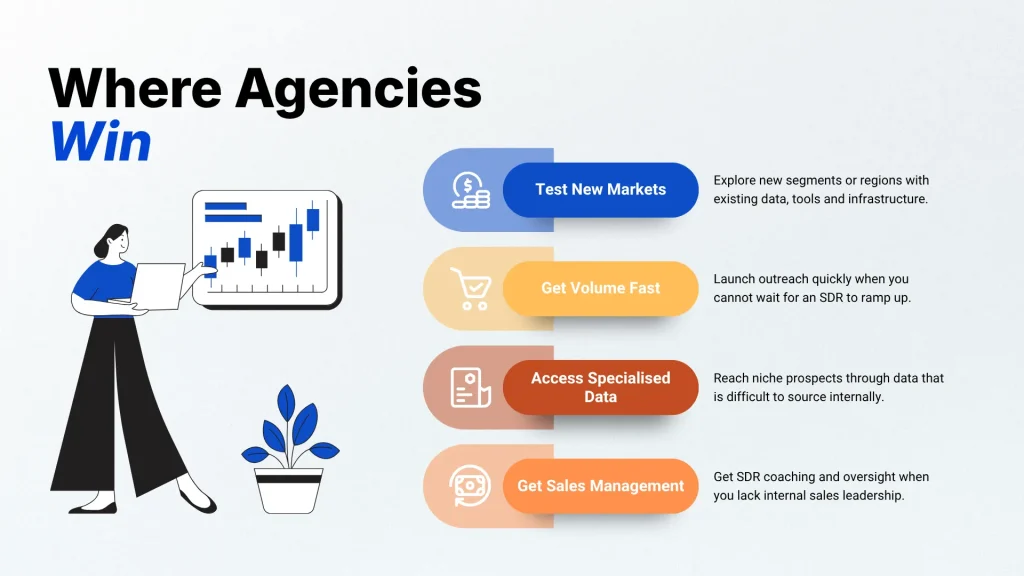
This section exists because a comparison that always lands on hiring is an advertisement.
- Testing a new segment or geography. An agency already has the data, the tooling and the sending infrastructure. Standing that up internally to test a hypothesis is wasteful.
- You need volume immediately. An SDR takes six to eight weeks to ramp. An agency is sending in two. If the quarter depends on it, buy the speed.
- Highly specialised list building. Some segments require data nobody can buy off the shelf. Agencies with that data are selling access you cannot replicate quickly.
- You have no sales leadership to manage an SDR. An unmanaged SDR produces activity and no pipeline. If nobody will coach them, the agency’s management layer is the thing you are buying.
Outside those four, you are paying a margin for outreach you could run directly with someone who learns your product. Our guide to hiring a virtual sales assistant covers the delegation sequence that makes that work.
What the Dedicated Route Changes
An SDR on salary has no reason to loosen qualification, because they are not paid per meeting. They are also the only one of the three who accumulates knowledge of your product, which is what makes the fifth month better than the first.
The honest trade is ramp time and management. Six to eight weeks before meaningful volume, and someone has to review their messaging and coach their calls. If neither is available, the agency is the better buy and the comparison above is irrelevant.
At Pavago, placement is 3% of first-year salary. Searching, messaging and interviews are free. Terms including the 60-day replacement are on the pricing page.
You can search SDRs and open profiles in the client portal, or look at the sales development representative role directly.
OPW Commercial Services placed a dedicated SDR rather than contracting outreach as a service; the OPW Commercial Services case study covers how it was structured.
Four Questions Before Signing
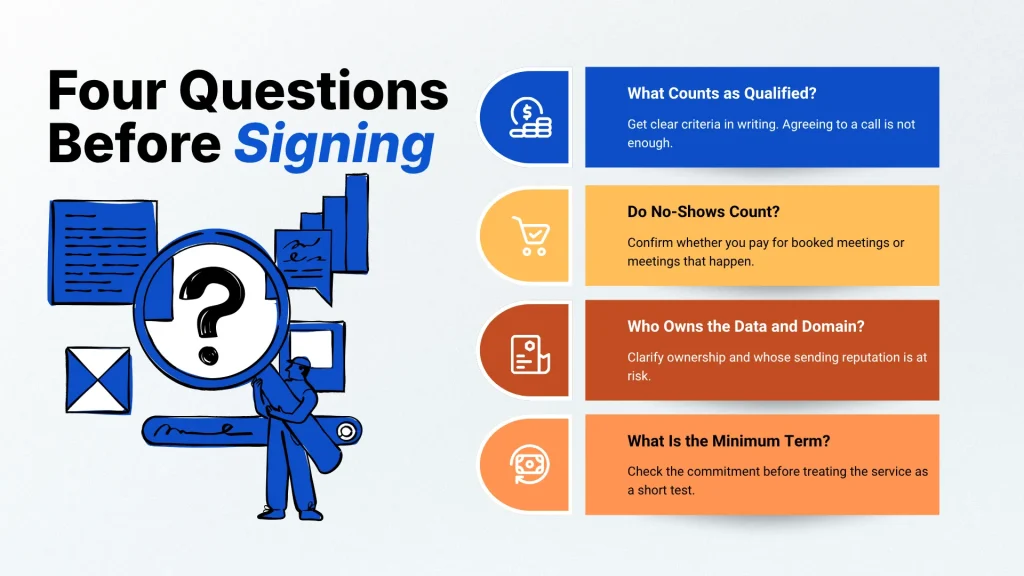
1. How is a qualified meeting defined, in writing? If the definition is a prospect who agreed to a call, you are buying calendar entries.
2. What happens if the prospect does not show? Some providers count booked meetings, some count held. The difference is substantial and rarely volunteered.
3. Who owns the data and the sending domain? If they send from their infrastructure, your reputation is not at risk and your list is not yours. Decide which matters more before signing.
4. What is the minimum term? Lead gen agencies commonly require three to six months, because ramp is real for them too. Know the floor before you treat it as a test.
Frequently Asked Questions
How much does outsourced lead generation cost?
Agencies charge per qualified meeting or a retainer plus per-meeting fee. Appointment setters bill hourly or part-time monthly. A dedicated SDR costs their salary plus a one-time placement fee. The units are not comparable, which is why comparing headline prices across models is misleading.
Is a lead generation agency better than hiring an SDR?
For testing a new segment, needing volume within weeks, or having no sales leadership to manage someone, yes. For ongoing pipeline you intend to own, a dedicated SDR costs less over time and does not have an incentive to loosen qualification.
What is a qualified meeting?
Whatever your contract says it is, which is the problem. Define it by criteria you can verify independently: company size, role seniority, a stated problem, and a timeframe. Measure the provider on meetings meeting all four rather than on meetings booked.
How long does an SDR take to ramp?
Six to eight weeks before meaningful volume, longer in complex sales. That ramp is the main argument for an agency when the quarter depends on immediate output.
Should outsourced outreach use my domain or theirs?
Theirs protects your sending reputation and means the data and warmed infrastructure are not yours. Yours builds an asset and carries deliverability risk if the outreach is poor. Decide deliberately before signing rather than discovering it in month two.
Buy pipeline, not calendar entries
Search the pool free. Messaging and interviews are free. 3% of first-year salary on placement, 60-day replacement.