

What an Outsourced Executive Assistant Covers
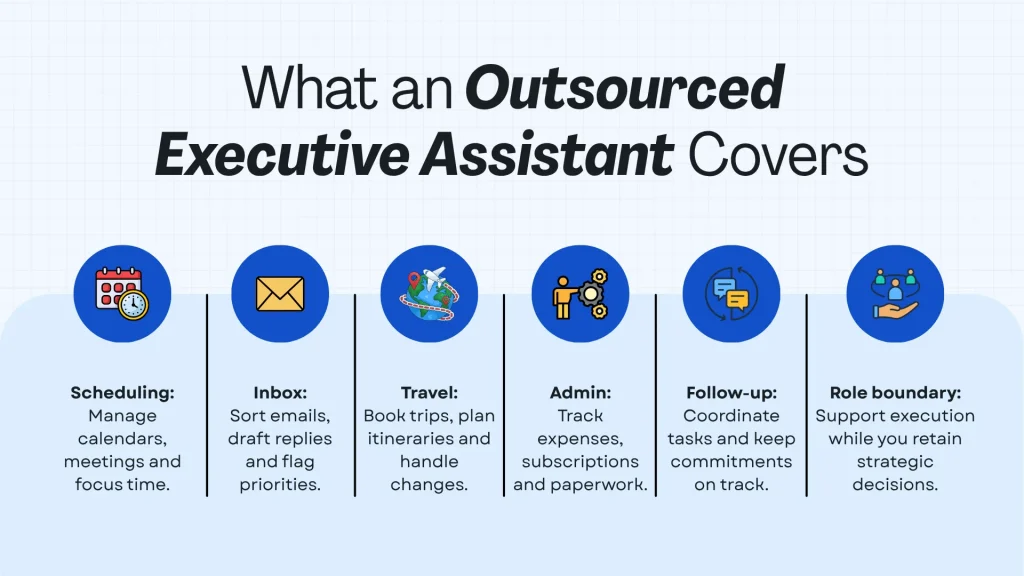
Worth defining, because the scope is wider than scheduling and narrower than operations.
Calendar and scheduling. Booking, rescheduling, protecting focus blocks, managing the constant negotiation of other people’s availability.
Inbox triage. Sorting, drafting replies, surfacing what genuinely needs you and clearing what does not.
Travel and logistics. Flights, hotels, itineraries, the rebooking when something changes at 6am.
Expenses and admin. Receipts, reports, subscriptions, renewals, the paperwork that accumulates.
Follow-up and coordination. Chasing the things you asked for, keeping commitments visible, closing loops.
Not strategy, and not decisions. An EA removes execution load. If what you need is someone to decide things, that is a chief of staff or an operations hire, and it is a different role at a different level.
The Number Nobody Calculates
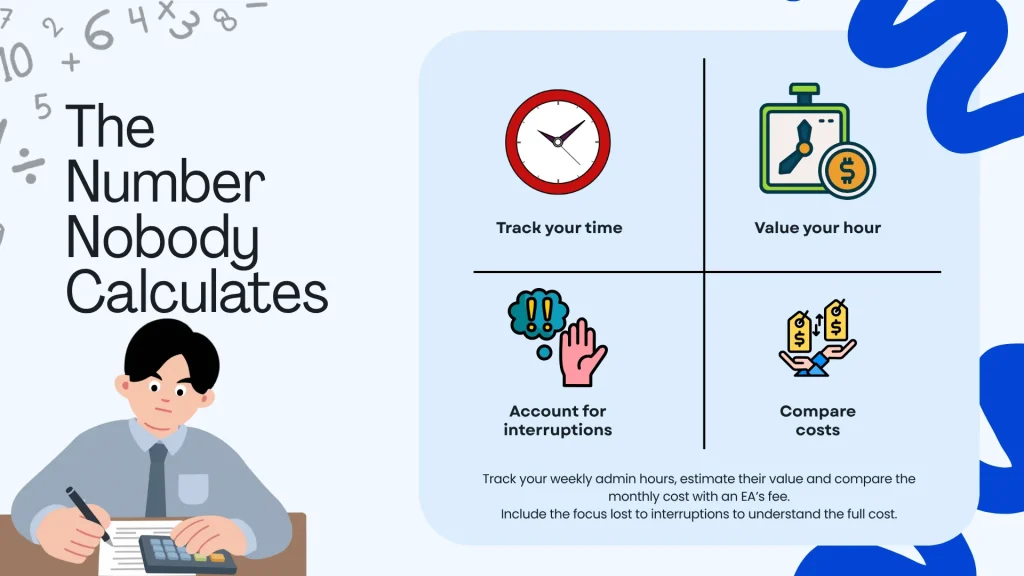
Run it properly once, and the decision stops being difficult.
Step one. Count the hours. For one week, log time spent on the six categories above. Most founders land between ten and fifteen hours. The number is usually higher than the estimate, because the work is fragmented and fragmented time is badly remembered.
Step two. Price your hour honestly. Not your salary divided by 2,000. What does an hour of your attention produce when spent on the thing you are actually for? For most founders, that is sales, product, or fundraising, and the answer is uncomfortable.
Step three. Multiply and compare. Twelve hours a week at any serious founder rate produces a monthly figure that makes most EA pricing look small.
Step four. Add the switching cost. This is the part people miss. Fragmented admin does not only consume the hours it occupies. It breaks the blocks around it. Three interruptions scattered through a morning can cost the whole morning, which means the true figure exceeds the raw hour count.
Why the Comparison Gets Made Wrong
Three reasons, and they are structural rather than careless.
- The fee arrives as an invoice. The alternative does not. One is a line item somebody has to approve. The other is absorbed silently into evenings and weekends.
- Founders discount their own time. Pricing your hour at a market salary rate rather than at what the hour actually produces understates the comparison badly.
- Admin feels like work, so doing it feels productive. Clearing an inbox produces a sense of progress that is difficult to distinguish from progress.
Employment economics make the gap wider than it looks. According to ADP’s breakdown of true employment costs, benefits add roughly $14,950 on a $50,000 salary, taking real employer cost to about $64,950. That is the reference point a domestic EA is measured against, and it is why the remote option changes the arithmetic rather than just shaving it.
The Three Ways to Buy It
| Agency or EA service | Fractional or shared EA | Dedicated remote hire | |
|---|---|---|---|
| What you get | An assigned assistant, managed by the provider | A portion of someone’s week, shared across clients | One person, your hours, your systems |
| Pricing | Monthly retainer | Hourly or tiered blocks | Salary plus a one-time placement fee |
| Context accumulation | Moderate. Assistants rotate. | Low. They are context-switching between clients. | High. The whole value is accumulated context. |
| Good for | Companies wanting zero management overhead | Under five hours a week of genuine need | Ten or more hours a week, ongoing |
| Fails when | You need deep familiarity with your business | You need responsiveness during your hours | Nobody internally will brief or review |
The context row is the one that compounds. An EA’s value in month six is substantially higher than in month one, because they have learned who matters, what you say yes to, and what you want protected. Shared and rotating arrangements never reach month six, because the clock restarts.
When You Should Not Hire One
Three cases, and they are common.
- Under five hours a week of genuine admin. Scheduling software and discipline cover it. A person would be underused and you would invent work to justify the cost.
- You cannot articulate what you want done. An EA executes against standards you set. If you cannot describe how you want your calendar protected, the first month produces frustration rather than relief.
- What you actually need is decisions made. That is a chief of staff or an operations lead. Hiring an EA for it produces someone waiting for instructions you do not have time to give.
The second case is the most common and the most fixable. Write down your rules before hiring, not after. Our guide to hiring an executive assistant covers the screening side, and our guide to outsourced executive assistants covers the arrangement.
What the Dedicated Route Costs
At Pavago, placement is 3% of first-year salary. Searching, messaging and interviews are free. Terms including the 60-day replacement window are on the pricing page.
Against a retainer, the structural difference is that the placement fee is paid once and a retainer is paid monthly, indefinitely. Against a domestic hire, you are comparing salary bands rather than fee structures.
You can search the pool and open profiles in the client portal before running your own version of the calculation above.
QBM Services placed a dedicated executive assistant rather than using a shared service; the QBM Services case study covers how the role was scoped.
Frequently Asked Questions
How much does it cost to outsource an executive assistant?
Agencies and EA services charge a monthly retainer. Fractional arrangements bill hourly or in tiered blocks. A dedicated remote hire costs their salary plus a one-time placement fee, with no recurring provider margin. The more useful comparison is against the founder hours currently spent on the work.
Is an executive assistant worth it for a small company?
Above roughly ten hours a week of genuine admin, almost always, once you price founder time at what it actually produces rather than at a salary equivalent. Below five hours, rarely, because the person would be underused.
What is the difference between an EA and a virtual assistant?
An EA supports one person and manages their calendar, inbox, travel and follow-ups with judgement about priority. A virtual assistant typically handles defined tasks across a wider surface. The distinction is proximity to one executive’s decisions rather than seniority.
Should I use an EA service or hire directly?
A service if you want zero management overhead and accept rotating assistants. A dedicated hire if you want accumulated context, which is where most of the value sits by month six. Shared arrangements rarely reach that point.
Can an executive assistant work from a different timezone?
Yes, and some of the work is better async. Scheduling, inbox triage and travel booking do not require live presence. What matters is overlap during the hours when you need responsiveness, which is usually a narrower window than people assume.
Run the calculation, then search
Search the pool free. Messaging and interviews are free. 3% of first-year salary on placement, 60-day replacement.