

The Two Functions
The confusion is understandable. Both involve technical problems, both run on ticketing systems, and both get measured on response time. The similarity ends there.
| Internal IT support | Customer tech support | |
|---|---|---|
| Who raises the ticket | Your employees | Your customers |
| What breaks | Laptops, accounts, access, network, devices | Your product, integrations, data, workflows |
| Knowledge required | Endpoint management, identity, networking, hardware | Your product architecture, your API, your edge cases |
| What failure costs | An employee loses an hour | A customer loses trust, then churns |
| How it is measured | Resolution time, ticket backlog | CSAT, escalation rate, churn among ticket-raisers |
| Tooling | Intune, Jamf, Okta, Google Admin, ticketing | Your product, logs, staging, API console, helpdesk |
| Who they escalate to | Nobody. They are the escalation. | Your engineering team |
Read the knowledge row twice. Internal IT knowledge is portable. Someone who administered identity and endpoints at one company can do it at yours within days. Customer tech support knowledge is not portable at all, because it is knowledge of your specific product. That single difference determines how each one should be bought.
Why Portability Changes the Purchase
Because internal IT knowledge transfers, a shared or fractional arrangement genuinely works. A provider supporting eight companies can support yours competently, since Okta behaves the same way everywhere and a failed Windows update is a failed Windows update.
Customer tech support does not transfer. A shared agent covering your product alongside four others cannot learn any of them deeply enough to be useful beyond the first tier. They will resolve password resets and escalate everything else, which means your engineering team absorbs the work you outsourced.
The practical rule: internal IT outsources well to shared providers. Customer tech support needs someone dedicated. Vendors who sell both rarely make this distinction, because the same sales motion covers both and the differences only surface in month two.
What Goes Wrong When They Get Mixed
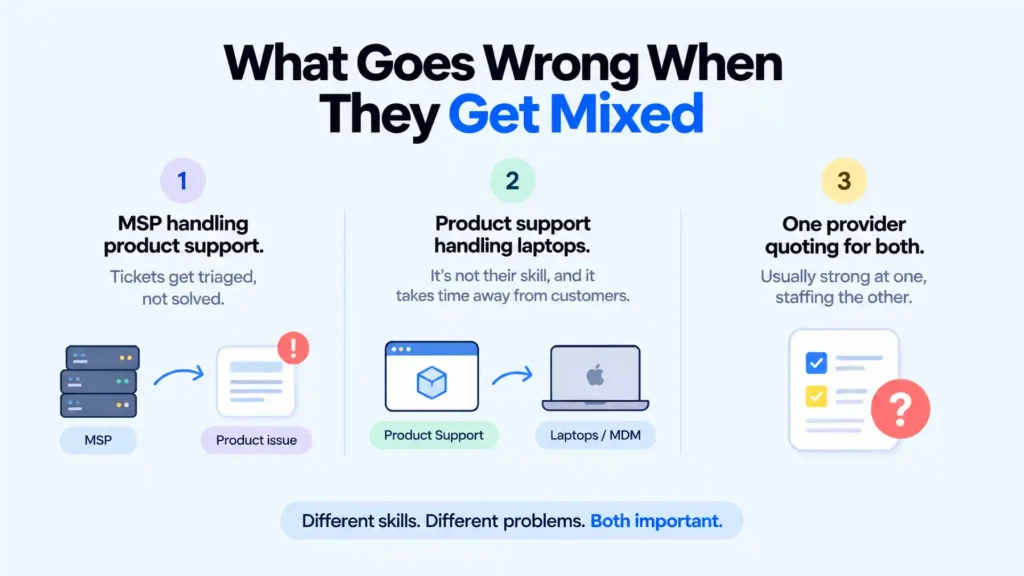
Three failure patterns, all common enough to name.
- The MSP handling product support. Managed service providers are built for infrastructure. Given customer tickets about your software, they triage, cannot diagnose, and forward. You have added a queue rather than removed one.
- The product support team handling laptops. The inverse. A dedicated support person who knows your product deeply is being asked to configure MDM policies. It is not their skill, and it consumes time they should spend on customers.
- One provider quoting for both. Usually they are strong at one and staffing the other with whoever is available. Ask which half they built the business on. The answer is normally in their case studies.
The version of this that hurts most is the third, because it is discovered late. The quote covers everything, the first month looks fine, and the weakness only appears when a customer hits a genuine product issue.
How to Buy Each One
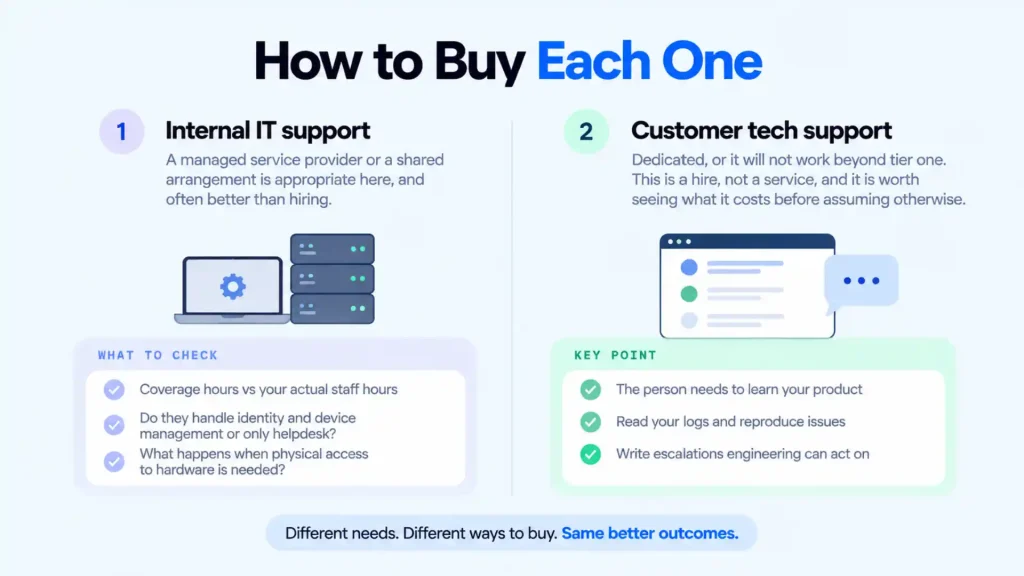
Internal IT support
A managed service provider or a shared arrangement is appropriate here, and often better than hiring. The knowledge is portable, the volume is usually low, and you benefit from a provider who has seen the same failure across many companies.
What to check: coverage hours against your actual staff hours, whether they handle identity and device management or only helpdesk, and what happens when something needs physical access to hardware.
Customer tech support
Dedicated, or it will not work beyond tier one. The person needs to learn your product, read your logs, reproduce issues, and write escalations engineering can act on without repeating the diagnosis.
That is a hire rather than a service, and it is worth seeing what it costs before assuming otherwise. You can search the pool and open profiles in the client portal without creating anything.
Our guide to outsourcing customer support covers the handover sequence for the customer-facing side, which is where most of these engagements fail.
What It Costs to Get This Wrong
Downtime is the cost everyone quotes and the least useful number, because it varies enormously by business. The more reliable framing is that Gartner’s research on customer service consistently finds that resolution effort, not speed, drives loyalty. A fast response that does not solve the problem performs worse than a slower one that does.
That is the argument against tier-one-only outsourcing in customer support. Fast acknowledgement followed by escalation is exactly the pattern that damages retention, and it is what shared agents produce when they do not know the product.
Pavago is a self-serve hiring marketplace for dedicated support and technical staff rather than shared agents. You search vetted remote talent yourself, get matched in under a minute, watch video intros and hire directly, with no sales call. Searching, messaging and interviews are free, and each hire costs 3% of first-year salary. The pricing page has the detail.
For the customer-facing side specifically, the customer service representative role is the usual starting point, and the wider admin and support category covers adjacent functions.
OPW Commercial Services placed a dedicated client-facing hire rather than using a shared arrangement, and the OPW Commercial Services case study covers how it was structured.
A Question That Sorts It in One Minute
Who raises the ticket, and what do they lose when it is not resolved?
If the answer is an employee losing an hour, it is internal IT and a shared provider is fine.
If the answer is a customer losing confidence in your product, it is customer tech support, and it needs someone who knows the product. No amount of responsiveness compensates for not being able to diagnose.
Most companies need both and buy them as one line item. Splitting the purchase is usually cheaper as well as better, because internal IT genuinely is a commodity and customer support genuinely is not. Our guide to remote customer service staffing compares the staffing models for the second half.
Frequently Asked Questions
What is the difference between IT support and tech support?
Internal IT support serves your employees and covers devices, accounts, access and network. Customer tech support serves your buyers and covers your product. The knowledge required is almost entirely different, and internal IT knowledge is portable while product knowledge is not. Security sits closer to the internal IT side, and AI-powered cyber security is changing what that role needs to know.
Can one provider handle both IT support and customer tech support?
Some claim to. Most are strong at one and staff the other with whoever is available. Ask which half the business was built on and check their case studies, because the weakness only surfaces when a customer hits a real product issue.
Should internal IT support be outsourced or hired?
Outsourced is usually correct below roughly fifty employees. The knowledge is portable, the ticket volume is low, and a provider who has seen the same failures across many companies resolves faster than a lone internal hire.
Should customer tech support be outsourced to a shared team?
Only for tier one. Shared agents cannot learn your product deeply enough to diagnose, so anything beyond the basics gets escalated to engineering. If the goal was to reduce engineering interruptions, a shared arrangement will not achieve it.
How do I measure whether outsourced support is working?
For internal IT, resolution time and backlog. For customer support, escalation rate and retention among customers who raised tickets. Response time alone is misleading, because fast acknowledgement followed by escalation looks good on a dashboard and damages retention.
Hire support that knows your product
Search the pool free. Messaging and interviews are free. 3% of first-year salary on placement, 60-day replacement.