

What Logistics Outsourcing Usually Means
Before deciding anything, it is worth being clear about what the term covers, because providers use it to mean very different things.
At the broadest level, outsourcing logistics means paying someone else to move, store, or manage the flow of goods rather than doing it yourself. In practice, that splits into two layers that get bought separately and are often confused.
| Physical layer | Coordination layer | |
|---|---|---|
| Physical layer | Coordination layer | |
| What it is | Warehousing, pick and pack, freight, last mile | Tracking, exception handling, carrier communication, customer updates, invoice reconciliation |
| Who provides it | 3PL, fulfilment centre, freight forwarder, courier | A person, in-house or remote, working in your systems |
| How it is priced | Per pallet, per order, per shipment, plus storage | Salary, or hourly through an agency |
| What it removes | Handling goods | Administrative load and inbox volume |
| What it does not remove | The coordination work. A 3PL does not chase your delayed container. | The physical work |
The row that matters is the last one. Signing a 3PL removes the warehouse from your operation. It does not remove the person who checks whether the shipment left, calls when it did not, tells the customer, and argues with the freight invoice. That work often increases after a 3PL is onboarded, because there is now a third party to coordinate with.
Which Layer Is Actually Causing the Problem
The decision turns on where the pain is, and most founders can answer this in a minute if they ask the right question.
Ask: what did you personally spend logistics time on last week?
- Physically handling, packing, or storing goods. The physical layer is the constraint. A 3PL or fulfilment partner is the right purchase.
- Emailing carriers, checking tracking, answering where-is-my-order, reconciling freight bills. The coordination layer is the constraint. A 3PL will not fix this and may make it worse.
- Both, roughly evenly. Sequence them. Physical first if storage or headcount is the binding limit. Coordination first if the volume is manageable but the admin is not.
The mistake is assuming the second problem is a symptom of the first. It is not. Coordination load scales with order count and exception rate, not with whether you own the warehouse.
The Three Models for the Physical Layer
| 3PL | Fulfilment centre | In-house | |
|---|---|---|---|
| Best for | Mixed freight, B2B pallets, variable volume | Ecommerce, high order count, small parcels | Low volume, fragile or custom handling, or goods requiring control |
| Typical pricing | Storage plus handling plus freight | Per order pick and pack plus storage | Rent, staff, equipment |
| Scales | Yes, with volume | Yes, with volume | Only by hiring |
| Control | Low to moderate | Low | Full |
| Switching cost | Moderate. Inventory has to move. | Moderate to high. Integrations plus inventory. | N/A |
Worth naming a risk here that rarely appears in the comparison. Handing goods and data to a third party expands your exposure. According to the UK National Cyber Security Centre’s guidance on supply chain security, most organisations have limited visibility into their suppliers’ security practices, and third-party access is a recurring route into otherwise well-defended systems. A 3PL with access to your order data and customer addresses is a supplier in that sense.
The Coordination Layer, Which Nobody Sells You
There is no marketplace of vendors offering to be your logistics coordinator, which is part of why this layer gets ignored. It is a role, not a service.
The work is specific and recurring. Monitoring shipments against expected dates. Contacting carriers when something stalls. Handling damaged or missing deliveries. Updating customers before they ask. Reconciling freight invoices against quotes, which is where a surprising amount of money leaks. Maintaining supplier and carrier records.
It is administrative work requiring industry vocabulary rather than specialist qualification, which is why it outsources well to a dedicated remote person rather than to a logistics vendor. The person works in your systems, talks to your carriers, and holds the context that a 3PL account manager never will.
Pavago is a self-serve hiring marketplace. You search vetted talent for the logistics coordinator role yourself, get matched in under a minute, watch video intros and hire directly, with no sales call. Searching, messaging and interviews are free, and each hire costs 3% of first-year salary. The pricing page has the full terms, including the 60-day replacement window.
If you want to see the profiles before deciding which layer to tackle, the client portal lets you search and open them directly.
Sequencing the Two Decisions
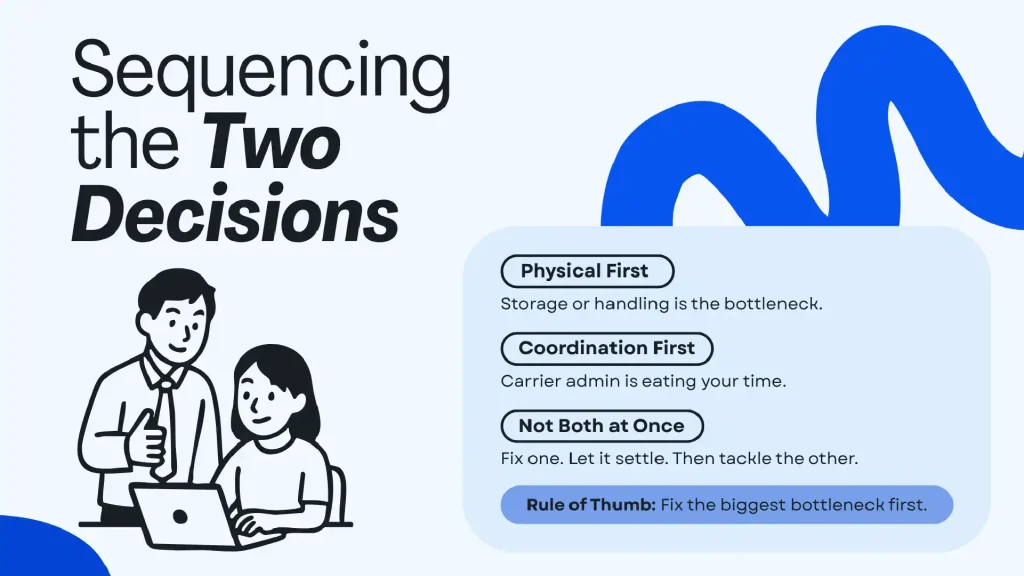
Where both layers need addressing, order matters more than most people expect.
Physical first when: storage is the binding constraint, you are turning away volume, or handling is consuming staff who should be doing something else. Fix the bottleneck, then address the admin it creates.
Coordination first when: volume is manageable, but the founder or an office manager is spending a day a week on carrier email. This is the more common situation and the less commonly diagnosed one.
Never both in the same month. Onboarding a 3PL changes every process the coordinator would be learning. Do one, let it settle for a quarter, then do the other.
For the broader pattern of consolidating operational functions rather than adding vendors one at a time, our guide to back office outsourcing covers the accounting.
What to Ask a 3PL Before Signing
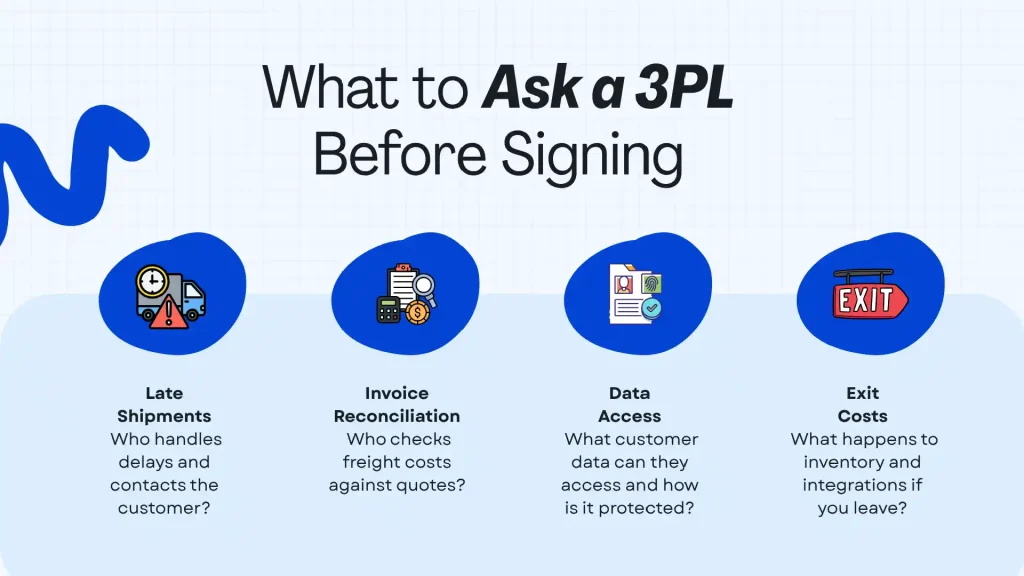
What happens when a shipment is late, and who contacts the customer? If the answer is that they notify you and you handle it, you have just confirmed the coordination layer stays with you.
How are freight invoices reconciled against quotes? Ask who checks. If nobody does, that is a leak you are absorbing.
What access will you have to our order and customer data, and what are your controls? Per the supply chain point above, this is a security question and deserves a specific answer.
What does it cost to leave? Inventory has to physically move. Integrations have to be rebuilt. Ask before signing, not after.
Sudberry Southern built out operational support rather than adding vendors to manage; the Sudberry Southern case study covers how the role was scoped.
Frequently Asked Questions
What does it mean to outsource logistics?
Paying a third party to move, store or manage goods rather than doing it in-house. In practice, it covers two separate layers: the physical handling, bought from a 3PL or fulfilment centre, and the coordination work of tracking, exception handling and carrier communication, which is a role rather than a service.
Does a 3PL handle shipment tracking and customer updates?
Usually not beyond providing data. Most 3PLs notify you of exceptions and expect you to contact the customer. The coordination work stays with you unless you specifically contract for it, which is why operational load often does not fall after onboarding a 3PL.
What is a logistics coordinator?
The person who monitors shipments, chases carriers when something stalls, handles damaged or missing deliveries, updates customers, and reconciles freight invoices. It is administrative work requiring industry vocabulary rather than a specialist qualification.
Should I outsource fulfilment or hire a coordinator first?
Fulfilment first if storage or handling is the binding constraint. A coordinator first if volume is manageable but the admin is consuming a day a week. Do not do both in the same quarter, because onboarding a 3PL changes every process the coordinator would be learning.
Can logistics coordination be done remotely?
Yes. The work is carrier portals, email, spreadsheets, and your order system, all of which are accessible from anywhere. What matters is timezone overlap with your carriers and suppliers, not physical proximity to the goods.
Hire the coordination layer
Search the pool free. Messaging and interviews are free. 3% of first-year salary on placement, 60-day replacement.