

Why Nobody Adds It Up
Back office functions arrive one crisis at a time. The books fall behind, so a bookkeeper is hired. Payroll gets complicated, so a payroll service is added. The founder drowns in email, so a virtual assistant appears. A spreadsheet needs cleaning, so someone is found on Upwork.
Each decision was correct given the problem in front of it. None of them were made with the others in view, and they sit in different budget lines, so the total never appears on any single report.
The overlap is the part that costs most. A bookkeeper reconciling accounts and a payroll provider processing runs are handling adjacent data. An admin VA chasing invoices and a data entry contractor updating records are doing the same category of work. Each relationship carries its own scoping, onboarding, context-setting, and management overhead, and that overhead multiplies with every vendor rather than the work itself. If data entry is your largest piece, read how to outsource data entry without the usual accuracy problems.
What the Fragmented Stack Actually Costs
Not the invoice totals, which are easy to find. The costs that sit around them.
| Cost | Where it hides | Why fragmentation multiplies it |
|---|---|---|
| Management time | Nobody’s budget | Five relationships to brief, review, and chase instead of one |
| Context rebuilding | Invisible | Each vendor knows only their slice. Anything spanning two requires you to explain both. |
| Handoff gaps | Surfaces as errors | Work that falls between two vendors belongs to neither until something breaks |
| Duplicate tooling | Software budget | Separate subscriptions where one person would use one stack |
| Onboarding, repeatedly | Nowhere | Every vendor change restarts the learning curve for that slice |
The management cost is the one that rarely gets counted and usually dominates. Five vendor relationships consume founder or office-manager attention every week, and that attention is the scarcest input in a small company.
Which Functions Genuinely Overlap
Consolidation only works where the skills actually converge. They converge more than the vendor landscape suggests.
| Cluster | Functions that fit together | Why one person can hold them |
|---|---|---|
| Finance operations | Bookkeeping, payroll processing, accounts payable and receivable, reconciliation, reporting | Same data, same software, same monthly cycle |
| Business operations | Admin, data entry, CRM maintenance, document management, vendor coordination | Same skills: accuracy, organisation, tool fluency |
What does not consolidate: anything requiring a licence or carrying legal exposure. Tax filing, employment law advice, and audit work stay with a CPA or a lawyer. Consolidation applies to the operational layer, not the professional one.
The two clusters above are usually two hires, not one. A finance operations person and an operations generalist between them cover what five vendors were covering, and each holds enough context to notice when something is wrong.
The Comparison Nobody Runs
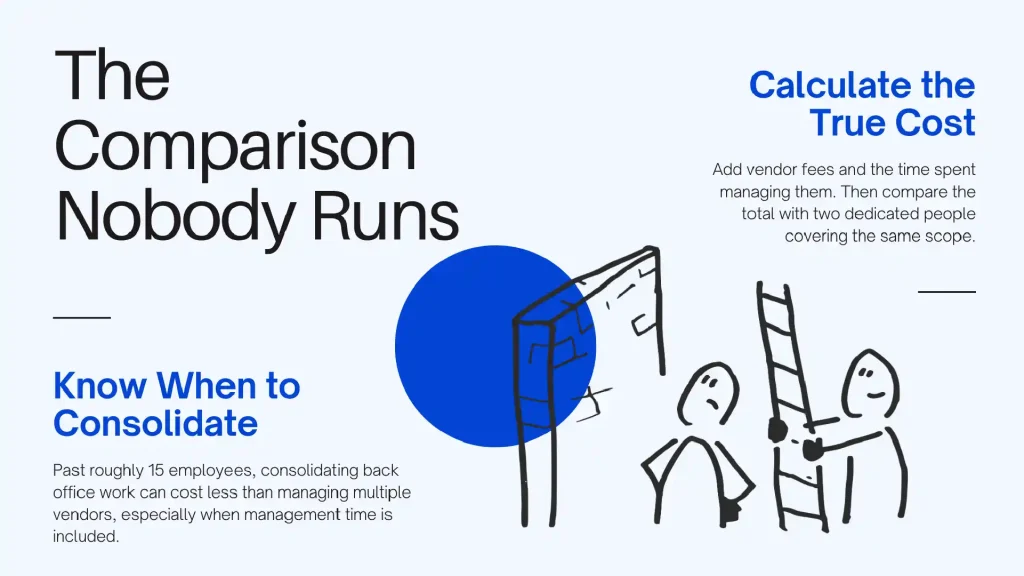
The reason the fragmented stack persists is that no single moment forces the comparison. Each vendor is renewed on its own timeline against its own budget line.
Running it is straightforward. List every provider touching back office work. Add the monthly cost. Add an honest estimate of the hours spent managing them. Then compare that against two dedicated people covering the same scope.
For most SMBs past roughly fifteen employees, the consolidated figure is lower, and it is lower before counting the management time. Below that headcount, fragmentation is often correct, because the volume in each function is genuinely too small to occupy anyone.
If you want to see what the consolidated version would cost before running the comparison, the client portal lets you search the pool and open profiles directly.
What It Costs to Hold Data Across Five Vendors
There is a second cost to fragmentation that has nothing to do with money. Every additional vendor holding your financial or employee data is an additional surface. According to the UK National Cyber Security Centre’s guidance on supply chain security, most organisations have limited visibility into the security practices of their suppliers, and third-party access is a recurring route into otherwise well-defended systems.
Five vendors with access to payroll records, bank feeds, and customer data are five sets of practices you are not auditing. Two people working inside your own systems, under your own access controls, is a materially smaller surface. That is not the primary argument for consolidation, but it is a real one, and it never appears in the cost comparison.
When Fragmentation Is Right
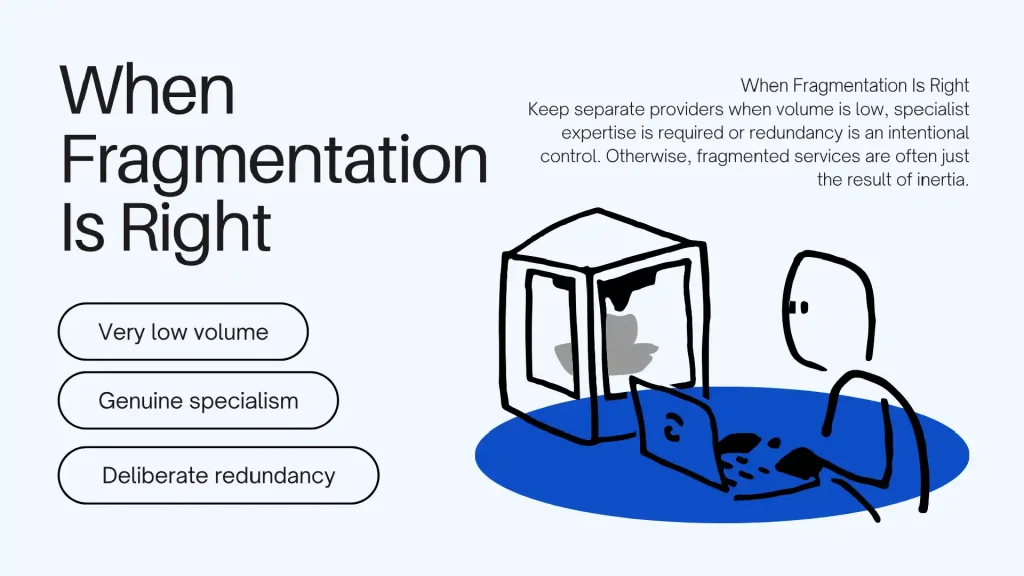
Three situations where buying separately is correct and consolidating would be a mistake.
- Very low volume. Under roughly ten employees, each function may genuinely need a few hours a month. A person would be underused, and a service is cheaper.
- Genuine specialism. Multi-state payroll, complex revenue recognition, or regulated reporting are worth a specialist provider even when everything else consolidates.
- Deliberate redundancy. Some businesses want the bookkeeper and the payroll provider separate as a control. That is a reasonable governance choice, and it costs what it costs.
Outside those, fragmentation is usually inertia rather than design. The stack grew one crisis at a time, and nobody revisited it. Our guide to outsourcing payroll covers the finance cluster in more detail.
What Consolidation Looks Like in Practice
Pavago is a self-serve hiring marketplace, not a service you buy, which is the relevant difference here. You search vetted remote talent yourself, get matched in under a minute, watch video intros and hire directly, with no sales call. Searching, messaging and interviews are free, and each hire costs 3% of first-year salary. The pricing page carries the 60-day replacement terms.
For the finance cluster, the offshore bookkeeper role is the usual anchor. For the operations cluster, admin and operations talent covers the range.
FLLR Consulting built operational infrastructure this way rather than adding vendors, and the FLLR Consulting case study covers how the functions were grouped.
Frequently Asked Questions
What is back office outsourcing?
Contracting out the functions that keep a business running without generating revenue directly: bookkeeping, payroll, administration, data operations, and HR paperwork. It is usually bought function by function, which is why the total is rarely examined.
Is it cheaper to consolidate back office functions?
Above roughly fifteen employees, usually yes, and the savings come from removing duplicated scoping, onboarding, and management rather than from cheaper labour. Below that, fragmentation is often correct because each function is too small to occupy a person.
Which back office functions can be combined?
Finance operations cluster well: bookkeeping, payroll processing, accounts payable and receivable, reconciliation, and reporting all run on the same data and cycle. Business operations cluster separately: admin, data entry, CRM maintenance, and vendor coordination share the same underlying skills. The same split applies when you outsource logistics: the physical handling and the coordination work are separate purchases.
What should not be consolidated?
Anything requiring a licence or carrying legal exposure. Tax filing, employment law advice, and audit work stay with a CPA or a lawyer regardless of how the operational layer is arranged.
How do I compare my current back office spend?
List every provider touching back office work, total the monthly cost, then add an honest estimate of hours spent managing them. Compare that against the cost of two dedicated people covering the same scope. The management time is usually the figure that changes the answer.
See what consolidation would cost
Search the pool free. Messaging and interviews are free. 3% of first-year salary on placement, 60-day replacement.