

What PPC Management Covers
Paid search and paid social management splits into two layers, and providers price them very differently.
Build. Account structure, conversion tracking, audiences, bid strategy, ad copy and landing page alignment. Done once, revisited occasionally.
Run. Search term review, negative keywords, budget shifts, bid adjustments, creative testing and reporting. Weekly, forever, and where performance is actually won or lost.
A provider strong at building and light on running produces a good launch and a slow decline. Ask which layer the fee pays for.
The Two Questions
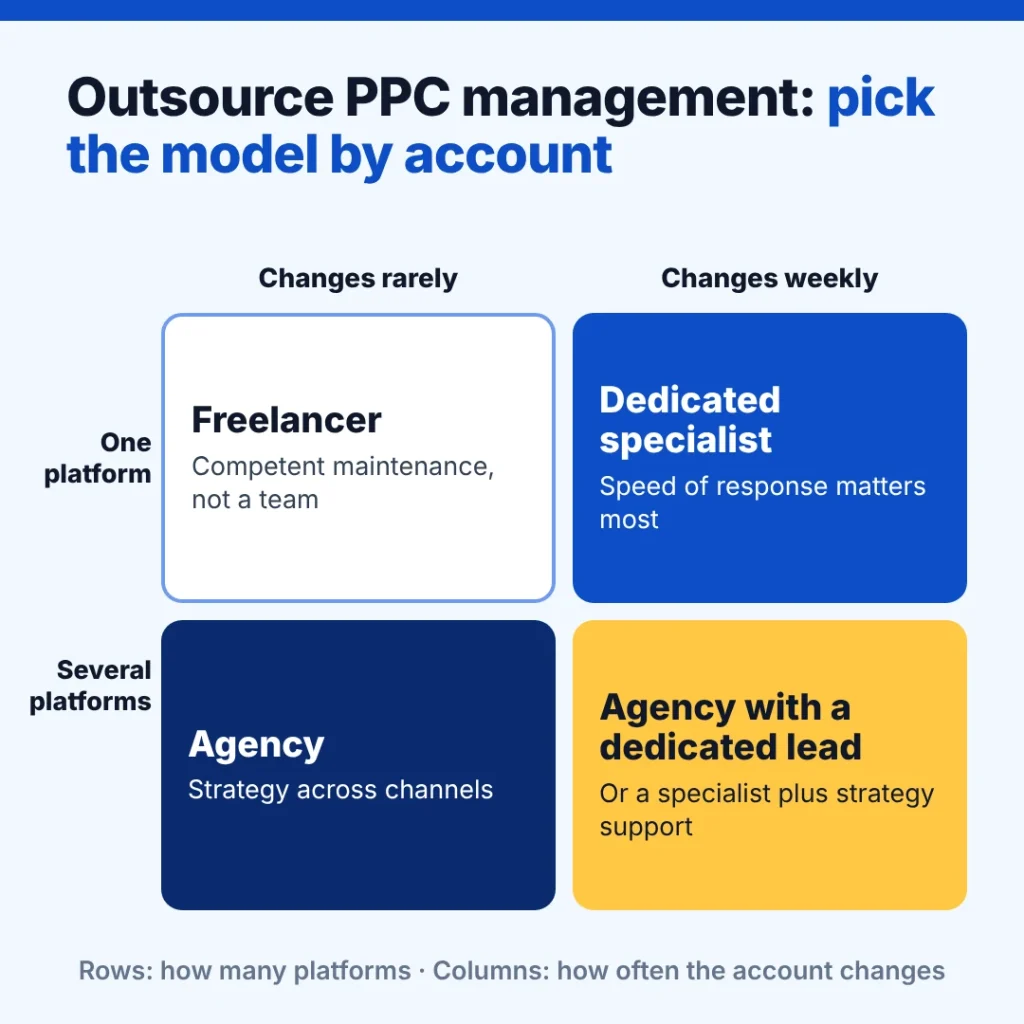
Question one: how many platforms? Google only, or Google plus Meta, LinkedIn and Microsoft. Each platform has its own auction, tooling and failure modes.
Question two: how often does the account change? Stable offers and evergreen campaigns, or new promotions, product launches and seasonal swings every month.
| Changes rarely | Changes weekly | |
|---|---|---|
| One platform | Freelancer | Dedicated specialist |
| Several platforms | Agency | Agency with a dedicated lead, or a dedicated specialist plus strategy support |
The grid is simple on purpose. Most mismatches come from ignoring one axis: a stable single-platform account paying agency retainers, or a fast-moving account handed to a freelancer who checks in fortnightly.
The Four Models
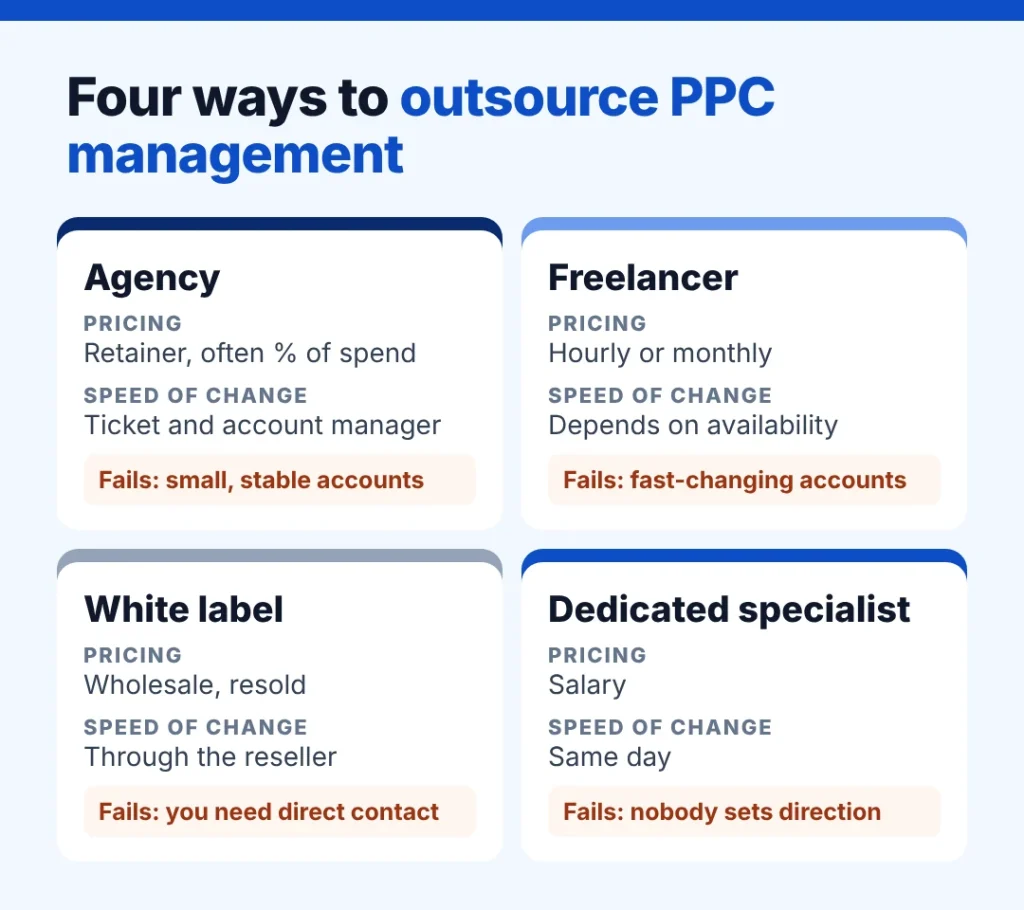
| Agency | Freelancer | White label | Dedicated specialist | |
|---|---|---|---|---|
| Pricing | Retainer, often a percentage of spend | Hourly or monthly | Wholesale, resold | Salary |
| Strategy included | Yes | Sometimes | No, the reseller supplies it | You supply it |
| Attention per account | Shared across clients | Shared | Shared | Yours only |
| Speed of change | Ticket and account manager | Depends on availability | Through the reseller | Same day |
| Fails when | Account is small and stable | Account changes faster than their schedule | You need direct contact | Nobody sets direction |
Watch the percentage-of-spend fee. If the agency fee rises with your budget, the provider earns more when you spend more, whether or not the extra spend was wise. It is common and worth noticing before you sign.
Budget scrutiny makes this sharper. The U.S. Bureau of Labor Statistics puts benefits at roughly 30 percent of total employer compensation, which is why in-house domestic PPC hires are rare at SMB scale and why the choice usually sits between the four models above.
Where Each Model Genuinely Wins
- Agency: multi-platform accounts where creative, strategy and channel mix are all in play, or businesses with no marketing lead to set direction.
- Freelancer: one platform, stable campaigns, modest spend. You need competent maintenance, not a team.
- White label: marketing agencies reselling PPC to their own clients without building the capability.
- Dedicated specialist: accounts that change weekly, where speed of response matters more than bundled strategy.
For the spend level at which a dedicated specialist starts paying for itself, our guide to hiring a Google Ads specialist covers where that line sits.
What the Dedicated Route Costs
At Pavago, searching, messaging and interviews are free, and placement is 3% of first-year salary. The pricing page has the 60-day replacement terms.
The structural difference against an agency is that a salary does not rise with your ad budget. You can open profiles in the client portal before deciding.
The performance marketing specialist role covers multi-platform paid work.
The Google Ads specialist role covers search-only accounts.
Zen Dental Studio placed an offshore Google Ads hire rather than staying on an agency retainer, and the Zen Dental Studio case study covers how it was set up.
Four Questions Before You Sign
How is the fee calculated? Flat, hourly or percentage of spend. The last one deserves the most scrutiny.
Who owns the ad accounts? They should be registered to you, with the provider added as a user. Leaving is otherwise a negotiation.
How often are search terms reviewed? Weekly is the standard for active accounts. Monthly means waste accumulates for weeks.
What gets reported beyond clicks and spend? Cost per acquisition and conversion quality. Click reports show activity, not results.
What Good PPC Management Looks Like Week to Week
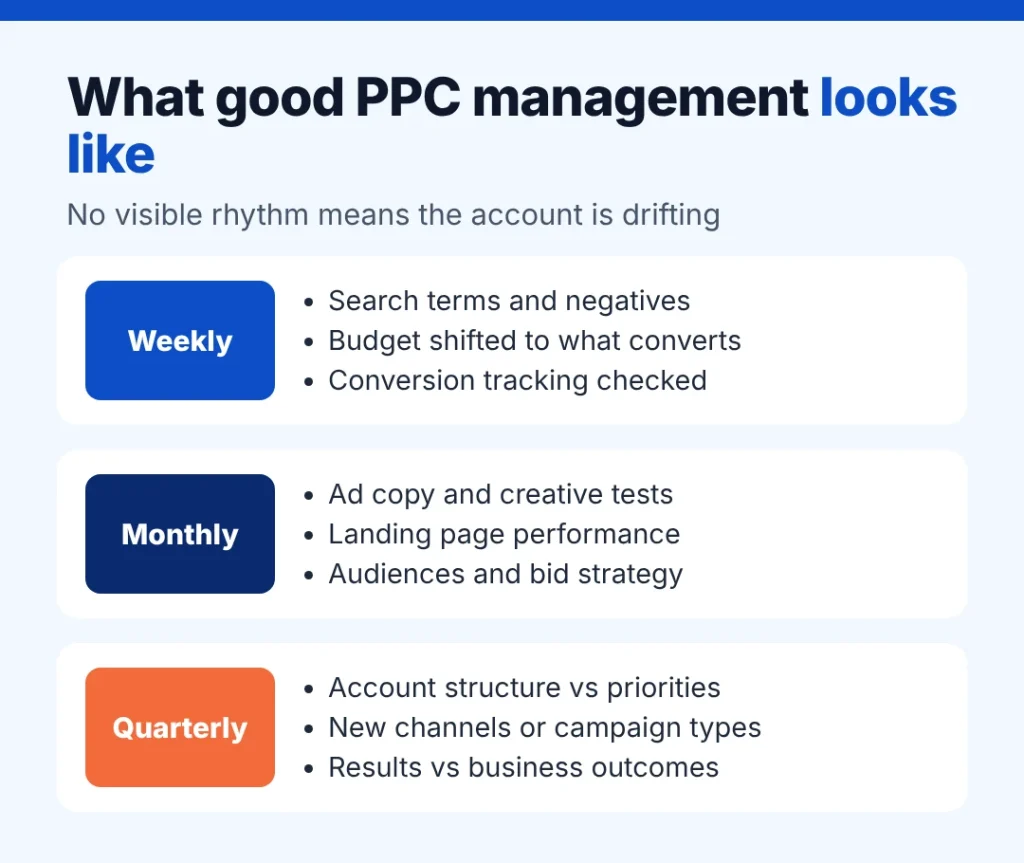
Whichever model you choose, the work itself should follow a recognisable rhythm. If it does not, the account is drifting.
Weekly. Search term review, negative keywords added, budget shifted between what is converting and what is not, and a check that conversion tracking is still firing.
Monthly. Ad copy and creative tests reviewed, landing page performance checked, and audience and bid strategies adjusted.
Quarterly. Account structure reviewed against current priorities, new channels or campaign types considered, and reporting compared against business outcomes rather than platform metrics.
A provider who cannot show you this rhythm, whether agency, freelancer or employee, is maintaining the account rather than managing it.
How to Hand Over an Existing Account
Keep ownership. Make sure every ad account, analytics property and tag manager container is registered to your business before the change.
Document what is running and why. Active campaigns, budgets, bid strategies and anything paused deliberately.
Freeze major changes for two weeks. Let the new manager learn the account before restructuring it, so you can tell their impact from the noise of a handover.
Agree a baseline. Record cost per acquisition and conversion volume at the handover date so improvement can actually be measured.
Red Flags in a PPC Provider
Reports full of clicks and impressions, light on conversions. Activity is not results.
Reluctance to give you admin access. Your accounts should never be hostage to a contract.
Every recommendation increases spend. Good management cuts waste as often as it scales.
Accepting every automated platform recommendation. Several of them broaden targeting in ways that suit the platform more than your margin.
More on how hiring works is on the Pavago homepage.
How to Think About PPC Management Cost
The cost of management only makes sense when compared with what it changes. A management fee that seems high is cheap if it removes more wasted spend than it costs, and a low fee is expensive if the account keeps leaking budget.
Three numbers matter more than the fee itself: how much of your spend goes to searches that never convert, your cost per acquisition today, and how quickly the account responds when performance changes. A provider worth paying should be able to show movement on all three within a few months.
Be cautious of pricing that rises automatically with your budget. It rewards the provider for spending more of your money rather than spending it better. A flat fee, or a salary for a dedicated specialist, removes that incentive.
Questions to Ask Before Choosing a Model
Who will actually work on the account each week? A named person, or a rotating team behind an account manager.
How quickly can changes be made? Same day, or through a ticket queue.
What happens to the account if we part ways? You should leave with full access and full history.
Which platforms are covered? Make sure every channel you run is included, not just search.
When to Move From an Agency to a Dedicated Specialist
The switch usually makes sense when three things are true at once: the account changes often enough that waiting on an agency ticket costs you results, your spend is large enough that wasted budget outweighs a salary, and someone internally can set direction on offers and audiences. If any one of those is missing, an agency or freelancer may still be the better fit for now.
Frequently Asked Questions
Should I outsource PPC to an agency or a freelancer?
An agency for multi-platform accounts that need strategy. A freelancer for a single platform with stable campaigns. If the account changes weekly, a dedicated specialist usually outperforms both.
How much does outsourced PPC management cost?
Agencies charge retainers, often as a percentage of ad spend. Freelancers bill hourly or monthly. A dedicated specialist costs a salary. The comparison that matters is fee against wasted spend, not fee against zero.
What is white label PPC?
A provider that manages accounts on behalf of another agency, which resells the service under its own brand. Useful for agencies; rarely the right choice for a business buying directly.
Who should own my Google Ads account?
You. Register it to your business and add the provider as a user. Accounts registered to a provider make switching difficult.
Can PPC be managed remotely?
Yes. All of the work happens inside ad platforms and analytics, granted by user permission. Location is irrelevant; responsiveness during your working hours is what matters.
Match the model to the account
Search the pool free. Messaging and interviews are free. 3% of first-year salary on placement, 60-day replacement.