

What Outsourcing Recruitment Actually Means
Worth defining, because providers in all three categories describe themselves the same way.
RPO, or recruitment process outsourcing. A provider takes over part or all of your hiring function. Sourcing, screening, scheduling, offer management, reporting. Usually priced as a monthly retainer or per hire against a committed volume. You are renting a department.
Contingency agency. A recruiter works your role and gets paid only if you hire their candidate, typically a percentage of first-year salary. No fee if nothing lands. You are buying an outcome on commission.
Talent platform. The provider vets a pool and gives you search and direct messaging. You run the process. Priced per hire, by subscription, or both. You are buying access and keeping the judgement.
The Question That Decides It
What is actually stopping you from hiring right now?
Three honest answers, and each points somewhere different.
| Your constraint | What it sounds like | The model that fits |
|---|---|---|
| Capacity | We know what good looks like. Nobody has time to run the process. | RPO, or a platform if volume is low |
| Capability | We cannot tell a strong candidate from a plausible one in this role. | Contingency agency, or RPO with domain expertise |
| Cost | We know what we want and we can assess it. The fees are the problem. | Talent platform |
| Volume | We need 20 people this quarter. | RPO. Nothing else scales that fast. |
| Confidentiality | We are replacing someone who still works here. | Contingency agency. An open search is impossible. |
The second row is the one people misdiagnose. A non-technical founder hiring their first engineer has a capability constraint, not a cost one. Buying the cheapest option and then being unable to evaluate the shortlist produces a bad hire, which costs more than any fee saved.
What Each Model Costs, and How the Cost Behaves
| RPO | Contingency agency | Talent platform | |
|---|---|---|---|
| Pricing shape | Monthly retainer, or per hire against committed volume | Percentage of first-year salary, on success | A small fee per hire (Pavago: 3% of first-year salary) |
| Scales with salary | Sometimes | Yes, directly | No |
| Scales with hire count | Yes | Yes | Yes, at a small fee per hire |
| Paid if you do not hire | Yes | No | Subscription only |
| Minimum commitment | Usually annual | None | None |
| Who evaluates candidates | The provider, then you | The provider, then you | You |
Hiring carries internal cost before any provider is involved. G2’s cost-per-hire analysis tracks SHRM’s benchmark rising to $4,700 per hire by 2023, a 14% increase. That figure exists whichever model you pick, and it is the baseline any provider fee sits on top of.
The contingency model has one feature worth naming. Because the fee is a percentage of salary, hiring a stronger and better-paid candidate costs you more for identical search work. That is not dishonest, it is how the model prices, but it is worth knowing before you negotiate.
Where RPO Genuinely Wins
This section exists because a comparison that always lands on the cheapest option is an advertisement.
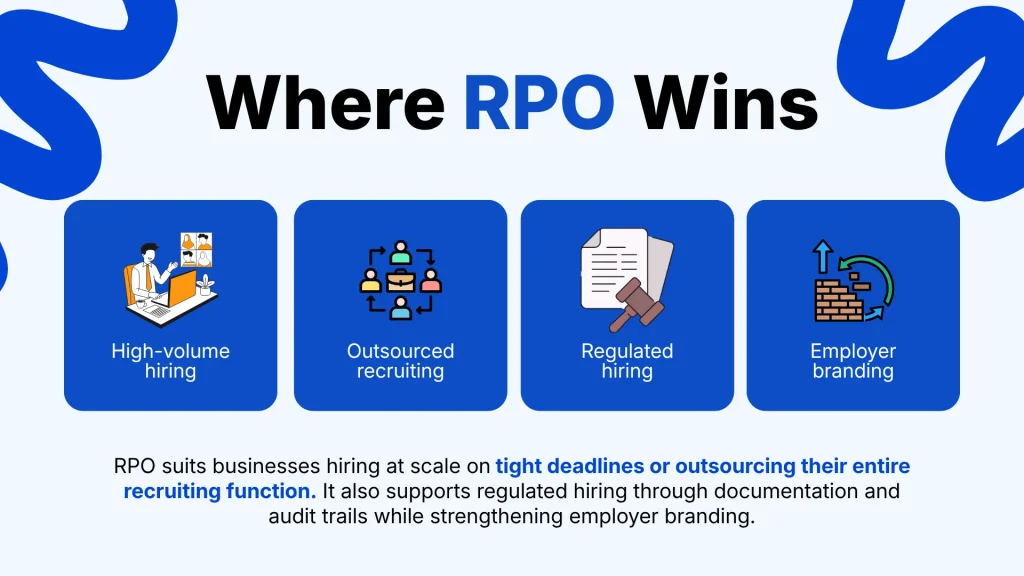
- Volume hiring on a deadline. Twenty roles in a quarter is a programme. A platform cannot compress that and an agency working role by role will not either.
- You have no recruiting function and no intention of building one. RPO is a department you rent. If nobody internally will ever own hiring, that is a real answer.
- Compliance-heavy or regulated hiring. Where documentation and audit trails matter, a provider who does this professionally is worth the retainer.
- Employer brand work alongside hiring. Good RPO providers improve how you present to candidates, which a platform does not touch.
Below roughly ten hires a year, RPO economics stop working, because you are funding infrastructure capacity you will not use. Our guide to remote recruitment process outsourcing covers that threshold in more detail.
Where the Platform Model Wins
When the constraint is cost and you can evaluate candidates yourself, paying a percentage or a retainer is buying judgement you already have.
At Pavago, searching, messaging and interviews are free. Placement is 3% of first-year salary, with a 60-day replacement window. The pricing page carries the full terms.
The low fee is the structural difference. At 3%, hiring a stronger candidate barely moves it: an extra $20,000 of salary adds $600, against $4,000 at 20%. You can search the pool and open profiles in the client portal before committing to anything.
For the recruiter role specifically, Pavago also places recruiters directly through the recruiter role, which is the fourth option nobody lists: hiring the recruiting capability rather than renting it.
The Fourth Option Nobody Puts in the Comparison
All three models assume recruiting is something you buy. Past a certain hiring volume it becomes something you should own.
Roughly fifteen to twenty hires a year is where an in-house recruiter starts to make sense. At that volume, agency fees or an RPO retainer exceed what a dedicated recruiter costs, and the recruiter accumulates knowledge of your roles, your market and your bar that no provider retains between engagements.
That recruiter does not have to be local. The work is sourcing, screening and coordination, all of which happen in an ATS and over video. Tenant Planet structured hiring this way rather than through an agency; the Tenant Planet case study covers the arrangement.
Four Questions Before You Sign Anything
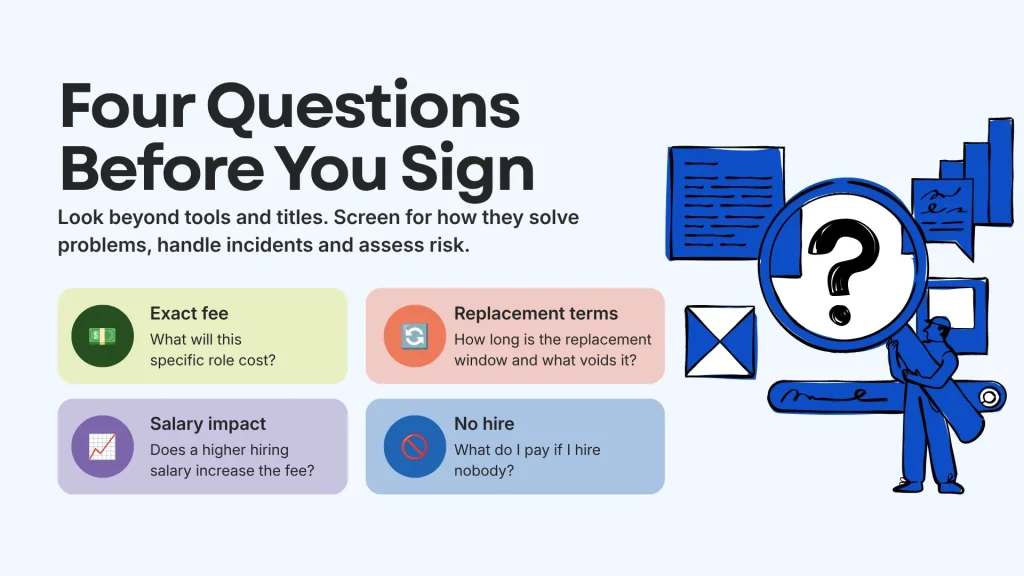
1. What is the fee in dollars for this specific role? If it cannot be answered without a call, the number is negotiable, which means it is arbitrary.
2. What is the replacement window and what voids it? Thirty days is common and close to useless. Ask what happens if the hire resigns in week nine.
3. How much does the fee rise if I hire at a higher salary? At 20%, every extra $10,000 of salary adds $2,000. Ask for the number directly.
4. What happens if I hire nobody? RPO retainers are paid regardless. Contingency is not. Platforms charge subscription only. This single answer separates the three models faster than any brochure.
Frequently Asked Questions
What does it mean to outsource recruitment?
Paying an external provider to handle part or all of hiring. It covers three distinct models: RPO rents you a recruiting function on retainer, a contingency agency works roles on commission, and a talent platform sells vetted access while you run the process.
Is RPO cheaper than using a recruitment agency?
At volume, usually. Below roughly ten hires a year, rarely, because RPO retainers fund capacity you will not use. Contingency agencies cost nothing if you do not hire, which makes them cheaper for sporadic roles and more expensive per hire when you do.
How much does outsourcing recruitment cost?
Contingency agencies typically charge a percentage of first-year salary. RPO is a monthly retainer or a per-hire rate against committed volume. Talent platforms charge far less per hire: Pavago takes 3% of first-year salary.
When should I hire an in-house recruiter instead?
Around fifteen to twenty hires a year. At that volume agency fees or an RPO retainer exceed a recruiter’s cost, and an in-house recruiter accumulates knowledge of your roles and standards that providers do not retain between engagements.
Can recruitment be outsourced to another country?
Yes. Sourcing, screening and coordination happen in an ATS and over video. What matters is familiarity with your market and enough timezone overlap to schedule interviews, not physical location.
Keep the judgement, drop the 20%
Search the pool free. Messaging and interviews are free. 3% of first-year salary on placement, 60-day replacement.