

What a QuickBooks Consultant Actually Does
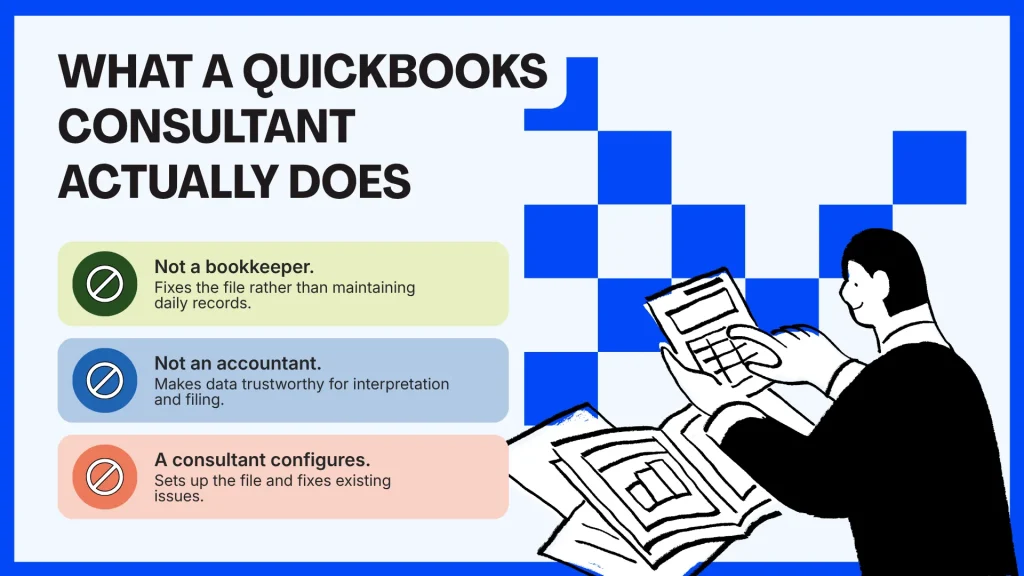
Worth defining, because the title gets used for three different things, and only one of them is a consultant.
Not a bookkeeper. A bookkeeper works inside the file continuously, recording and reconciling. A consultant works on the file itself, usually once, and leaves.
Not an accountant. An accountant interprets and files from the data. A consultant makes the data trustworthy enough to interpret.
A consultant configures. Chart of accounts structure, bank and credit card feed rules, item and product setup, sales tax configuration, class or location tracking, integrations with payroll and payment processors, user permissions, and the opening balances that determine whether anything ties out. Then they fix whatever is already broken from the previous setup.
Where the Cost Of a Bad Setup Actually Lands
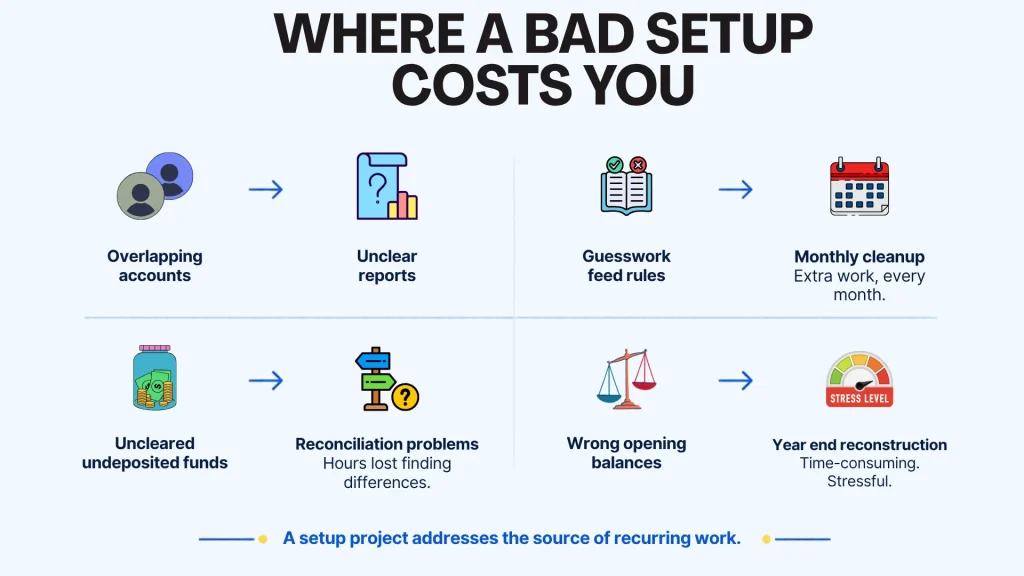
Nobody budgets for this because it never arrives as a bill labelled QuickBooks.
| Symptom | What it looks like day to day | Where the cost shows up |
|---|---|---|
| Chart of accounts improvised | Forty expense accounts, half of them overlapping, nobody sure which to use | Reports that cannot be read. Decisions made on the wrong numbers. |
| Bank feeds categorising by guess | Transactions auto-assigned to whatever matched last time | Monthly cleanup, and a P&L that is wrong until someone fixes it |
| Undeposited funds accumulating | A balance that grows and never clears | Cash position overstated. Reconciliation fails. |
| Opening balances wrong | Books never tie to the bank | Year-end becomes reconstruction rather than review |
| Sales tax misconfigured | Liability account that does not match what was collected | Filing errors and penalties |
| No class or location tracking | One combined P&L for several locations or lines | No visibility into which part of the business works |
The second row is the one that compounds quietly. Auto-categorisation that is roughly right produces books that look finished and are not. The error is invisible until someone looks closely, which is usually an accountant at year-end charging by the hour.
The IRS requirement underneath all of this is simple and often missed. Its guidance on recordkeeping for businesses expects records that clearly establish income, deductions, and credits. A file nobody can reconcile does not meet that standard, and the exposure is not theoretical if anything is ever examined.
The Arithmetic Nobody Runs
Compare two scenarios over twelve months.
Scenario one, left alone. Your bookkeeper or office manager spends several hours each month correcting categorisation and chasing reconciliation differences. Your accountant spends additional hours at year-end reconstructing rather than reviewing, billed at advisory rates. You make at least one decision on a report that turned out to be wrong.
Scenario two, fixed once. A consultant restructures the chart of accounts, sets feed rules properly, clears undeposited funds, corrects opening balances, and documents how the file is meant to work. That is a defined engagement with an end date.
The second is cheaper in almost every case, and the reason it does not happen is that the first cost is distributed across people who are not tracking it. Nobody sees the total, so nobody acts on it.
When You Need a Consultant Versus a Bookkeeper
These are different purchases, and buying the wrong one is common.
- Consultant, once: the file is broken, you are migrating from spreadsheets or another system, you have just changed entity structure, or you are adding a second location or revenue line that needs tracking.
- Bookkeeper, ongoing: the file is fine, and someone needs to work in it every week recording, reconciling and invoicing.
- Both, in order: if the file is broken and nobody owns it, fix it first. Hiring a bookkeeper into a broken file asks them to build on a foundation they cannot assess, and they will spend their first quarter on cleanup you could have scoped as a project.
That ordering matters more than the choice. Our comparison of bookkeeping roles covers where the bookkeeper line sits once the file is clean.
What to Screen For
Ask them to describe a chart of accounts they restructured. Not the software steps. The reasoning: what was wrong, what they changed, how they decided the structure.
Ask what they do about historical data. Restating prior periods versus starting clean from a date is a real decision with tax implications. A consultant who has no view on it has not done this often.
Ask for the ProAdvisor certification. It is free to obtain, which makes its absence more telling than its presence.
Give them view access and ask what worries them. The most useful signal available. Someone competent names three problems within fifteen minutes of looking at a real file.
On Pavago, you search vetted QuickBooks specialists yourself through the QuickBooks consultant role, and the broader finance talent pool covers bookkeepers and accountants for the ongoing work.
Search, messaging and interviews are free, and placement is 3% of first-year salary. Terms on the pricing page.
You can search the pool and open profiles in the client portal before deciding whether this is a project or a hire.
When You Do Not Need One
Three cases, and they are common enough to state plainly.
- A new file, set up correctly, under fifty transactions a month. QuickBooks defaults are adequate at that scale. Spending on configuration you will outgrow in a different direction is waste.
- Your accountant already configured it and reviews it quarterly. The work is done. A second opinion on a working file is not a project.
- You are about to change systems. Do not pay to restructure a file you are leaving. Decide the platform first.
Outside those, if your balance sheet is something you avoid looking at, the file is the problem rather than the business. QBM Services restructured finance operations rather than continuing to work around them, and the QBM Services case study covers how the support was scoped.
Frequently Asked Questions
What does a QuickBooks consultant do?
Configures and repairs the file itself: chart of accounts structure, bank feed rules, item setup, sales tax, class tracking, integrations, permissions, and opening balances. It is usually a one-off engagement, distinct from a bookkeeper who works in the file continuously.
Is a QuickBooks consultant the same as a bookkeeper?
No. A consultant works on the file once. A bookkeeper works in it continuously. If the file is broken and nobody owns it, fix it first, because a bookkeeper hired into a broken file spends their first quarter on cleanup.
How do I know if my QuickBooks is set up wrong?
Four signs: undeposited funds that never clear, a chart of accounts with overlapping categories nobody is sure how to use, reconciliation differences that get carried forward, and a balance sheet you avoid relying on for decisions.
Do I need a ProAdvisor certification holder?
Not strictly, but the certification is free to obtain, which makes its absence more informative than its presence. Experience restructuring real files matters more than the badge itself.
Can QuickBooks work be done remotely?
Yes. QuickBooks Online is browser-based, and access is granted by user permission, so location is irrelevant. What matters is familiarity with US chart of accounts conventions and sales tax handling.
Fix the file, then decide about the hire
Search the pool free. Messaging and interviews are free. 3% of first-year salary on placement, 60-day replacement.
Pavago is a hiring marketplace, so you run the search yourself. Tell it the role, your budget and the region, and you get matched with vetted remote candidates in under a minute. Watch their video intros, message the ones you like, and hire straight from the app. No sales call, no job post, no recruiter in the middle. It’s the most frictionless way we know to hire.