

What Each One Actually Is
Definitions first, because the titles are used loosely, and the looseness is where the mis-buying starts.
A bookkeeping virtual assistant handles the recording layer: entering transactions, categorising expenses, chasing receipts, raising and sending invoices, following up on unpaid ones, and keeping the ledger tidy. Remote, usually full-time or part-time on a fixed monthly basis.
A bookkeeper does that and takes responsibility for reconciliation and month-end close. Bank and credit card reconciliation, accruals where relevant, and producing a set of books an accountant can work from without rebuilding them.
An accountant interprets and certifies. Financial statements, tax filing, advisory on structure and treatment, and in many cases a professional credential carrying legal weight. They work from books someone else maintained.
The distinction that matters: the first two record, the third interprets. Most SMBs need recording continuously and interpretation a few times a year, then buy as though the ratio were reversed.
The Comparison
| Bookkeeping VA | Bookkeeper | Accountant | |
|---|---|---|---|
| Core job | Record and maintain | Record, reconcile, close | Interpret, report, certify |
| Transaction entry and categorisation | Yes | Yes | Rarely, and expensively |
| Invoicing and receivables chasing | Yes | Sometimes | No |
| Bank reconciliation | Basic, with a defined process | Yes, owns it | Reviews it |
| Month-end close | Assists | Owns | Reviews |
| Financial statements | No | Draft | Yes, and signs |
| Tax filing | No | No | Yes |
| Credential | None required | Sometimes | Yes, and it carries legal weight |
| Engagement | Monthly, dedicated | Monthly or hourly | Periodic, often annual |
| Best for | Ongoing volume, clean records, freeing up whoever is currently doing it | Companies needing owned reconciliation and a reliable close | Filing, advisory, and anything requiring certification |
Where the honest concession sits: a bookkeeping VA is not a substitute for a bookkeeper if nobody is currently owning reconciliation. Recording without reconciliation produces a ledger that looks complete and does not tie out, which is worse than obviously incomplete books because the error is invisible until year-end. For a VA who wants to take on reconciliation, becoming a bookkeeper does not require a degree or a paid course.
The Question That Decides It
Who currently does the recording, and what is that person worth doing instead?
If the answer is the founder, at the weekend, the bookkeeping VA is almost always the right first purchase. The work is genuinely administrative, the volume is continuous, and the alternative use of that time is unambiguous.
If the answer is nobody, and the books are reconstructed quarterly by an accountant charging to do it, you are already paying interpretation rates for recording work. That is the most expensive configuration available, and it is common.
If the answer is that a bookkeeper owns it and the cost feels high for what it is, the useful split is to keep the bookkeeper for close and move the daily recording to a VA. That is the configuration this keyword usually gets searched for, and it works when reconciliation ownership stays explicit.
The Classification Question Nobody Raises
Where a bookkeeping VA works full time for one company, the engagement structure deserves a moment. In the US, whether someone is an employee or an independent contractor turns on behavioural control, financial control and the nature of the relationship rather than on what the contract is titled. The IRS guidance on worker classification sets out the test.
For a contractor engaged outside the US, US employment law generally does not apply, and the arrangement is governed by the contractor’s local law. The point is worth knowing rather than worrying about, and it is a question to raise before the engagement rather than after.
What a Bookkeeping VA Should Be Able to Do
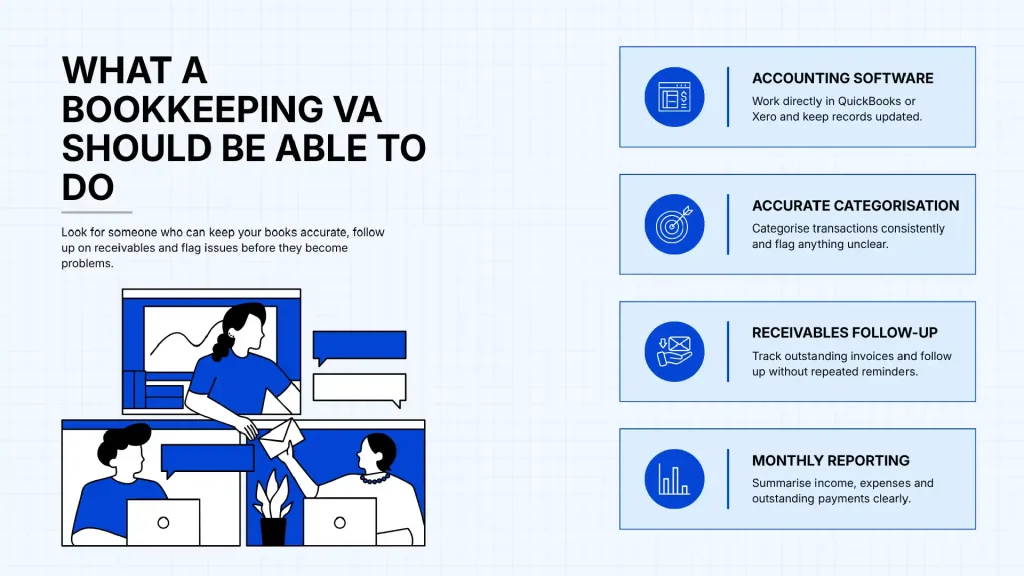
- Work inside your accounting software rather than a spreadsheet handed over monthly. QuickBooks Online and Xero cover most SMB setups. Ask for the certification.
- Categorise consistently and flag what they are unsure about. The second half matters more. Silent guessing is the failure mode that makes books untrustworthy.
- Chase receivables without being asked twice. This is where a VA often pays for itself, and it is the task most likely to be quietly dropped.
- Produce a monthly summary a non-accountant can read. Not a financial statement. A short note on what came in, what went out, and what is outstanding.
On Pavago, you can hire bookkeeping support through the offshore bookkeeper role, with the wider finance talent pool covering accountants and payroll specialists.
Search, messaging and interviews are free, and placement is 3% of first-year salary. Full terms on the pricing page.
The client portal lets you search the pool and open profiles before deciding which of the three roles you actually need.
When the Accountant Is the Right Answer
This section exists because a comparison that always lands on the cheapest option is not a comparison.
- Anything requiring certification. Filed accounts, audited statements, anything a lender or investor will rely on.
- Structural decisions. Entity type, revenue recognition treatment, multi-state or cross-border questions. Getting these wrong is expensive to unwind.
- When the books are already broken. Reconstruction is accountant work. Hiring a VA into a broken ledger asks them to build on a foundation they cannot assess.
The common and sensible configuration is all three at different cadences: a VA continuously, a bookkeeper monthly if nobody internally owns close, and an accountant periodically. For how these functions consolidate rather than fragment, our guide to back office outsourcing covers the accounting.
QBM Services structured finance and administrative support this way rather than routing everything through their accountant; the QBM Services case study covers the placement.
Frequently Asked Questions
What does a bookkeeping virtual assistant do?
Records transactions, categorises expenses, chases receipts, raises and sends invoices, follows up on unpaid ones, and keeps the ledger clean. They work inside your accounting software. They do not own reconciliation, produce financial statements, or file tax.
Is a bookkeeping VA the same as a bookkeeper?
No. A VA handles the recording layer. A bookkeeper additionally owns reconciliation and month-end close. If nobody currently owns reconciliation, a VA alone will produce a ledger that looks complete and does not tie out.
Do I need a bookkeeper if I have an accountant?
Usually yes, or a VA at minimum. Accountants interpret and certify from books someone else maintained. Having an accountant reconstruct records quarterly means paying interpretation rates for recording work, which is the most expensive configuration available.
Can a bookkeeping VA use QuickBooks or Xero?
Yes, and they should work inside your software rather than handing over a spreadsheet monthly. Both platforms offer free certification, so ask which one they hold.
What should a bookkeeping VA never handle?
Tax filing, financial statements anyone will rely on, and structural decisions about entity type or revenue treatment. Those require an accountant, and in many cases a credential carrying legal weight.
Search bookkeeping talent free
Free to search. Messaging and interviews are free. 3% of first-year salary on placement, 60-day replacement.
Pavago is a hiring marketplace, so you run the search yourself. Tell it the role, your budget and the region, and you get matched with vetted remote candidates in under a minute. Watch their video intros, message the ones you like, and hire straight from the app. No sales call, no job post, no recruiter in the middle. It’s the most frictionless way we know to hire.