

What a DevOps Engineer Actually Does
Worth defining, because the title covers a wide range, and the range is why hiring decisions go wrong.
A DevOps engineer owns the path from written code to running software. That includes continuous integration and deployment pipelines, infrastructure provisioning and configuration, monitoring and alerting, incident response, and the security and access controls around all of it. Some organisations split this into platform engineering and site reliability engineering. At SMB scale, it is one role. If security is the bigger worry, read our guide to AI-powered cyber security for SMBs before you scope the role.
What it is not: a systems administrator with a new title, and not a developer who is willing to touch the servers. The second is how most teams cover the function before hiring, and it works until it does not.
The Signal Everyone Watches, and Why It Arrives Late
The common trigger is infrastructure complexity. Multiple environments, a container orchestrator, a growing cloud bill, something nobody fully understands. When that becomes uncomfortable, someone suggests hiring DevOps.
The problem is that infrastructure complexity is a lagging indicator. By the time it is visible, it was built by developers optimising for shipping their own feature rather than for operability, and the new hire spends their first two quarters undoing decisions rather than building.
The leading indicator is simpler and arrives earlier: how often can you deploy, and does it require a specific person? If shipping on a Thursday afternoon depends on whether one engineer is online, that is a bottleneck. It does not look like an infrastructure problem yet. It is one.
Where the Threshold Sits
| Stage | Deploy pattern | Who owns it | Hire DevOps? |
|---|---|---|---|
| 1 to 2 engineers | Manual or a simple pipeline, deploys are events | Whoever wrote the code | No. Overhead exceeds benefit. |
| 3 to 5 engineers | Deploys need coordination. One person is the unofficial owner. | An engineer, unofficially, alongside their real work | This is the line. Most teams are already past it. |
| 6 to 12 engineers | Deploys are blocked by availability. Environments drift. Incidents need a specific person. | Still unofficial, now visibly costly | Yes, and you are late |
| 12+ engineers | Multiple teams, shared infrastructure, compliance pressure | Nobody, adequately | Yes, and possibly more than one |
Row two is the threshold, and the one most teams misread. At three to five engineers, nothing is on fire. One person has quietly become the deploy owner, they are doing it in gaps between their real work, and the cost is invisible because it shows up as their reduced output rather than as an outage.
The test: name the person who would need to be online for you to ship a fix at 4pm on a Friday. If you can name one person, that is the answer. If you cannot name anyone, the answer is worse.
What Waiting Actually Costs
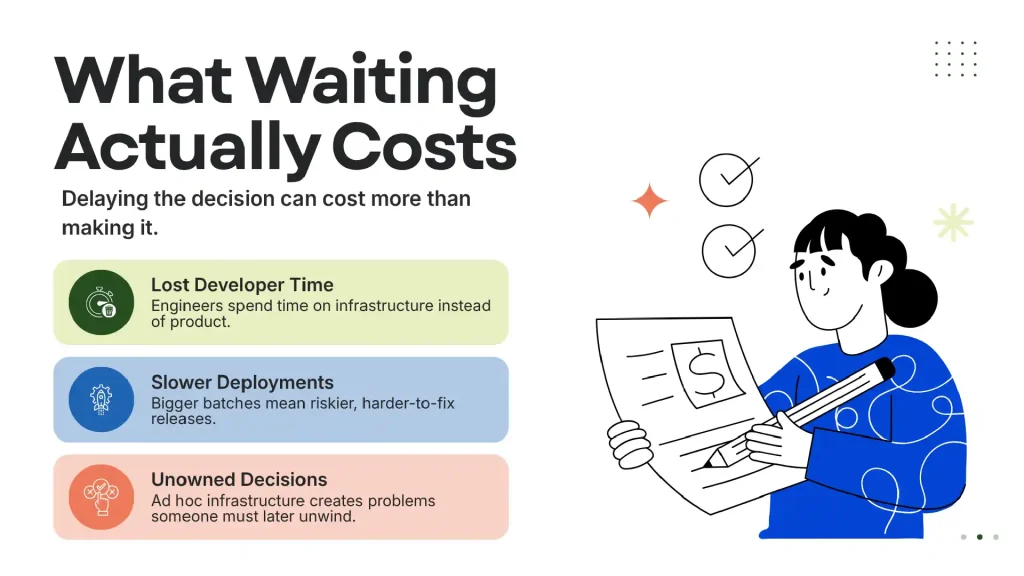
Three costs, in rough order of how visible they are.
- The unofficial owner’s lost output. An engineer spending a third of their week on pipelines and environments is not building product. This is the highest cost, and it never appears in any budget line, because it is not a payment.
- Deployment frequency is falling. When shipping is painful, teams batch changes. Larger batches are riskier, take longer to review, and fail in ways that are harder to diagnose. The pain is self-reinforcing.
- Accumulated decisions nobody owns. Infrastructure built ad hoc by people optimising for their own feature. Each choice was locally reasonable. The aggregate is what the eventual hire spends two quarters unwinding.
Developer time is the expensive input here, which is what makes the third-engineer threshold matter. According to Stack Overflow’s Developer Survey, containerisation and cloud tooling now sit among the most widely used technologies across professional developers, which means the operational surface is present in small teams that have not staffed for it.
What to Screen For
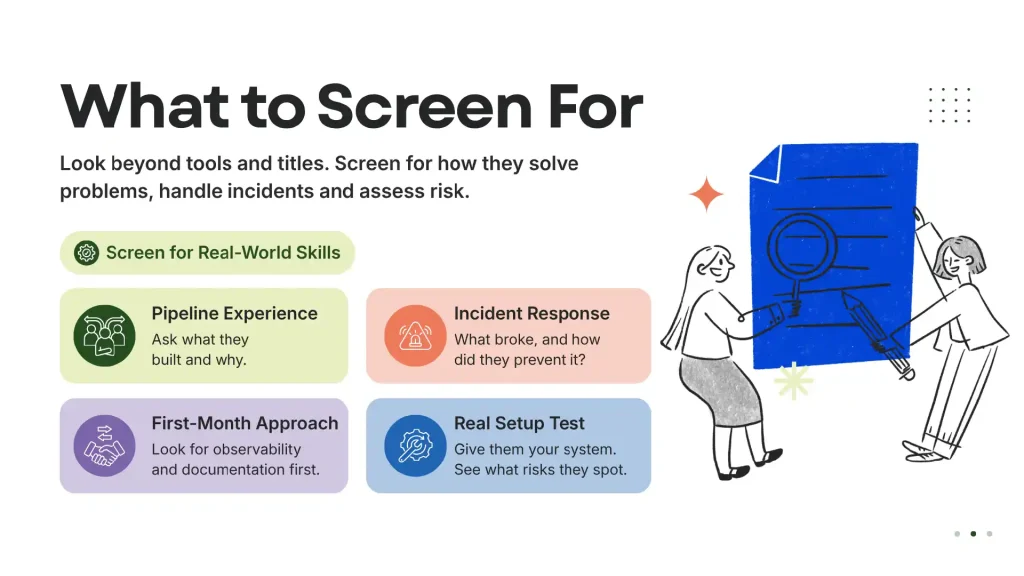
DevOps titles cover a wide range of ability, and the gap between the ends is larger than in most engineering roles.
- Ask them to describe a pipeline they built, end to end. Not tools used. The decisions: what runs on every commit, what gates a release, how rollback works, what they would do differently.
- Ask about an incident they handled. What broke, how they found it, what they changed so it could not recur. Answers that stop at the fix and never reach the prevention are the tell.
- Ask what they would do in their first month on an unfamiliar system. Strong answers start with observability and documentation. Weak answers start with migrating something.
- Give them your actual setup and ask what worries them. The most useful signal in the process. A good engineer will name two or three real risks within ten minutes.
On Pavago, you search vetted DevOps engineers yourself through the offshore DevOps developers role, and the wider engineering talent pool covers adjacent infrastructure roles.
Search, messaging and interviews are free, and placement is 3% of first-year salary. Details on the pricing page.
If you want to look at profiles before deciding whether you are past the threshold, the client portal lets you search directly.
When Not to Hire
Three situations where the answer is genuinely no, and hiring would be a mistake.
One or two engineers on a managed platform. If you are on a platform-as-a-service and deployments are a git push, there is no bottleneck to remove. Hiring adds a salary and a person looking for work to do.
A stable product with infrequent releases. Deploy frequency is the variable. A product shipping monthly does not have a deployment bottleneck regardless of headcount.
You need one project done, not a function run. A cloud migration or a pipeline rebuild is a defined engagement. Buy it as a project. Hiring for it leaves you with a permanent role after the project ends.
For the broader question of when a technical function justifies a hire rather than a contractor, our guide to hiring WordPress developers covers the same threshold logic applied to web work.
Press Advantage built an in-house technical team rather than contracting the function out piece by piece; the Press Advantage case study covers how the team was assembled.
Frequently Asked Questions
When should a startup hire a DevOps engineer?
When deploying requires a specific person to be available, which for most teams happens between the third and fifth engineer. That is earlier than the point at which infrastructure looks complicated, because infrastructure complexity is a lagging indicator of a bottleneck that formed earlier.
What does a DevOps engineer do?
Owns the path from written code to running software: CI and CD pipelines, infrastructure provisioning, monitoring and alerting, incident response, and the access and security controls around all of it. At SMB scale, it is one role. Larger organisations split it into platform engineering and site reliability.
Can a developer cover DevOps instead?
For one or two engineers, yes. Past three, it becomes a hidden cost, because the unofficial owner is spending a meaningful share of their week on it, and the infrastructure accumulates decisions made by someone optimising for their own feature rather than for operability.
DevOps engineer or site reliability engineer?
At SMB scale, the distinction is mostly semantic, and you want one person covering both. SRE as a separate discipline makes sense when you have service level objectives, an error budget, and enough traffic for reliability engineering to be a distinct practice.
Can DevOps be done remotely?
Yes, and it is among the most remote-compatible engineering roles, since the work is entirely in cloud consoles, repositories, and monitoring tools. The constraint is incident response coverage, so timezone matters more here than in most roles.
Search DevOps engineers before you commit
Free to search. Messaging and interviews are free. 3% of first-year salary on placement, 60-day replacement.
Pavago is a hiring marketplace, so you run the search yourself. Tell it the role, your budget and the region, and you get matched with vetted remote candidates in under a minute. Watch their video intros, message the ones you like, and hire straight from the app. No sales call, no job post, no recruiter in the middle. It’s the most frictionless way we know to hire.