

What a Machine Learning Engineer Does
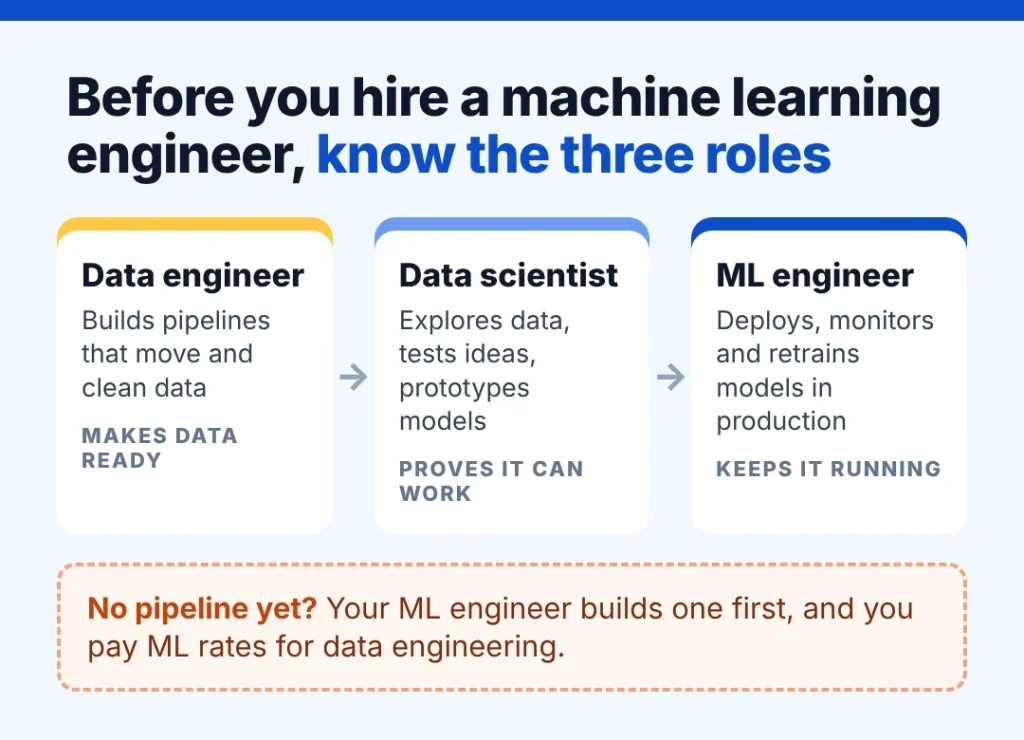
The title gets used loosely, so it is worth separating it from the roles it is confused with.
A data engineer builds pipelines that move and clean data. They make data available and reliable.
A data scientist explores data, tests hypotheses and builds prototype models, often in notebooks.
A machine learning engineer turns models into production systems: training pipelines, deployment, monitoring, retraining, and the engineering that keeps a model working once real users depend on it.
The confusion matters because many first ML hires are really data engineering jobs in disguise. If no pipeline exists, the ML engineer builds one, and you have paid ML rates for it.
The Sequence
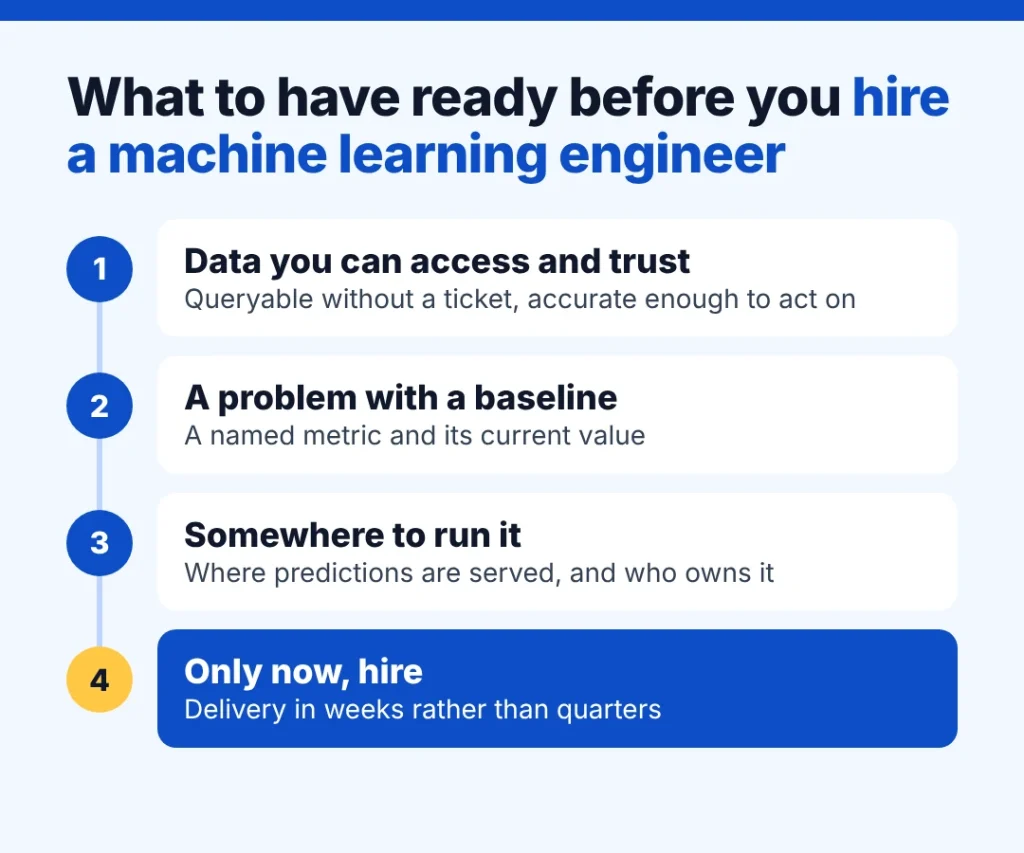
One. Data you can access and trust
Before anyone models anything, answer three questions. Where does the data live? Can someone query it without a ticket and a week’s wait? Is it accurate enough that a decision based on it would hold up?
If any answer is no, the first hire is a data engineer or an analyst, not an ML engineer. Modelling on unreliable data produces confident wrong answers, which is worse than no model at all.
Two. A problem with a measurable baseline
Machine learning is a way to improve a number. If you cannot name the number and its current value, there is nothing to improve.
- Weak framing: use AI to improve customer experience.
- Workable framing: reduce the share of support tickets routed to the wrong team, currently measured weekly.
The second one has a baseline, a metric and a way to know if the model helped. Write it down before the job description, because it shapes which skills you actually need.
Three. Somewhere to run it
A model in a notebook does nothing. Decide where predictions will be served, how they reach the product or the team using them, and who owns it when it breaks.
This is also where existing engineering capacity matters. If your platform team is stretched, the ML engineer inherits deployment work on top of modelling. Our guide to hiring a DevOps engineer covers when that infrastructure role is needed first.
Four. Only now, hire
With data, a measurable problem and a path to production in place, the brief writes itself and the hire can start delivering in weeks rather than quarters.
What to Screen For
| Signal | What it tells you |
|---|---|
| They ask about your data before your model | They have shipped before and know where projects fail |
| They describe a model they retired | They monitor in production rather than ship and forget |
| They propose a simple baseline first | They will not overbuild. Most wins come from simple models done well. |
| They talk about evaluation, not only accuracy | They understand that the metric that matters is a business one |
Tooling now overlaps heavily with general engineering. Stack Overflow’s Developer Survey shows Python, cloud platforms and containerisation among the most widely used technologies across professional developers, which is why strong general engineering habits matter as much as model knowledge.
When Not to Hire One Yet
- No reliable data pipeline. Hire a data engineer first.
- No defined metric. Spend a week defining the problem. A hire will not do it for you.
- An off-the-shelf API solves it. Classification, summarisation and extraction are often solved by existing model APIs. Build only when the API cannot meet your accuracy, cost or privacy needs.
For broader technical hiring, our analysis of outsourced web development costs covers the project-versus-ownership question that applies here too.
What It Costs to Hire
At Pavago, placement is 3% of first-year salary. Searching, messaging and interviews are free. Terms on the pricing page.
Pavago places through the offshore ML engineer role.
The wider engineering talent pool covers data engineers and analysts for the earlier steps.
You can search profiles in the client portal once the sequence above is in place.
Press Advantage built an in-house technical team rather than contracting each piece, and the Press Advantage case study covers how it was assembled.
What the First 90 Days Should Look Like
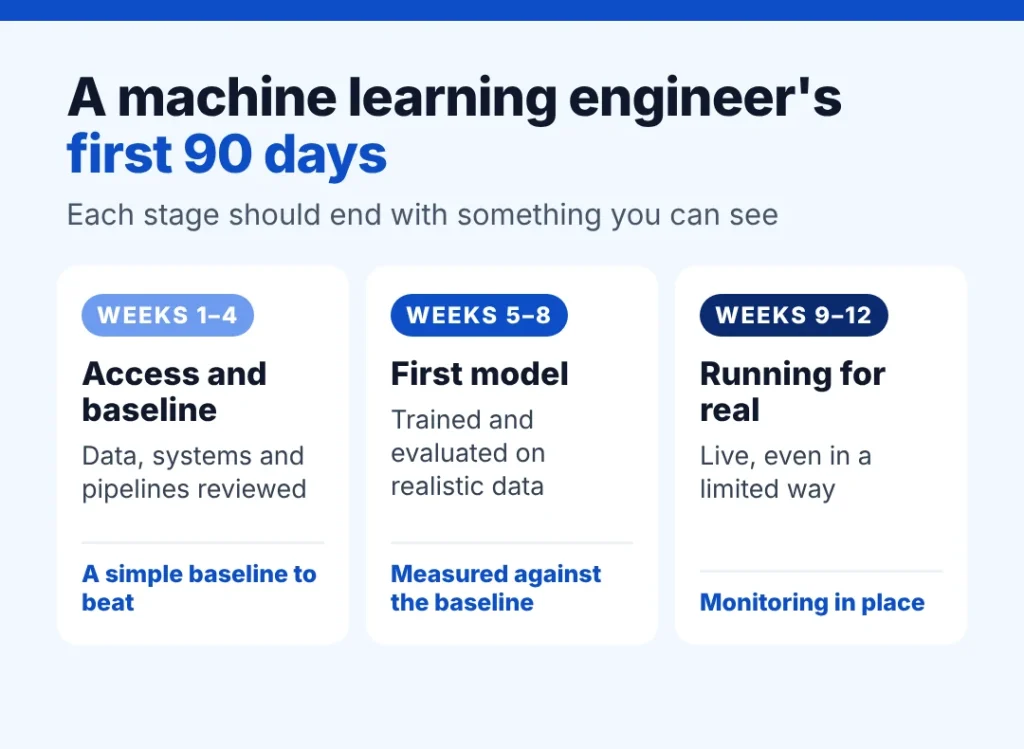
A well-prepared ML hire should be delivering something measurable within a quarter. If the first three months pass with no working baseline, the preparation was not done.
Weeks one to four. Access to data and systems, review of existing pipelines, and a simple baseline model or rule-based approach to beat.
Weeks five to eight. A first model trained, evaluated against the baseline, and tested on realistic data.
Weeks nine to twelve. The model running somewhere real, even in a limited way, with monitoring in place so you know when it degrades.
Each stage should end with something you can see, not a progress update.
Interview Questions That Reveal Real Experience
Tell me about a model that worked in testing and failed in production. Everyone experienced has one. The answer shows whether they understand data drift and monitoring.
How would you know if a model you shipped had stopped working? Strong answers describe specific monitoring, not just accuracy checks at launch.
What would you try before building a model for this problem? Good engineers often start with a simple rule or an existing API.
Walk me through how you would get our data ready. This tests whether they will do the unglamorous work the project depends on.
Build, Buy or Hire
Not every machine learning problem needs an ML engineer. Many common tasks, such as classifying text, extracting information from documents or summarising content, can be solved with existing model APIs at lower cost and much faster. Building your own model makes sense when the API cannot meet your accuracy, cost, speed or data privacy requirements, or when the model itself is a competitive advantage. Hiring makes sense when you will keep building and maintaining models over time, not for a single project.
More on how hiring works is on the Pavago homepage.
Where ML Projects Usually Fail
Most machine learning projects that disappoint do not fail because the model was badly built. They fail earlier or later than that.
Before modelling: the data turns out to be incomplete, inconsistent or inaccessible, and months go into fixing it.
At definition: the success measure was vague, so nobody can say whether the model helped.
After launch: the model is deployed with no monitoring, quietly degrades as real-world data changes, and nobody notices until the results are visibly wrong.
The sequence in this guide is designed to remove the first two before you hire, and to make the third part of the role from the start.
Hiring ML Engineers Remotely
Machine learning work is well suited to remote hiring. Data, models and monitoring all live in cloud platforms and repositories. The practical considerations are data access controls, since the engineer will work with sensitive company data, and enough timezone overlap to respond when a production model behaves unexpectedly. Both are arrangements to settle up front rather than reasons to limit the search to local candidates.
Where to find ML engineers offshore
| Region | Strengths | Best for |
|---|---|---|
| Pakistan and India | Large talent pool, strong Python and TensorFlow experience, used to working with U.S. and European teams | Cost-effective hires with production experience |
| Eastern Europe (Poland, Ukraine, Romania) | Algorithm design, computer vision and fintech ML | Complex projects, and overlap with European hours |
| Latin America (Brazil, Argentina, Colombia) | Strong communication and close time zone overlap with the U.S. | U.S. teams that need real-time collaboration |
Wherever you hire, check the technical basics: Python, a major framework such as PyTorch, TensorFlow or scikit-learn, MLOps tooling like Docker and CI/CD pipelines, and one cloud ML platform (AWS SageMaker, Google Cloud or Azure ML). Industry experience shortens onboarding, and in regulated fields like healthcare or finance it’s close to essential.
Protecting your data and IP
- Put intellectual property ownership and confidentiality in the contract before any data is shared.
- If you handle regulated data (health, financial, or personal data under GDPR), confirm the hire understands the rules that apply.
- Start with limited access to sensitive datasets and widen it as trust builds.
- Keep all work inside your own cloud accounts and repositories, with access you control.
What to Look For in an ML Portfolio
Notebooks and competition results show modelling skill but say little about production work. Look for evidence of systems that ran for real users: pipelines, deployment, monitoring and retraining. A candidate who can explain why a model was retired or replaced has usually done the full job, not just the part that happens in a notebook.
Frequently Asked Questions
What does a machine learning engineer do?
Turns models into production systems: training pipelines, deployment, monitoring and retraining. It differs from a data scientist, who explores and prototypes, and a data engineer, who builds the pipelines that supply data.
When should a company hire a machine learning engineer?
When reliable data access exists, the problem has a measurable baseline, and there is a path to run a model in production. Without those, the first hire should usually be a data engineer or analyst.
Data scientist or machine learning engineer: which first?
If the question is still whether a model can help, a data scientist. If a prototype exists and needs to run reliably in production, an ML engineer.
Do I need a custom model or an existing AI API?
Try the API first. Build a custom model when the API cannot meet your accuracy, cost, latency or data privacy requirements.
Can machine learning engineers work remotely?
Yes. The work happens in cloud platforms, repositories and monitoring tools. Data access controls and timezone overlap for incidents matter more than location.
How do I protect my IP and data when hiring an ML engineer offshore?
Use a contract that assigns IP ownership to you and includes confidentiality terms, limit access to sensitive data until trust is built, keep work inside your own cloud accounts and repositories, and make sure the hire understands any compliance rules that apply, such as GDPR or HIPAA.
Get the sequence right, then hire
Search the pool free. Messaging and interviews are free. 3% of first-year salary on placement, 60-day replacement.