

What a Mobile App Developer Actually Does
The title covers three distinct skill sets that do not fully overlap, which is the root of most mis-hires.
Native iOS. Swift, Xcode, Apple’s frameworks, and review process. Builds only for Apple platforms.
Native Android. Kotlin, Android Studio, Google Play’s requirements. Builds only for Android.
Cross-platform. React Native or Flutter. One codebase producing both apps. Trades some native capability and performance for roughly halving the build and maintenance surface.
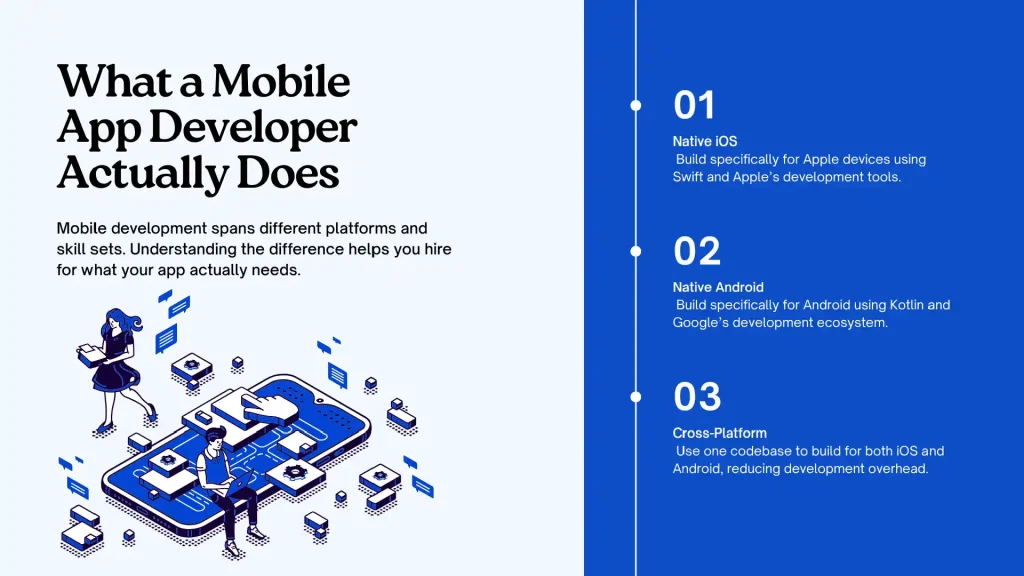
A native iOS developer cannot ship your Android app. That sounds obvious written down and is routinely discovered after the hire, when the founder assumed mobile developer meant both.
The Four Decisions, In Order
One. Which platforms do you actually need, and when
Not both by default. Look at where your users are, not at market share globally. A B2B tool sold to US enterprises skews iOS. A consumer product in Nigeria, Kenya, or India skews Android heavily. Shipping both from day one doubles build cost and maintenance for a second audience you may not have.
Most SMBs should ship one platform, learn from it, and add the second once the product has stopped changing weekly. Building both while the product is still moving means every change is made twice.
Two. Does the app need anything the device does natively
This decides cross-platform versus native, and it is a capability question rather than a preference.
| What the app needs | Cross-platform works | Native usually required |
|---|---|---|
| Forms, lists, content, accounts, payments | Yes | No |
| Camera, basic location, notifications | Yes | No |
| Heavy graphics, real-time rendering, games | No | Yes |
| Bluetooth peripherals, background location, hardware sensors | Sometimes, with native modules | Often yes |
| Platform-specific features at launch day | No | Yes |
For most SMB products, the answer is that cross-platform is sufficient, and the decision matters because it halves both the initial build and every subsequent change. Discovering the answer after hiring a native specialist means paying twice for the second platform.
Three. Who owns the store accounts.
The Apple Developer account and Google Play Console account should be registered to your company, with you as account holder, before a developer touches anything.
This is the single most common recoverable disaster in app projects. A developer registers the app under their own account for convenience during the build. The relationship ends. The app is now published under someone else’s developer account, and transferring it requires their cooperation. Sometimes that cooperation is forthcoming. Sometimes it is not, and the only route is rebuilding and republishing under a new listing, which loses reviews, ranking, and existing installs.
Register both accounts yourself. Add the developer as a team member with the permissions they need. This takes an afternoon and removes a category of risk entirely.
Four. What happens after launch
Apps decay faster than websites, because the platforms move underneath them. Operating system releases arrive annually and deprecate APIs. Store requirements change. A build handed over and left alone typically starts showing problems within a year and can be rejected from the stores for failing updated requirements.
Dependency drift compounds this. According to GitHub’s Octoverse report, modern applications are overwhelmingly assembled from open source packages rather than written from scratch, so an app is only as current as the libraries beneath it.
Decide before hiring whether maintenance is the same person, a retainer, or nobody. If the answer is nobody, that is a decision rather than an oversight, and it should be made knowingly.
Only Now Does Hiring Start
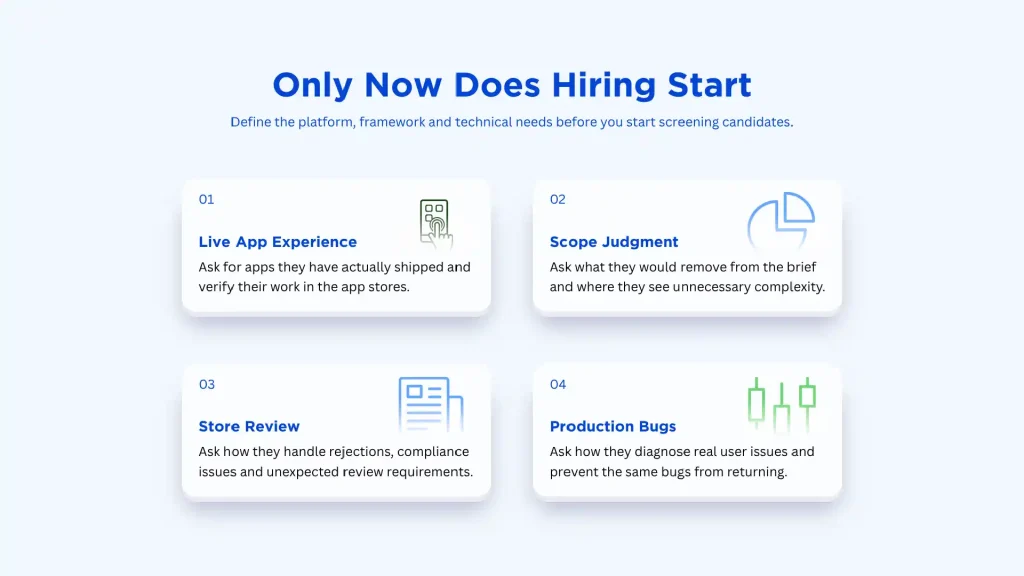
With those four settled, the brief writes itself. You know the platform, the framework, whether native capability is required, and what the ongoing commitment is. The hire is being fitted to the product rather than the reverse.
- Ask for a shipped app in the stores, not a portfolio screenshot. Download it. A live listing under their name is verifiable in a way that a mockup is not.
- Ask what they would cut from your scope. A developer who accepts every requirement without pushing back has not thought about it. The useful answer names two things that add disproportionate cost.
- Ask how they handle store review rejections. Everyone gets rejected. What matters is whether they treat it as routine or as a crisis.
- Ask about their last production bug. How it surfaced, how they diagnosed it without access to the user’s device, what they changed.
On Pavago, you search mobile developers yourself in the engineering talent category, with the offshore front-end developer role covering React Native work specifically.
Search, messaging and interviews are free, and placement is 3% of first-year salary. Terms on the pricing page.
The client portal lets you search the pool and open profiles once the four decisions are made.
The Three Ways This Goes Wrong
Hiring before deciding the platform. The developer’s skill set becomes the architecture. If you hire iOS first and later need Android, you are starting a second build rather than extending the first.
Letting the developer own the store accounts. Covered above, and worth repeating because the cost of getting it wrong is losing the listing entirely.
Treating launch as the finish line. It is the point at which maintenance starts. An app with no maintenance owner degrades on a schedule set by Apple and Google rather than by you.
For the same ownership question applied to web work, our guide to the cost of outsourcing web development covers what arrives after launch. And for the threshold logic on when a technical function justifies a hire, our guide to hiring DevOps engineers covers it.
Press Advantage built an in-house technical team rather than contracting each piece separately; the Press Advantage case study covers the structure.
Frequently Asked Questions
Should I build for iOS or Android first?
Whichever your users are on, which is a question about your specific audience rather than global market share. B2B products sold to US buyers skew iOS. Consumer products in Nigeria, Kenya, India, and much of South Asia skew heavily Android. Ship one, learn, then add the second once the product has stopped changing weekly.
Is React Native good enough, or do I need native?
For forms, content, accounts, payments, camera, and notifications, cross-platform is sufficient and halves your build and maintenance surface. Native is usually required for heavy graphics, real-time rendering, deep hardware integration, or platform-specific features at launch.
Who should own the Apple and Google developer accounts?
You, registered to your company, before any development starts. Add the developer as a team member. Apps published under a developer’s personal account require their cooperation to transfer, and without it the only route is republishing as a new listing and losing reviews, ranking, and installs.
How much maintenance does a mobile app need?
More than a website. Operating system releases arrive annually and deprecate APIs, store requirements change, and dependencies drift. An app left untouched typically shows problems within a year and can eventually be rejected for failing updated store requirements.
Can one developer build both iOS and Android?
With cross-platform frameworks, yes, from a single codebase. A native iOS developer cannot ship your Android app and vice versa. Confirm which of the three skill sets you are hiring before the offer, not after.
Settle the four decisions, then search
Free to search. Messaging and interviews are free. 3% of first-year salary on placement, 60-day replacement.
Pavago is a hiring marketplace, so you run the search yourself. Tell it the role, your budget and the region, and you get matched with vetted remote candidates in under a minute. Watch their video intros, message the ones you like, and hire straight from the app. No sales call, no job post, no recruiter in the middle. It’s the most frictionless way we know to hire.