

What Outsourcing Data Analytics Covers
Data engineering. Getting data from your tools into one place, cleaned and joined.
Reporting. Dashboards and recurring metrics.
Analysis. Answering specific questions: why churn rose, which channel brings the best customers, where margin is leaking.
Advanced analytics. Forecasting, segmentation, experimentation.
Most outsourcing briefs ask for the second item. Most of the value sits in the third, and it depends on the first.
Why the Dashboard Approach Fails
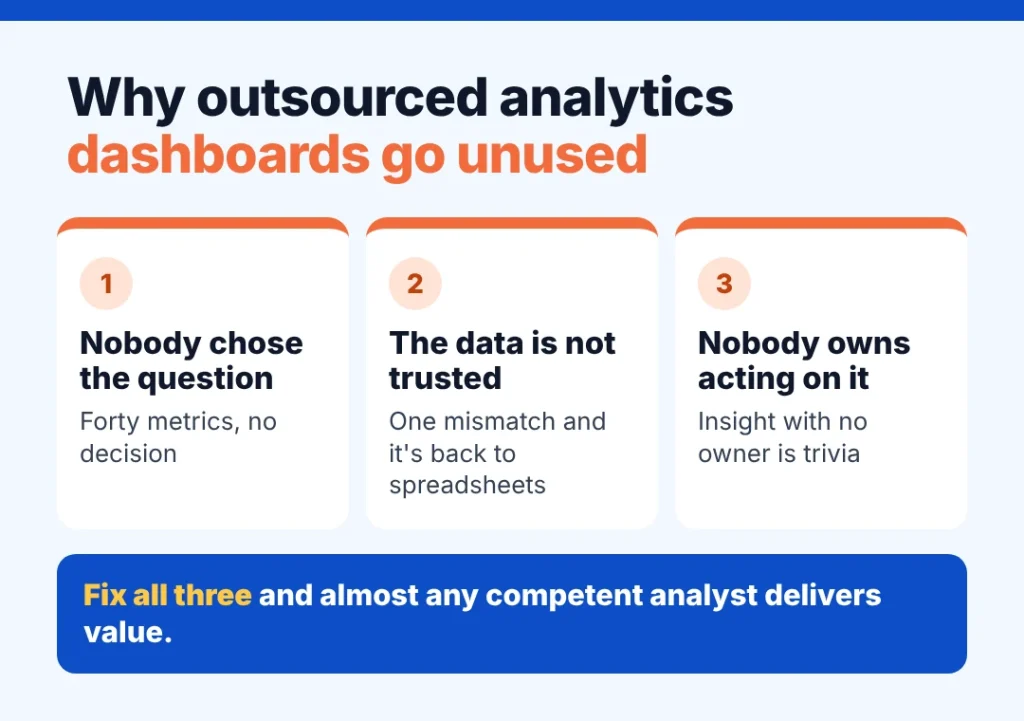
Three reasons, and none of them is the analyst’s fault.
- Nobody chose the question. A dashboard with forty metrics answers no question in particular, so nobody knows what to do differently after looking at it.
- The data is not trusted. The first time a number on the dashboard disagrees with someone’s spreadsheet, people stop believing it and go back to the spreadsheet.
- Nobody owns acting on it. Insight with no owner is trivia.
Fix those three and almost any competent analyst produces value. Leave them and even an excellent one produces reports that sit unopened.
What to Buy Instead
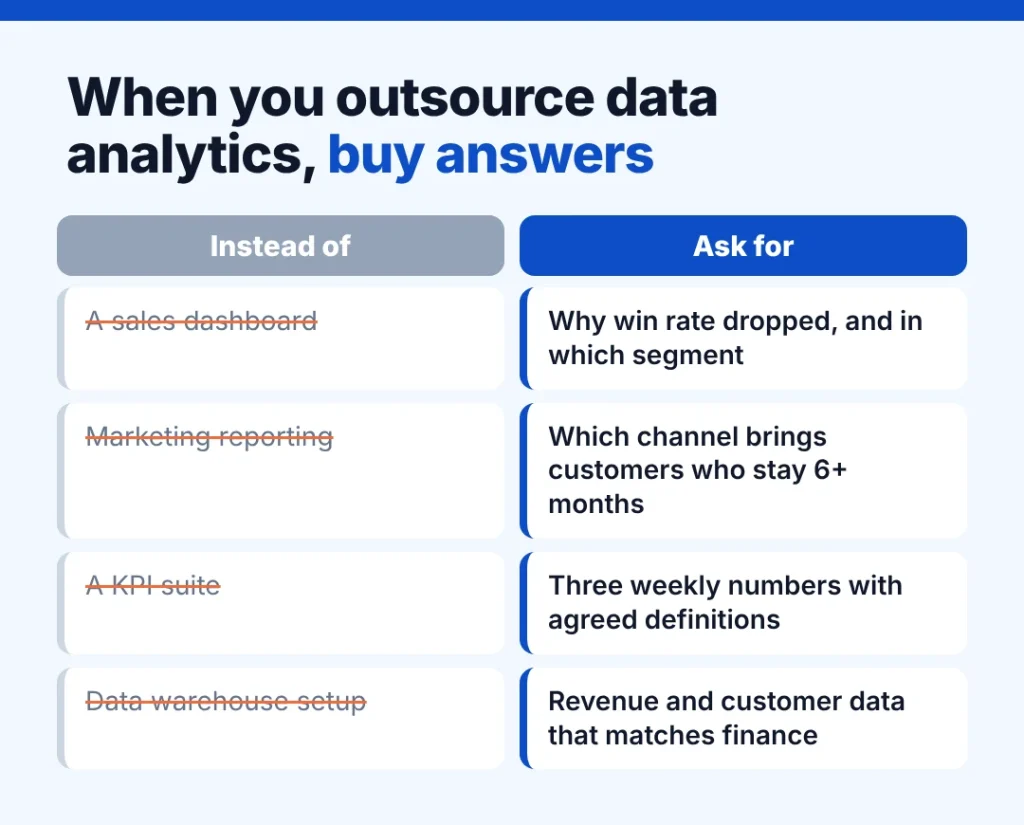
| Instead of asking for | Ask for |
|---|---|
| A sales dashboard | Why did win rate drop last quarter, and in which segment? |
| Marketing reporting | Which channel brings customers who stay longer than six months? |
| A KPI suite | Three numbers the leadership team will review weekly, with agreed definitions |
| Data warehouse setup | Reliable revenue and customer data that matches finance |
Each right-hand item has an end point and an owner. You know when it is done and who will use it. Dashboards can follow once the questions are clear.
The Data Handover Risk
Outsourcing analytics means giving someone outside the business access to customer, revenue and operational data. The UK National Cyber Security Centre’s supply chain guidance notes that most organisations have limited visibility into their suppliers’ security practices, and third-party access is a recurring route into otherwise well-protected systems.
Practical steps: give read-only access, limit it to the datasets needed, avoid exporting raw customer data to personal machines, and remove access when the engagement ends. An analyst working inside your own tools under your own permissions is a smaller risk than data shipped out to a vendor.
Agency, Freelancer or Dedicated Analyst
| Analytics agency | Freelance analyst | Dedicated analyst | |
|---|---|---|---|
| Best for | Data infrastructure projects, one-off audits | Defined questions with an end point | Ongoing questions as the business changes |
| Business context | Built per project | Built per project | Accumulates over time |
| Data access risk | Data often leaves your systems | Varies | Works inside your tools |
| Fails when | Questions keep changing | Work is continuous | Nobody sets the questions |
An agency is genuinely the right call for a warehouse build or a data audit with a clear scope. For ongoing questions, a dedicated analyst who learns the business is usually better value, because context is most of the job. Our guide to hiring a machine learning engineer covers the step that comes after analytics is working.
At Pavago, searching, messaging and interviews are free, and placement is 3% of first-year salary. Terms on the pricing page.
Pavago places analysts through the data analyst role.
You can open profiles in the client portal before writing a brief.
FLLR Consulting built operational capability in-house rather than buying reporting as a service, and the FLLR Consulting case study covers the structure.
For consolidating back-office functions generally, our guide to back office outsourcing covers the accounting.
How to Choose the First Questions
Good analytics starts with questions that lead to decisions. A useful test is to ask what you would do differently depending on the answer. If the answer would not change anything, the question is interesting rather than useful.
Revenue questions. Which customers, products or channels drive most profit, not just most revenue?
Retention questions. Who leaves, when, and what did they do beforehand?
Efficiency questions. Where does time or money leak in operations?
Pick two or three and answer them properly before building anything broad. Early, visible answers build trust in the data and the analyst.
Getting Data Ready
Most analytics time goes into data, not analysis. Before any outsourced analyst starts, confirm three things: which systems hold the data you need, whether someone can grant access without weeks of delay, and whether the core numbers, such as revenue and customer counts, agree between systems. If revenue in your dashboard does not match revenue in finance, fixing that comes first. Every answer built on unreconciled numbers will be questioned, and rightly so. Much of that clean-up is careful record-keeping, which is why many teams offshore their data entry before hiring an analyst.
Agree Metric Definitions in Writing
Arguments about numbers are usually arguments about definitions. What counts as an active customer? Is revenue booked, billed or collected? When does a lead become an opportunity? Write the definition of each core metric down, agree it with the people who will use it, and keep it somewhere everyone can see. An analyst working from agreed definitions produces reports people trust; one working without them produces reports people dispute.
What Good Analytics Delivery Looks Like
A short written answer first. The finding in plain language, then the supporting charts.
A recommendation. What the analyst thinks should happen as a result.
The method and its limits. How the answer was reached, and what it cannot tell you.
A follow-up check. A date to look again and see whether the action worked.
Signs Your Analytics Spend Is Not Working
Dashboards nobody opens. Usage data on your BI tool will tell you quickly.
Meetings still run on spreadsheets. People do not trust the official numbers.
No decisions traced to analysis. If nobody can name a change made because of a finding, the work is not connected to the business.
More on how hiring works is on the Pavago homepage.
Tools Do Not Fix Analytics
A common response to analytics frustration is buying a new tool. A better dashboard platform rarely solves the problem, because the problem is usually unclear questions, untrusted data or nobody acting on the answers. Tools matter once those three are in place. Before they are, a new tool simply displays the same disputed numbers in a nicer layout. When the questions themselves are unclear, a business system analyst can turn business needs into clear requirements first.
If you are choosing where to spend first, spend on data quality and a person who can answer business questions. The tool can follow.
Building the Function Over Time
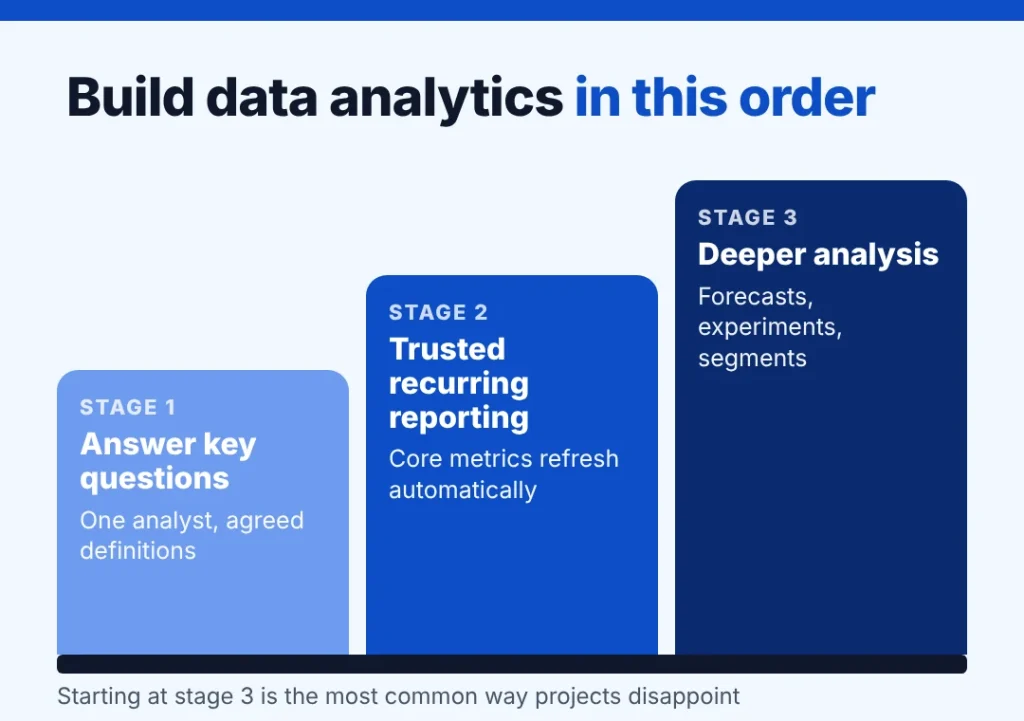
Stage one: answers to a few key questions. One analyst, agreed definitions, and a handful of decisions made on evidence.
Stage two: reliable recurring reporting. The core metrics are refreshed automatically and trusted by leadership.
Stage three: deeper analysis. Forecasting, experiments, and segmentation, once the foundations hold.
Trying to start at stage three is one of the most common reasons outsourced analytics projects disappoint. The foundations are not glamorous, but everything else rests on them.
Who Should Own Analytics Internally
Even when the analysis is outsourced, someone inside the business must own it. That person sets the questions, signs off metric definitions, makes sure findings reach the people who can act on them, and checks later whether the action worked. Without an internal owner, analysts drift toward producing whatever is easiest to measure rather than what matters most.
In small companies this is often the founder or head of operations. What matters is that one named person is accountable for turning findings into decisions, and that the analyst knows who that is from the first day.
Frequently Asked Questions
Is it worth outsourcing data analytics?
Yes, if you buy answers to specific business questions rather than a set of dashboards. Outsourcing fails most often when the brief is reporting with no agreed question and no owner for acting on the results.
What should I ask an analytics provider to deliver?
Answers to named questions with an owner, plus agreed definitions for a small number of core metrics. Dashboards can follow once the questions are clear.
Is it safe to give an outsourced analyst access to my data?
It can be, with read-only access limited to needed datasets, no raw exports to personal devices, and access removed at the end. Working inside your own tools is safer than sending data to a vendor.
Agency or dedicated analyst?
An agency for infrastructure builds and audits with a defined scope. A dedicated analyst for ongoing questions, where business context is most of the value.
Can data analytics be done remotely?
Yes. Warehouses, BI tools and notebooks are cloud-based. Access controls and overlap for stakeholder reviews matter more than location.
Buy answers, not dashboards
Search the pool free. Messaging and interviews are free. 3% of first-year salary on placement, 60-day replacement.