

The Two Readers
Understanding this sequence is the whole thing, because the two readers are looking for completely different signals.
Reader one is a filter. Either software or a person doing a thirty-second keyword scan. It looks for exact terms: QuickBooks, Xero, Shopify, Zendesk, HubSpot, Asana, Calendly. It does not interpret. Experience with accounting software does not match a search for QuickBooks.
Reader two is a human. They have shortlisted ten resumes and are deciding which three to message. They are not checking whether you can use a calendar. They are checking whether handing you something means it comes back finished.
Writing for only one fails differently. Filter-optimised and nothing else reads as a keyword list and gets no reply. Beautifully written with no exact tool names never reaches a human at all.
The Sequence
One. Name the tools exactly, near the top
Not in a skills section at the bottom. In a short line directly under your name and title, where both readers see it first.
Use the exact product names. QuickBooks Online, not accounting software. Zendesk, not helpdesk experience. Shopify, not ecommerce platforms. The filter matches strings, and a synonym is a miss.
List what you actually know: two to five tools. Twenty reads as shallow familiarity and the trial task will expose it.
Two. Lead with a one-line positioning statement
One sentence naming what you do and for whom. Bookkeeping support for ecommerce businesses, mostly QuickBooks and Shopify. Insurance agency admin covering renewals and certificates.
This replaces the objective statement, which says nothing, and the summary paragraph, which nobody reads. A specific one-liner tells the human reader in three seconds whether to keep going.
Three. Write experience as outcomes, not duties
The single largest difference between resumes that get replies and resumes that do not.
| Written as a duty | Written as an outcome |
|---|---|
| Responsible for managing email inbox | Cleared a 400-email backlog and kept inbox under 20 daily |
| Handled scheduling for executives | Managed calendars for three executives across two timezones |
| Performed data entry tasks | Processed 300 invoices monthly in QuickBooks with reconciliation to bank |
| Assisted with social media | Scheduled and published 20 posts monthly across three platforms |
Numbers do the work here, and they do not need to be impressive. They need to be specific. A specific modest number reads as true. A vague large claim reads as invented.
Four. State hours and availability explicitly
One line, naming the hours you will be online in the client’s timezone rather than yours. Not flexible, which reads as unconsidered. Specific hours read as someone who has already thought about how the arrangement works.
Five. Link one piece of real work
One link, at the bottom. Not a portfolio site with six half-finished samples. One documented piece of work showing what the situation was, what you decided and what changed. Our guide to building a virtual assistant portfolio covers how to structure it so it demonstrates judgement rather than completion.
What to Cut
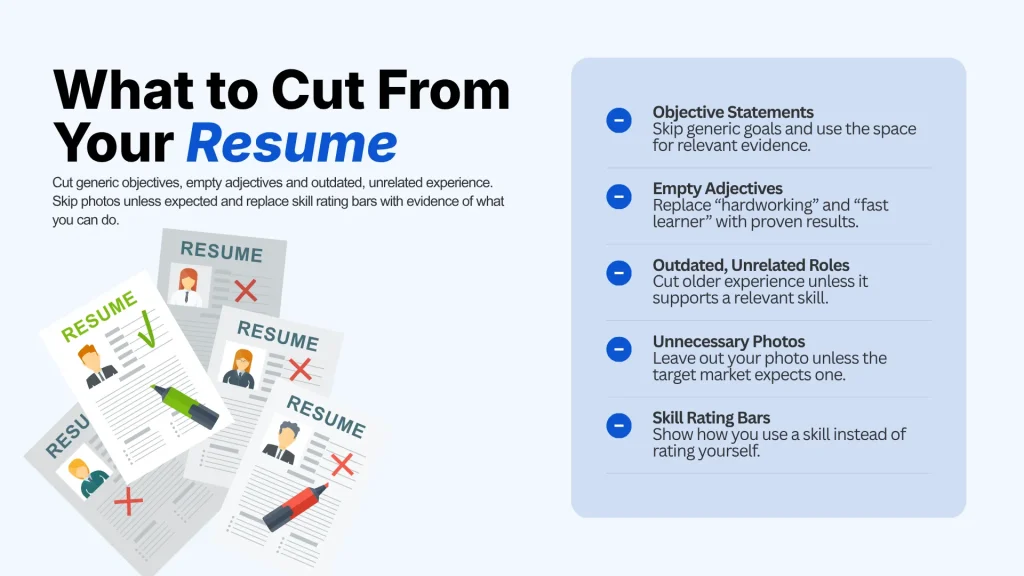
Resumes in this category are weakened more by what is included than by what is missing.
- The objective statement. Everyone says the same thing. It occupies the most valuable space on the page.
- Adjectives about yourself. Hardworking, detail-oriented, fast learner. Unverifiable, universal, and the human reader skips them automatically.
- Unrelated work history older than about five years. Unless it maps to a skill you are claiming, it is using space that evidence should occupy.
- A photo, unless the market expects one. In the US market, it is generally not expected and occasionally screened against.
- Skill rating bars. Self-assigned percentages mean nothing. Nobody has ever been hired because they rated themselves 90% at Excel.
Format, Which Matters More Than People Think
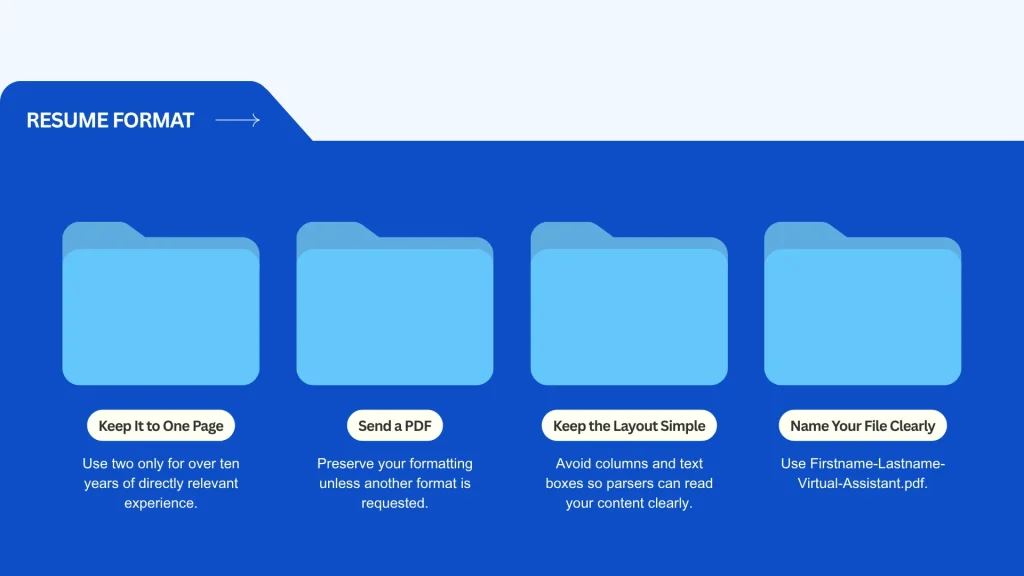
One page unless you have more than ten years of directly relevant experience. Two pages of a thin career reads as padding.
Send a PDF unless asked otherwise. Formatting survives. Word documents reflow unpredictably on someone else’s machine.
Plain structure, no columns or text boxes. Parsers read multi-column layouts badly and can scramble your content before anyone sees it.
Name the file properly. Firstname-Lastname-Virtual-Assistant.pdf. Not resume-final-2.pdf, which tells the reader something before they open it.
Where the Resume Matters Less
On platforms where companies search rather than post listings, the resume does different work. A client browsing profiles has already decided to look at you, so the document confirms a decision rather than winning attention. That is a lower bar and a different kind of writing.
At Pavago, the platform is free for candidates permanently and you keep your full rate, with nothing deducted from what the company pays you. Companies search the pool and message directly. You can see how profiles are presented on the candidate portal.
Browse open roles to see which tools appear repeatedly in current listings, which is the cheapest way to know what to put at the top of your resume. Or start with your region: South Asia, Southeast Asia, Africa, LATAM, Europe. You can also search by country: Serbia, Albania, Armenia, Georgia or Turkey.
If you are earlier in the process and do not yet have tools to name, our guide to virtual assistant skills covers which ones employers can actually verify.
Frequently Asked Questions
What should a virtual assistant resume include?
Exact tool names near the top, a one-line positioning statement naming your niche, experience written as outcomes with specific numbers, your available hours in the client’s timezone, and one link to a documented piece of real work.
How long should a virtual assistant resume be?
One page, unless you have more than ten years of directly relevant experience. Two pages of a thin career reads as padding and reduces the chance the second page is read at all.
Should I list every tool I have used?
No. Two to five you genuinely know well. A list of twenty signals shallow familiarity, and the paid test task that follows will expose it.
Do I need a photo on my resume?
In the US market, generally not. It is not expected and is occasionally screened against. Follow the convention of the market you are applying into rather than your own.
Why am I getting no replies to my applications?
Most commonly because the resume lacks exact tool names, so it never passes the first scan, or because it describes duties rather than outcomes, so the human reader sees nothing distinguishing it from the other nine.
Let companies find you instead
Free for candidates, always. You keep your full rate, with nothing deducted from what the company pays you. Companies search the pool and message you directly.