

What a Client Is Actually Checking
Put yourself on the hiring side. Someone is choosing between six virtual assistants, all of whom list the same tools and describe themselves in the same words.
They are not trying to establish whether you can build a spreadsheet. They are trying to establish what you do when the instruction is vague, when two tasks conflict, when the data is wrong, or when you do not know the answer. Those moments are most of the job and none of them appear in a gallery of finished work.
A finished file proves the task was completed. It says nothing about how. Did you ask a clarifying question or guess? Did you notice the source data was inconsistent? Did you flag the thing that looked wrong, or enter it and move on? That is what the client needs to know, and it is entirely absent from a screenshot.
The Structure That Works
Three entries, each one a decision rather than a deliverable. Each follows the same shape.
| Section | What goes in it | Why it matters |
|---|---|---|
| The situation | Two sentences. What existed, what was wrong with it. | Shows you can describe a problem without exaggerating it |
| What was unclear | The thing the brief did not specify | This is the section clients read most carefully |
| What you decided | The call you made and the reason | Judgement, which is the thing being assessed |
| What happened | The result, honestly, including anything that did not work | Honesty here reads as experience |
Three of these carry more weight than twenty screenshots, because each one demonstrates something a client cannot verify any other way. The fourth section matters more than people expect. An entry admitting that the first approach failed and describing the second reads as someone who has actually done work, not someone presenting a highlight reel.
Building It Without a Client
This is the part people get stuck on, and the answer is that portfolio work does not require a paying client. It requires a real problem. The same applies to your CV: a virtual assistant resume should point to this work rather than list tools.
- A small business you know. A shop, a clinic, a relative’s company. Offer to fix one specific thing. Not ongoing help, one thing with a defined end.
- A community organisation. Churches, schools, local associations and sports clubs almost universally have administrative problems nobody has time to solve.
- Your own operation. If you have run anything, including a household budget or an informal side business, the systems you built for it are real work.
- A rebuild of something public. Take a badly organised public document or a business with a chaotic booking process and rebuild it as an exercise. Label it clearly as an exercise. Nobody objects to that if you are honest.
Stop at three. People who keep producing free work are usually avoiding the part where they apply. Three entries is enough, and the fourth adds nothing a client will read. Once you have them, getting clients as a virtual assistant comes down to where and how you apply.
What to Leave Out
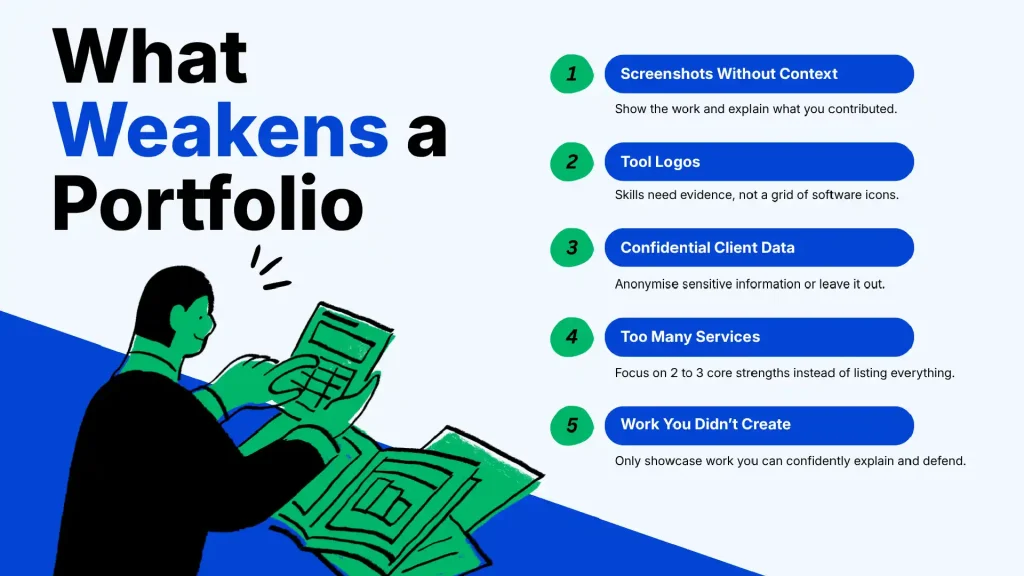
Portfolios are weakened more by inclusion than omission.
- Screenshots with no explanation. A calendar view proves you have seen a calendar.
- Tool logos. A grid of software icons is a claim, not evidence. Certifications are the verifiable version of the same statement.
- Anything confidential. Real client data in a portfolio is disqualifying, and clients notice. Anonymise properly or leave it out.
- A long list of services. Twenty offerings reads as someone who has done none of them seriously. Two or three reads as a specialist.
- Design work you did not do. Canva templates presented as your own graphic design collapses at the first question.
Where It Lives
The format matters less than people assume, and simpler is generally better.
A single well-organised document is sufficient, and often better than a website. A client opening a link wants to read three entries in two minutes. A portfolio site with navigation, an about page and a contact form adds friction to something that should take one click.
What matters is that it opens without a login, reads on a phone, and does not require downloading anything. A shared document with view access covers all three.
If you are earlier in the process and do not yet have the skills to demonstrate, our guide to virtual assistant skills covers which ones clients can actually verify.
What Changes by Market
Virtual assistants in the Philippines, Nigeria, Kenya and Indonesia are competing for the same remote roles as candidates everywhere else, and there are two things worth addressing directly in a portfolio rather than leaving to assumption.
State your working hours in the client’s timezone, not yours. Do not write that you are flexible. Write which hours you will be online in Eastern or Pacific time. Vagueness here reads as a problem to be discovered later.
Say how you get paid. Payment method is a live concern for clients hiring across borders and most candidates leave it unaddressed. Naming Payoneer, Wise or whatever you use removes a question the client would otherwise have to raise.
Neither of these belongs in the portfolio entries themselves. One line at the top of the document covers both and removes two objections before they form.
What Happens After the Portfolio
A portfolio gets you read. It does not get you hired on its own, and the stage after it is where most candidates are actually filtered.
Serious clients follow with a short paid task. What separates people there is not tool knowledge, which is assumed by that point. It is asking one clarifying question before starting, delivering on the stated deadline rather than early or late, and flagging what you were unsure about instead of silently guessing. Those are the same behaviours the portfolio entries were demonstrating, which is why the structure works.
On platforms where clients search rather than post listings, the portfolio does different work. It is being read by someone who already found you, so it needs to confirm a decision rather than win attention. You can see how that works on the candidate portal.
Pavago is a self-serve hiring marketplace. Companies search vetted remote talent themselves, get matched in under a minute, watch video intros and hire directly, with no recruiter in the middle. It is free for candidates permanently and you keep your full rate, with nothing deducted from what the company pays you. Browse open roles to see what is being hired for, or your region: South Asia, Southeast Asia, Africa, LATAM, Europe.
If you have not yet decided which direction to specialise in, our guide to becoming a virtual assistant covers choosing a niche before building anything.
Frequently Asked Questions
How do I make a virtual assistant portfolio with no experience?
Solve one real problem for a small business, a community organisation or your own operation, then document the decision rather than the deliverable. Three documented decisions is enough. A paying client is not required, only a real problem.
What should a virtual assistant portfolio include?
Three entries, each covering the situation, what was unclear in the brief, what you decided and why, and what happened. Clients are assessing judgement under uncertainty, which finished files do not show.
Do I need a website for my virtual assistant portfolio?
No. A single shared document that opens without a login and reads on a phone is usually better, because a client wants to read three entries in two minutes rather than navigate a site.
How many samples should a virtual assistant portfolio have?
Three. More does not improve the outcome and usually indicates time being spent on portfolio-building instead of applying.
Should I include unpaid or practice work in my portfolio?
Yes, provided you label it honestly. Nobody objects to an exercise clearly described as one. Presenting practice work as a client engagement collapses at the first question about the client.
Get vetted once. Let companies find you.
Free for candidates, always. You keep your full rate, with nothing deducted from what the company pays you. Companies search the pool and message you directly.