

What You Are Paying a Bookkeeper to Do
Before comparing prices, pin down the job. Bookkeeping usually covers recording transactions, categorising income and expenses, reconciling bank and credit card accounts, managing invoices and bills, and producing monthly records an accountant can work from. Some bookkeepers also run payroll, handle accounts receivable and payable, or track inventory.
It does not usually include tax filing, formal financial statements that others rely on, or advice on business structure. Those belong to an accountant. Mixing the two up is one of the main reasons quotes look inconsistent: one provider is quoting for recording only, another for recording plus advisory work.
The Four Ways to Pay for Bookkeeping
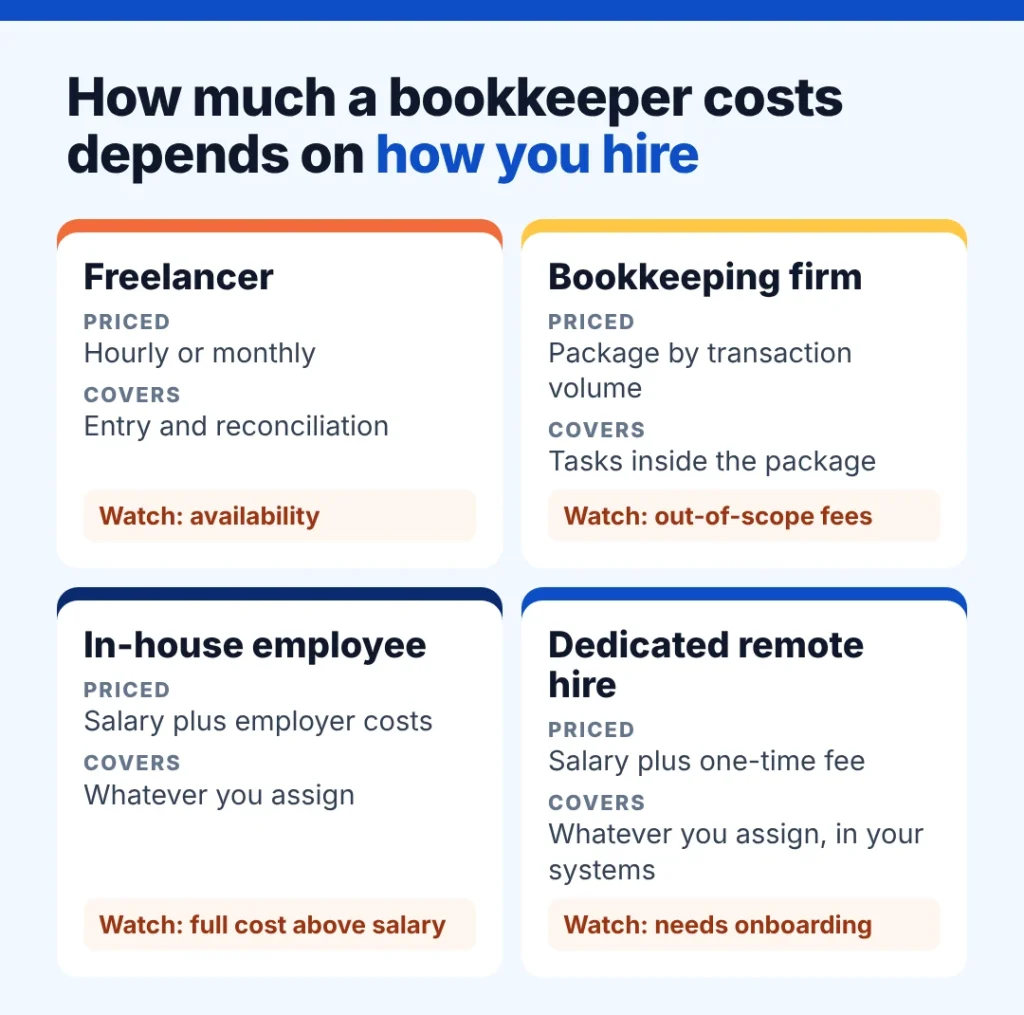
| Option | How it is priced | What it usually covers | Watch for |
|---|---|---|---|
| Freelance bookkeeper | Hourly or monthly | Transaction entry, reconciliation | Availability and continuity |
| Bookkeeping firm | Monthly package by transaction volume | Defined tasks within the package | Out-of-scope charges |
| In-house employee | Salary plus employer costs | Whatever you assign | Full cost is well above salary |
| Dedicated remote hire | Salary plus one-time placement fee | Whatever you assign, inside your systems | Needs clear onboarding |
Freelance bookkeeper
A freelancer typically bills by the hour or agrees a monthly rate for a set amount of work. It suits small businesses with simple books. The risks are continuity, because a freelancer serving many clients may not be available when you need them, and inconsistency if the person changes.
Bookkeeping firm
Firms sell monthly packages, usually tiered by the number of transactions or accounts. You get structure and a managed service, and someone else handles staffing. The trade-off is scope: anything outside the package costs extra, and the person doing your books may change from month to month.
In-house employee
An employee does whatever you assign and knows your business closely. The cost is higher than the salary suggests. The U.S. Bureau of Labor Statistics reports that benefits make up roughly 30 percent of total employer compensation costs, before you add equipment, software and management time.
Dedicated remote hire
A remote bookkeeper working only for you, inside your accounting software, costs a salary plus a one-time placement fee. You get continuity and full scope without the employer cost of a domestic hire. It needs proper onboarding and clear access controls.
What Drives the Price Up or Down
- Transaction volume. More transactions means more entry and reconciliation work.
- Number of accounts. Each bank account, card and payment processor adds reconciliation time.
- Payroll. Running payroll or recording payroll entries adds recurring work.
- Industry complexity. Ecommerce with multiple sales channels, inventory, or several entities is more involved than a simple service business.
- State of the books. Clean, current books cost less to maintain than books that need constant correction.
- Reporting frequency. Weekly reporting costs more than monthly.
What the Quote Usually Leaves Out
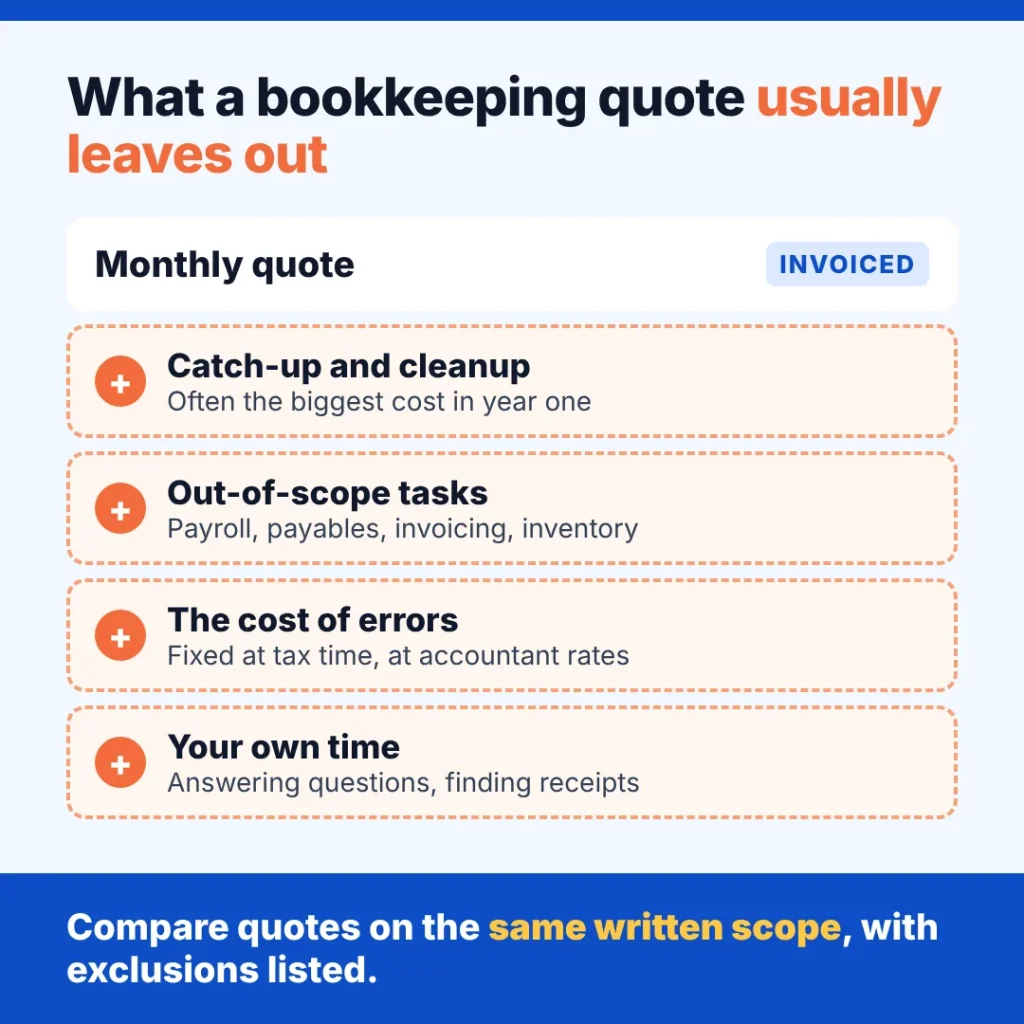
Catch-up and cleanup
If your books are months behind or were set up badly, the first engagement is reconstruction, not maintenance. It is usually billed separately and is often the single largest cost in year one.
If your accounting file itself is badly structured, our guide to QuickBooks consultants covers fixing it before any bookkeeper starts.
Scope creep
Packages are priced by volume and a fixed task list. Payroll entries, accounts payable, invoicing, inventory and extra reports are frequently extras that arrive on a later invoice.
The cost of errors
Miscategorised transactions and unreconciled accounts surface at tax time, when an accountant charges to fix them. A cheap bookkeeper who creates rework is not cheap.
Your own time
Answering questions, finding receipts and approving entries take hours that never appear on an invoice, and they rise sharply with an inexperienced bookkeeper.
How to Compare Quotes Fairly
Write a one-page scope first. Transactions per month, accounts, payroll, invoicing, inventory, reporting frequency.
Send the same scope to everyone. Quotes only compare when they price the same work.
Ask what is excluded. In writing, not just what is included.
Price catch-up separately. If your books are behind, get that as its own number.
Ask who does the work. A named person or whoever is available that month.
When Each Option Makes Sense
- Freelancer: low volume, simple books, an owner who can answer questions quickly.
- Firm: you want a defined package and someone else managing the bookkeeper.
- In-house: high volume and a need for someone on site.
- Dedicated remote hire: ongoing volume where continuity and context matter more than location.
Three Businesses, Three Different Answers
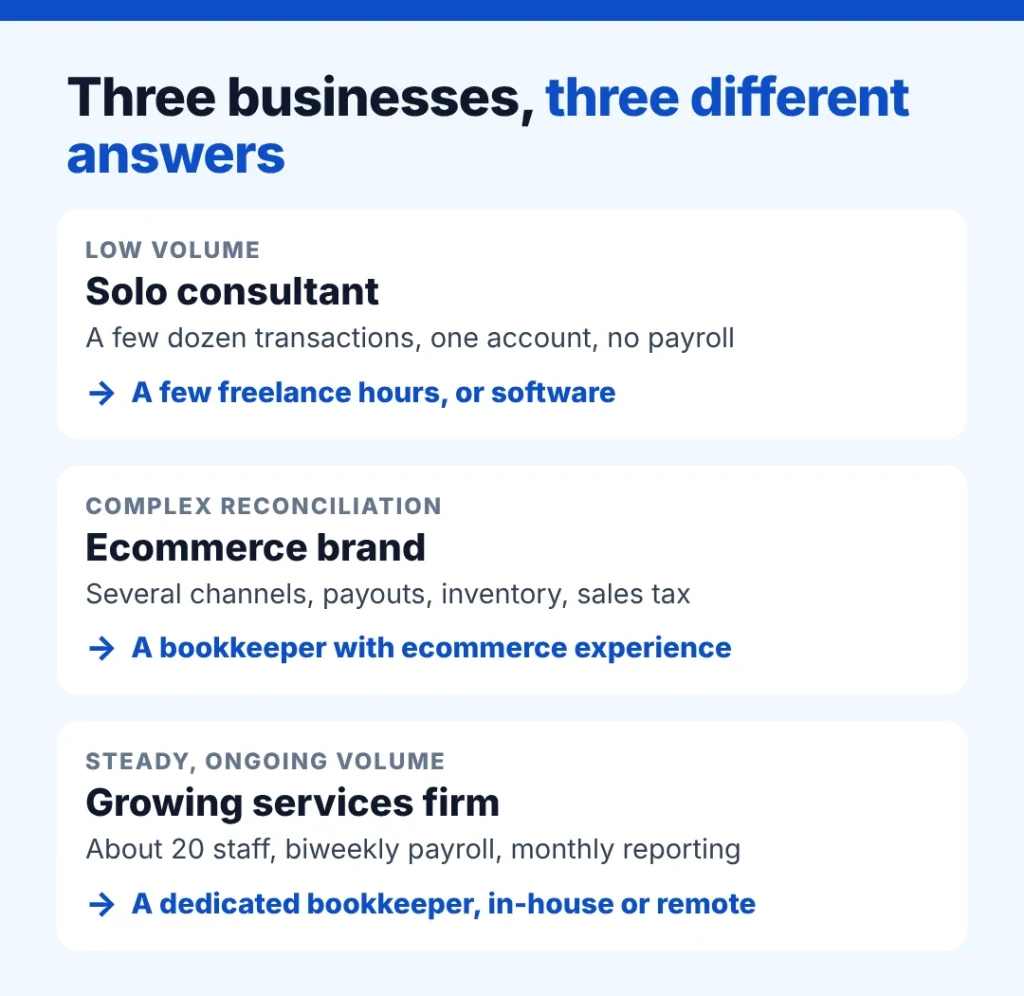
The right option depends on the shape of the business more than on any price list. Three common situations show how differently the same question resolves.
A solo consultant. A few dozen transactions a month, one bank account, no payroll, no inventory. A freelancer working a few hours a month, or careful use of accounting software with an accountant at year end, is usually enough. A firm package or a dedicated hire would be paying for capacity that sits unused.
An ecommerce brand. Sales across several channels, payment processor payouts that never match order totals, inventory, refunds and sales tax in multiple places. This needs someone who understands ecommerce reconciliation specifically. A generic package often struggles here, and catch-up work becomes a recurring cost rather than a one-off. A specialist freelancer or a dedicated bookkeeper with ecommerce experience usually fits better.
A growing services firm. Twenty or so staff, payroll every two weeks, client invoicing, supplier bills and monthly reporting to the owners. The volume is steady and ongoing. A dedicated bookkeeper, in-house or remote, usually costs less than a firm package once out-of-scope extras are counted, and builds knowledge of the business that a rotating firm does not.
In each case the cheapest-looking option was not the cheapest in practice. The cost that decided it was the work outside the quote.
Questions to Ask a Bookkeeper Before Hiring
Which accounting software do you work in daily? Fluency in your system matters more than general experience.
How do you handle a transaction you are not sure how to categorise? The right answer is that they flag it and ask, not that they guess.
What does your month-end look like? A clear routine is a sign of reliable books.
Have you worked with businesses like ours? Industry experience shortens the learning curve.
Signs You Are Paying Too Much, or Too Little
Too much: you pay a firm package but still do half the work yourself, or you are billed for tasks a simple rule in your software could automate.
Too little: your accountant spends hours fixing records at year end, reconciliations are always behind, or you cannot get a reliable monthly profit figure.
The second problem is usually more expensive than the first, because it is paid for later at accountant rates.
The Remote Option in Practice
Pavago’s placement fee is 3% of first-year salary, with search, messaging and interviews free. Details are on the pricing page.
You can browse bookkeepers in the client portal and compare profiles before deciding.
The offshore bookkeeper role covers dedicated bookkeeping support.
Related roles sit in the wider finance talent pool.
Our comparison of bookkeeping roles explains where recording ends and accounting begins.
QBM Services set up dedicated support rather than buying a package, and the QBM Services case study covers the arrangement.
More on how it works is on the Pavago homepage.
Frequently Asked Questions
How much does a bookkeeper cost for a small business?
It depends on how you hire and how much work there is. Freelancers bill hourly or monthly, firms sell packages by transaction volume, and employees cost salary plus employer costs.
Is it cheaper to hire a bookkeeper or use software?
Software alone is cheaper for very simple books. As volume and complexity grow, the time and error cost of doing it yourself usually exceeds a bookkeeper’s cost.
What is usually not included in a bookkeeping package?
Common extras include catch-up work, payroll entries, accounts payable, invoicing, inventory and additional reports. Ask for exclusions in writing.
Do bookkeepers charge for catch-up work?
Usually yes, separately from the ongoing fee, because reconstructing past records is a larger job.
Can a bookkeeper work remotely?
Yes. Cloud accounting software makes location irrelevant. Access permissions and responsiveness matter more.
Compare bookkeepers on full cost
Search the pool free. Messaging and interviews are free. 3% of first-year salary on placement, 60-day replacement.