

Why Applying More Does Not Work
The instinct when applications go unanswered is to send more. It is the wrong correction, and it makes the underlying problem harder to see.
Every application in the pile says the same things. Organised. Detail-oriented. Fast learner. Familiar with the tools. Those claims are identical across forty candidates, so they carry no information, and the client skips past them to whatever is left.
The question the client is silently asking is narrower than any of that. They are not wondering whether you can use a calendar. They are wondering what happens when they hand you something and are not there to supervise. Do you ask before guessing? Do you flag what looks wrong? Do you finish without being chased?
Nothing in a standard application speaks to that, which is why the standard application does not work regardless of how many times it is sent.
What Actually Answers It
Three things, and only one of them takes real time.
One piece of work you can point at
Not a portfolio. One thing. Something you did for a real business, a community organisation, or your own operation, with the decision documented rather than just the output.
The documentation is the part that matters, because it demonstrates judgement rather than completion. What the situation was, what the brief did not specify, what you decided and why, what happened. Our guide to building a virtual assistant portfolio covers the structure in detail.
A specific answer to what you do
Not a service list. A sentence naming an industry and a tool. Bookkeeping support for ecommerce businesses, mostly QuickBooks and Shopify. Insurance agency admin, renewals and certificates.
A general virtual assistant competes with everyone and gets found by nobody. The narrowing costs nothing and changes who reads you.
Evidence that survives a filter
Certifications are not proof of skill. They are proof you exist to whatever is screening applications before a human reads them. QuickBooks ProAdvisor, Xero Advisor, HubSpot Academy, and Google’s training are free and take days.
The Order to Work In
| Stage | What you do | What you have after |
|---|---|---|
| Week 1 | Two free certifications in one coherent direction | Something verifiable on your profile |
| Week 2 | Pick an industry, learn its primary tool | A specific answer to what you do |
| Weeks 3 to 4 | One real piece of work, documented as a decision | Proof you work unsupervised |
| Week 5 onward | Fifteen considered applications, not two hundred | Replies, and a signal about what is landing |
Fifteen applications with evidence attached beat two hundred without. Volume applying is how people conclude the market is saturated, when what they are actually testing is whether the same unanswerable application works on a larger sample.
Where Clients Are, and How Each Route Behaves
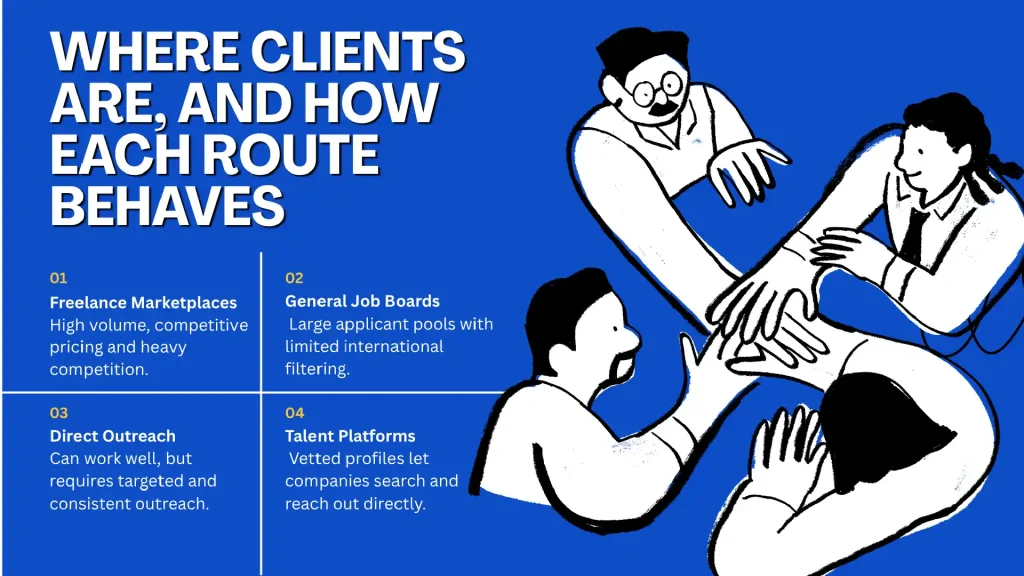
The routes are not equivalent and it is worth knowing how each one treats you before committing time to it.
- Freelance marketplaces. High volume, and pricing is set by competitive bidding, which pushes rates down and takes a cut of what remains. Reasonable for building an initial track record. A poor place to stay, because the mechanism works against you.
- General job boards. Rarely filter for international candidates, so you compete against everyone and are often screened out on location before anyone reads the application.
- Direct outreach. Works slowly, and only with the specificity above. Generic outreach to small businesses performs about as well as generic applications.
- Talent platforms. You are vetted once and then visible to companies hiring specifically for remote roles. The dynamic inverts, because clients search and message rather than you applying into silence.
On a platform where clients search, the profile does different work. It is read by someone who already decided to look at you, so it needs to confirm a decision rather than win attention. That is a lower bar and a different kind of writing.
Pavago is a self-serve hiring marketplace. Companies search vetted remote talent themselves, get matched in under a minute, watch video intros and hire directly, with no recruiter in the middle. It is free for candidates permanently, and you keep your full rate, with nothing deducted from what the company pays you. You can see how the search side works from the candidate portal.
What to Be Careful Of
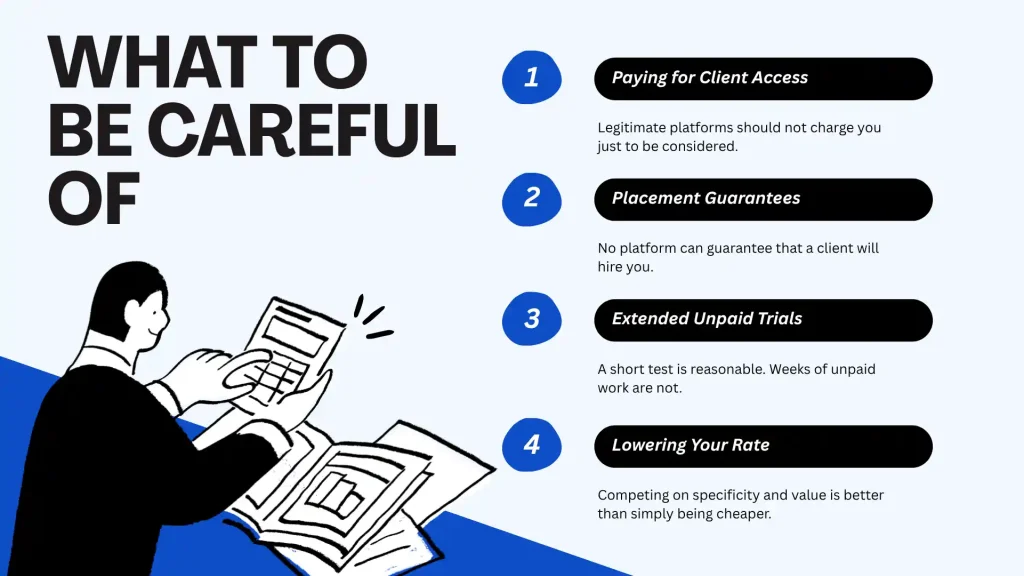
Four patterns worth recognising before spending money or time on them.
- Anyone charging you for access to clients. Legitimate platforms do not charge candidates. An arrangement where you pay to be considered deserves scepticism.
- Placement guarantees. No training provider or agency controls who clients hire. The guarantee is either meaningless or conditioned into meaninglessness.
- Unpaid trials beyond a few hours. A short test task is normal and reasonable. A two-week unpaid project is not a trial.
- Advice to lower your rate to win the first client. It sets an anchor you then negotiate up from, which is harder than starting correctly. Specificity wins work more reliably than price does.
If you are earlier than this and still deciding on a direction, our guide to becoming a virtual assistant covers choosing a niche before building anything.
What Happens at the Test Task
Most serious clients follow with a short paid task, and that stage filters more people than the application did.
What separates candidates there is not tool knowledge, which is assumed by then. It is asking one clarifying question before starting rather than guessing. Delivering on the stated deadline rather than early or late. Flagging the two things you were unsure about instead of silently deciding. Formatting the output so it can be used immediately.
Those are the same behaviours the documented work sample was demonstrating, which is why the sequence holds together. The sample shows the client what the test task will confirm.
For the skills clients can actually verify before any of this, our guide to virtual assistant skills covers the distinction between claimable and checkable.
You can browse open roles to see what is being hired for, or your region: South Asia, the Philippines and Southeast Asia, Africa, LATAM, Europe. You can also search by country: Chile, Peru, Ecuador or Uruguay.
Frequently Asked Questions
How do I get my first virtual assistant client?
Complete two free certifications, choose an industry rather than offering general admin, produce one documented piece of real work, then apply selectively with it attached. The constraint is almost never how many applications you send. It is that nothing in them shows how you work unsupervised.
How many applications should I send?
Fifteen considered ones beat two hundred generic ones. Volume applying tests whether the same unanswerable application works on a larger sample, and it does not.
Should I lower my rate to get the first client?
No. It sets an anchor you then have to negotiate up from, which is harder than starting at a defensible rate. Specificity about what you do wins work more reliably than price does.
Are freelance marketplaces worth using?
For building an initial track record, yes. As a place to stay, no. Pricing is set by competitive bidding, which pushes rates down, and the platform takes a share of what remains.
What do clients actually look for in a virtual assistant?
Evidence that you work well without supervision. Specifically: that you ask before guessing, flag what looks wrong, and finish without being chased. Adjectives do not demonstrate any of that. One documented piece of work does.
Let clients find you instead
Free for candidates, always. You keep your full rate, with nothing deducted from what the company pays you. Companies search the pool and message you directly.