
Start Here, Because Order Matters
Most people approach this backwards. They apply first, get no responses, conclude they need training, buy a course, and finish it with the same problem they started with: nothing an employer can verify.
The sequence below is ordered by return on time. Each step makes the next one work better, and skipping ahead is why the standard approach fails.
Step One. Two Free Certifications, This Week
Certifications are not proof of skill. They are proof you exist to an automated filter, and that is the barrier stopping most applications from reaching a human at all.
- QuickBooks ProAdvisor. Free. Opens bookkeeping-adjacent VA work, which pays above general admin.
- Xero Advisor. Free. Pairs with the above and covers the other half of the small-business accounting market.
- HubSpot Academy. Free. Covers CRM work, which appears in most sales-support and marketing-assistant listings.
- Google Workspace and Analytics. Free. Baseline expectations rather than differentiators, but their absence is noticed.
Pick two, not five. Two completed certifications in a coherent direction beat five scattered ones, because the scattered version reads as someone shopping for an identity rather than building toward a role.
Step Two. Choose a Niche Before You Choose a Service List
This is the step that separates people who get hired in two months from people still applying in year two.
A general virtual assistant competes with everyone. A virtual assistant for insurance agencies competes with a handful of people, charges more, and gets found rather than doing the finding. The narrowing costs you nothing and changes the economics entirely.
| Niche | What you would handle | What to learn first |
|---|---|---|
| Real estate and property management | Listings, tenant communication, scheduling showings, lease admin | AppFolio or Buildium basics |
| Ecommerce | Order issues, returns, product listings, supplier follow-up | Shopify admin, Gorgias or Zendesk |
| Insurance agencies | Policy renewals, certificates, claims intake paperwork | Agency management system terminology |
| Bookkeeping support | Reconciliation, invoicing, expense categorisation, AP and AR | QuickBooks or Xero, plus US GAAP basics |
| Legal support | Intake forms, calendaring, document preparation, billing entry | Clio or MyCase, and legal terminology |
| Healthcare admin | Scheduling, insurance verification, records, patient follow-up | HIPAA basics and practice management software |
Pick the one closest to work you have already done, not the one that sounds most lucrative. Prior exposure, even informal, is what makes your first application credible. Our guide to virtual assistant skills covers which skills within each niche employers can actually verify.
Step Three. Produce One Real Artefact
An employer scanning forty profiles cannot verify that you are organised. They can look at something you made.
Do the job once, deliberately, for someone real. A local business, a community organisation, a relative’s company. Reconcile three months of books. Build the scheduling system they have been running out of a notebook. Write and schedule a month of social content. Clean up their customer records.
You are not working free for exposure. You are manufacturing one concrete thing to point at, and you should stop at one. Two artefacts is not twice as persuasive, and people who keep producing free work are usually avoiding the part where they apply.
Keep the output, anonymise anything sensitive, and be able to describe in two sentences what the problem was and what you did.
Step Four. Write an Application That Survives Thirty Seconds
Remote work is written work, so your application is a work sample whether you meant it to be or not. Most are rejected on the message, not the credentials.
- Lead with the niche and the tool. Not ‘I am a hardworking and detail-oriented VA.’ Something closer to ‘I do bookkeeping support for ecommerce businesses, mostly in QuickBooks and Shopify.’
- Reference something specific about them. One line proving you read the listing separates you from the volume applicants immediately.
- Name your overlap hours explicitly. Not ‘flexible.’ State which hours you will be online in their timezone.
- Link the artefact. One link. Not a portfolio site with six half-finished samples.
- Stop. Four short paragraphs. Length reads as uncertainty.
What to Skip
Paid VA courses. The certifications employers screen for are free. Paid programmes sell structure and confidence, which are real but not what gets you hired. Treat any placement guarantee as a warning rather than a feature.
Applying to hundreds of listings. Fifteen applications with an artefact attached outperform two hundred without. Volume applying is how people conclude remote work is a scam.
Unpaid trials beyond a few hours. A short test task is normal and reasonable. A two-week unpaid project is not a trial.
Claiming experience you do not have. It surfaces in the first call and turns a solvable gap into a trust problem.
Building a website before you have a client. Nobody hiring a VA is evaluating your web design. A clear profile and one artefact is enough.
A Realistic Timeline
| Weeks | What you are doing | What you have at the end |
|---|---|---|
| 1 | Two free certifications | Something verifiable on your profile |
| 2 | Choose a niche, learn its primary tool | A specific answer to what you do |
| 3–4 | Produce one artefact for a real business | Proof you can do the work |
| 5–8 | Apply selectively, refine based on responses | Interviews, and a sense of what is landing |
Two to three months is realistic. Anyone promising two weeks is selling something. Anyone still applying at month eight is usually missing the niche or the artefact rather than needing more training.
Where to Apply
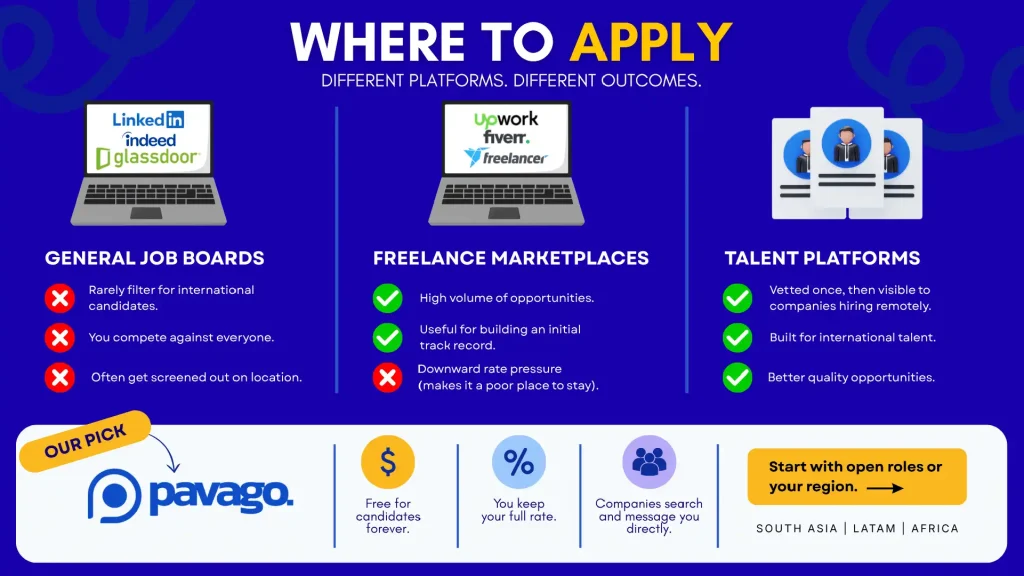
General job boards rarely filter for international candidates, so you compete against everyone and get screened out on location. Freelance marketplaces have volume and downward rate pressure, which makes them a reasonable place to build an initial track record and a poor place to stay. Talent platforms vet once and then make you visible to companies hiring specifically for remote roles.
At Pavago, the platform is free for candidates permanently, and you keep your full rate, with nothing deducted from what the company pays you. Companies search the pool and message directly, so you are not applying into silence. Start with open roles, or your region: South Asia, LATAM, Africa.
If you want to know what the work pays before committing to the path, our breakdown of virtual assistant earnings covers why published averages mislead. If you have no relevant background at all, our guide to landing a remote job without experience starts a step earlier.
Frequently Asked Questions
How do I become a virtual assistant with no experience?
Complete two free certifications, choose a niche rather than offering general admin, produce one real piece of work for an actual business, and apply selectively with that artefact attached. Most people searching this already have transferable experience and lack evidence rather than skills.
Do I need a course to become a virtual assistant?
No. The certifications employers screen for, including QuickBooks ProAdvisor, Xero and HubSpot Academy, are free. Paid courses provide structure, which has value, but they do not provide credentials employers check.
How long does it take to become a virtual assistant?
Two to three months from starting certifications to first interviews, if you follow the order. Longer if you apply before having anything verifiable, which is the most common reason people stall.
What niche should I choose as a virtual assistant?
The one closest to work you have already done. Real estate, ecommerce, insurance, bookkeeping support, legal and healthcare admin all pay above general administrative work because each carries workflows general experience does not cover.
Can I become a virtual assistant while working another job?
Yes, and most people do. The certification and artefact stages fit around existing work. The constraint arrives later, when a role requires overlap with US business hours, so decide early which hours you can genuinely commit to.
Get vetted once. Let companies find you.
Free for candidates, always. You keep your full rate. Companies search the pool and message you directly.