

What Outsourced Animation Covers
Projects move through stages, and quotes usually bundle them, which hides where the effort sits.
- Script. What is said and in what order.
- Storyboard. Rough frames showing what appears on screen at each moment.
- Style frames. A few finished stills to lock the visual look.
- Animation. Movement, timing, transitions. The expensive stage.
- Sound and final render. Voiceover, music, effects, export.
Where the Money Actually Goes
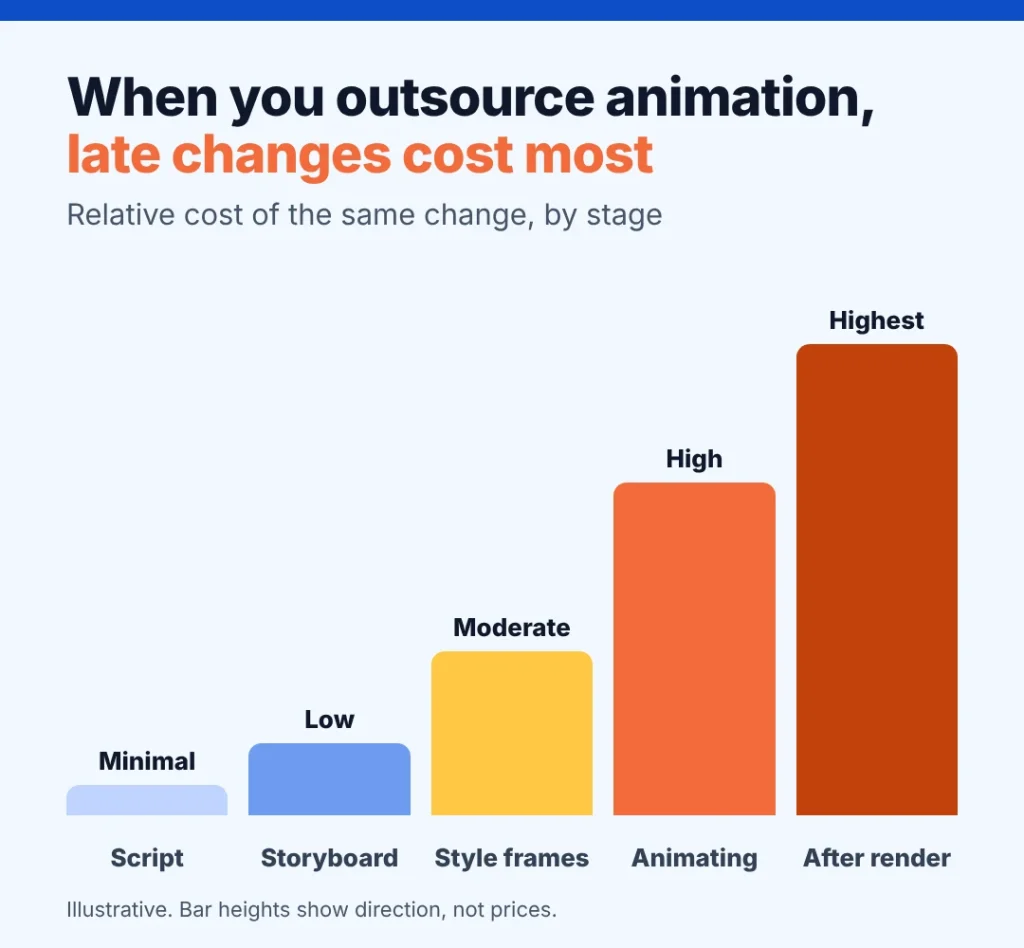
| Stage when a change is made | What changing it involves | Relative cost |
|---|---|---|
| Script | Editing words | Minimal |
| Storyboard | Redrawing a few frames | Low |
| Style frames | Reworking the look on a handful of stills | Moderate |
| Animation underway | Rebuilding scenes and timing | High |
| After final render | Reopening finished work, often several scenes | Highest |
Most quotes include a fixed number of revision rounds. What they rarely make clear is that a revision round at storyboard and a revision round after animation are priced as the same thing, while costing the studio very different amounts of work. Studios protect themselves by limiting rounds, and the overage is where projects go over budget.
Why Late Changes Happen
Not because anyone is careless. Because people often cannot judge a script or a storyboard until they see motion.
A storyboard looks fine on paper, then the animated version shows that a scene is too slow or a message lands in the wrong place. The fix is to get approvers looking properly at the cheap stages, with the people who will actually sign off present early, not just at the final review.
How to Keep the Cost Where It Was Quoted
Lock the script before anything is drawn. Every person with approval rights reads it and signs off. A late stakeholder is the most expensive person on any animation project.
Ask for an animatic. A rough timed version of the storyboard with temporary audio. It shows pacing problems before animation money is spent, and it is cheap.
Approve style frames as final. Once the look is locked, changing it means touching everything.
Define what a revision round includes. Get it in writing: what counts as a revision, and what counts as a change of scope.
Studio, Freelancer, or Dedicated Animator
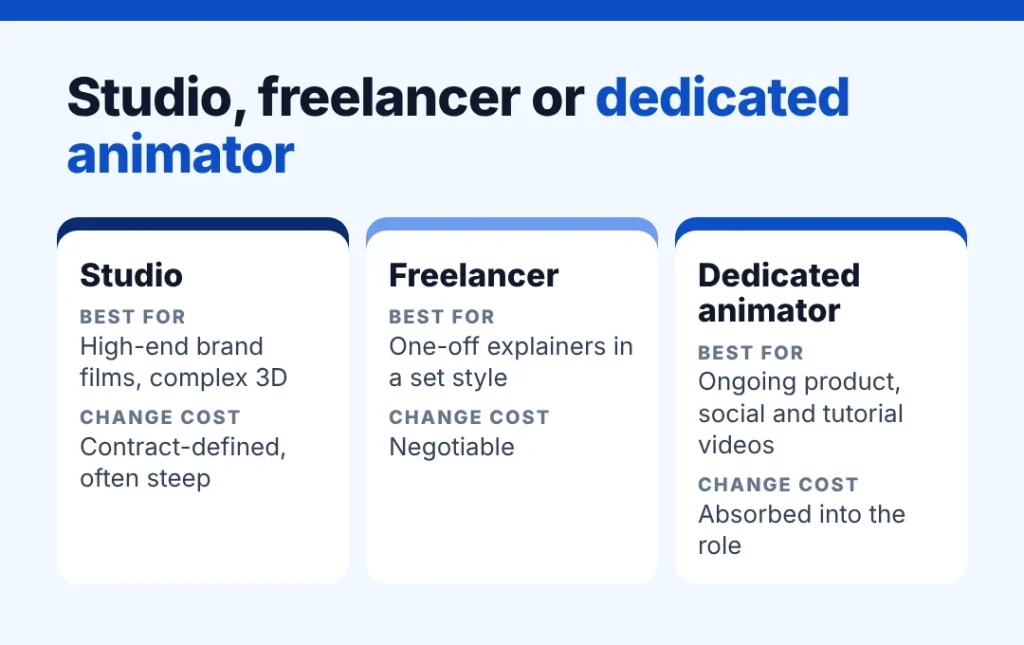
| Studio | Freelancer | Dedicated animator | |
|---|---|---|---|
| Best for | High-end brand films, complex 3D | One-off explainers in a defined style | Ongoing content: product videos, social, tutorials |
| Pricing | Per project | Per project or per second | Salary |
| Style consistency over time | High within a project | Varies between projects | High, it is the same person |
| Change cost | Contract-defined, often steep | Negotiable | Absorbed into the role |
For one hero video a year, a studio is the right buy. For a steady stream of short animations, per-project pricing repeats the briefing and style cost on every piece, and a dedicated animator who already knows the style is usually cheaper. Our guide to hiring a video editor covers the same set-up logic for live-action work.
Our guide to outsourcing graphic design covers static assets.
At Pavago, searching, messaging and interviews are free, and placement is 3% of first-year salary. Terms on the pricing page.
Pavago places animators through the offshore animation expert role.
It sits within the wider product and creative talent pool.
You can view animator portfolios in the client portal before choosing a model.
OneNine engaged creative talent directly rather than through a studio, and the OneNine case study covers how it was scoped.
Types of Animation and How They Affect Cost
| Type | Typical use | Effort |
|---|---|---|
| 2D motion graphics | Explainers, product overviews, social clips | Moderate |
| Character animation | Storytelling, brand mascots | High |
| 3D animation | Product renders, technical visuals | High |
| Whiteboard and kinetic text | Simple explainers, internal training | Lower |
| UI animation | App walkthroughs, product demos | Moderate |
The style you choose has more effect on cost than video length. Character animation and 3D require far more work per second than motion graphics or kinetic text. If budget is tight, a simpler style executed well usually communicates better than an ambitious style done cheaply. If you need 3D work regularly, hiring a 3D animation specialist from Pakistan full-time often costs less than paying per video.
What to Put in an Animation Brief
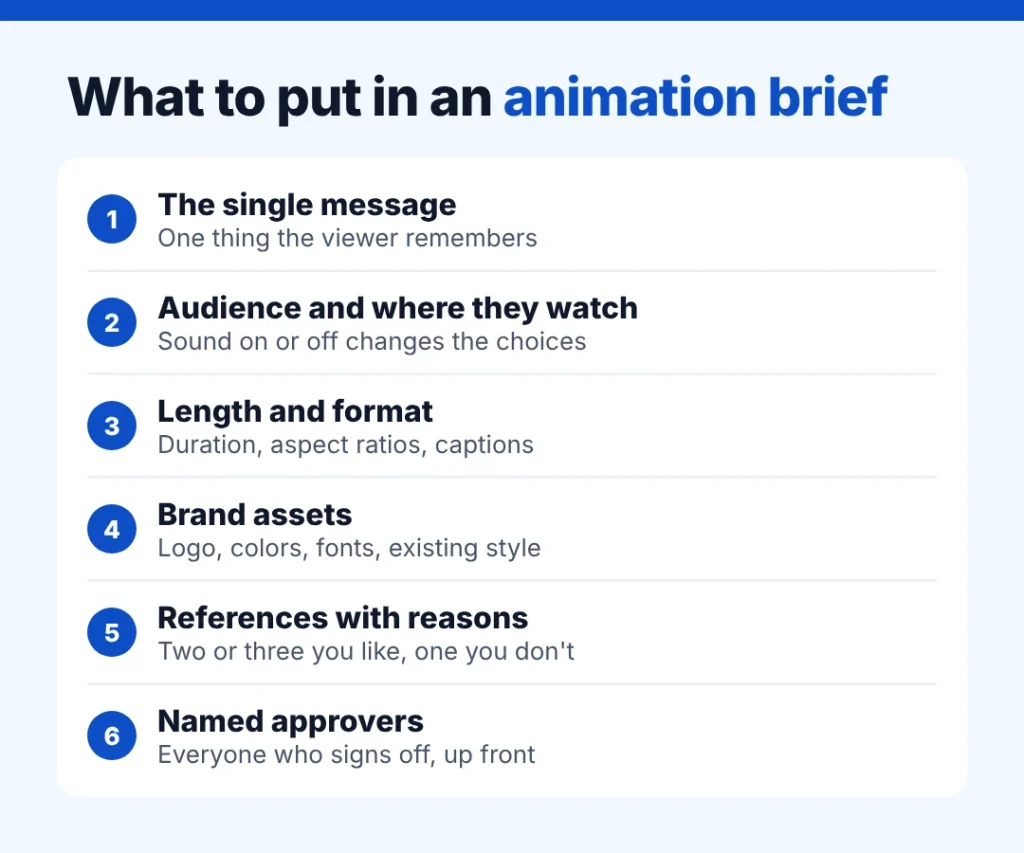
The single message. What one thing should the viewer remember? Videos that try to say five things say none of them clearly.
The audience and where they will watch. A social clip watched without sound needs different choices from a homepage explainer.
Length and format. Duration, aspect ratios, and whether captions are needed.
Brand assets. Logo files, colours, fonts and any existing visual style to match.
Reference videos with reasons. Two or three you like and why, plus one you do not.
Approvers. Everyone who must sign off, named up front.
How Many Revision Rounds to Agree
A common, workable structure is one round of feedback at script, one at storyboard, one at style frames, and one or two once animation is complete. Agree what counts as a revision versus a change in direction. A revision adjusts what was approved; a change in direction replaces it, and should be priced as new work.
Red Flags When Hiring an Animator
A reel with no explanation of their role. Animation is often team work. Ask exactly what they did on each piece.
No questions about your audience or message. An animator who starts with visuals is guessing at the purpose.
Unwillingness to share project files. You should be able to reuse and update what you paid for.
No storyboard stage. Skipping it moves every decision to the expensive stage.
Getting More From Every Animation
Animation is expensive to make and cheap to reuse. Ask for project files, character assets and scene elements as deliverables, not just the final video. With them, a single explainer can become short social clips, product page loops, presentation graphics and updated versions when your product changes. Over a year, reusable assets often cut the cost of new animation substantially, especially with a dedicated animator who already knows the style.
More on how hiring works is on the Pavago homepage.
Where to Spend and Where to Save
Spend on the script. A clear script makes every later stage cheaper and the final video more effective. Weak scripts cannot be rescued by good animation.
Spend on voiceover and sound. Professional audio lifts perceived quality far more than extra visual detail.
Save on length. Shorter videos are cheaper and usually perform better. Cut anything that does not serve the single message.
Save on style complexity. Clean motion graphics done well often outperform ambitious character work done on a thin budget.
Running a Clean Internal Review
Most animation overruns trace back to how feedback is gathered, not to the animator. Nominate one person to collect and consolidate comments at each stage, so the animator receives a single, consistent set of notes rather than conflicting instructions from several people. Give each round a deadline, and make sure the people with final approval see the work at the script and storyboard stages, when changes are still cheap, rather than only at the end.
A simple rule helps: every comment should say what is wrong and why, not just what to change. Animators can solve a stated problem in several ways, often better than the change a reviewer had in mind.
Keep a record of approved decisions at each stage, so later reviewers can see what was already agreed and why.
Frequently Asked Questions
How much does it cost to outsource animation?
Studios and freelancers usually quote per project or per second of finished video, varying with style, complexity and length. The bigger variable is late changes, which can cost more than the original quote if decisions are left until animation has started.
Why do animation projects go over budget?
Mostly because changes are made after animation begins, when they are most expensive. Locking the script, approving an animatic and fixing style frames early keeps the cost close to the quote.
What is an animatic?
A rough, timed version of the storyboard with temporary audio. It shows pacing and flow cheaply, before any expensive animation work starts.
Should I use an animation studio or a freelancer?
A studio for high-end or complex one-off pieces. A freelancer for single explainers. A dedicated animator for a steady stream of content, where style consistency and briefing time matter most.
Can animation be outsourced to another country?
Yes, and it commonly is. The work is file-based and review happens over shared links. Timezone overlap for review cycles matters more than location.
Decide early, pay once
Search the pool free. Messaging and interviews are free. 3% of first-year salary on placement, 60-day replacement.