

What QA Testing Covers
Quality assurance is broader than clicking through screens before a release.
Manual testing. Exploratory and scripted checks by a person, strongest for new features and user flows.
Automated testing. Regression suites that run on every change, so old features do not quietly break.
Test strategy. Deciding what to test, at what level, and what risk is acceptable. The part most often missing.
Release gating. The checks that must pass before code ships.
Why Developers Testing Their Own Code Stops Working
It works at the start, for a real reason. Small teams ship small changes, and the developer knows exactly what they touched.
It stops working for an equally real reason. As the product grows, a change in one place breaks something somewhere else, and the person who made the change is the person least likely to look there. They test what they built, not what they did not expect to affect.
That is why bug escape climbs with product size even when every developer is careful. It is a structural blind spot, not a discipline problem.
Where the Threshold Sits
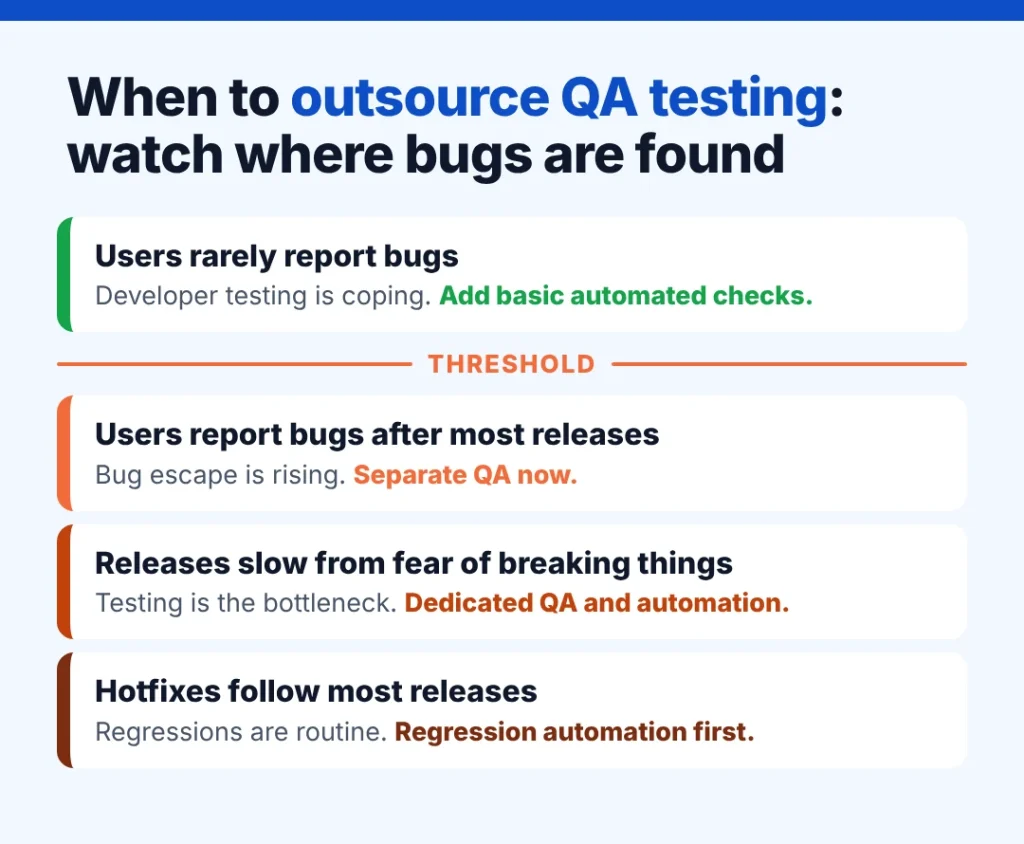
| Signal | What it means | What to do |
|---|---|---|
| Users rarely report bugs; releases are infrequent | Developer testing is coping | Keep it, add basic automated checks |
| Users report bugs after most releases | Bug escape is rising | This is the threshold. Separate QA. |
| Releases slow down because people fear breaking things | Testing has become the bottleneck | Past the threshold. Dedicated QA and automation. |
| Hotfixes follow most releases | Regressions are routine | Well past it. Regression automation first. |
Row two is the line most teams misread. A few user-reported bugs per release feels normal. It is the earliest reliable sign that testing no longer keeps pace with change.
The amount of change is rising across the industry. GitHub’s Octoverse report tracks sustained growth in contributions and automated workflows, which means more code changing more often, and more surface for regressions.
Ways to Outsource It
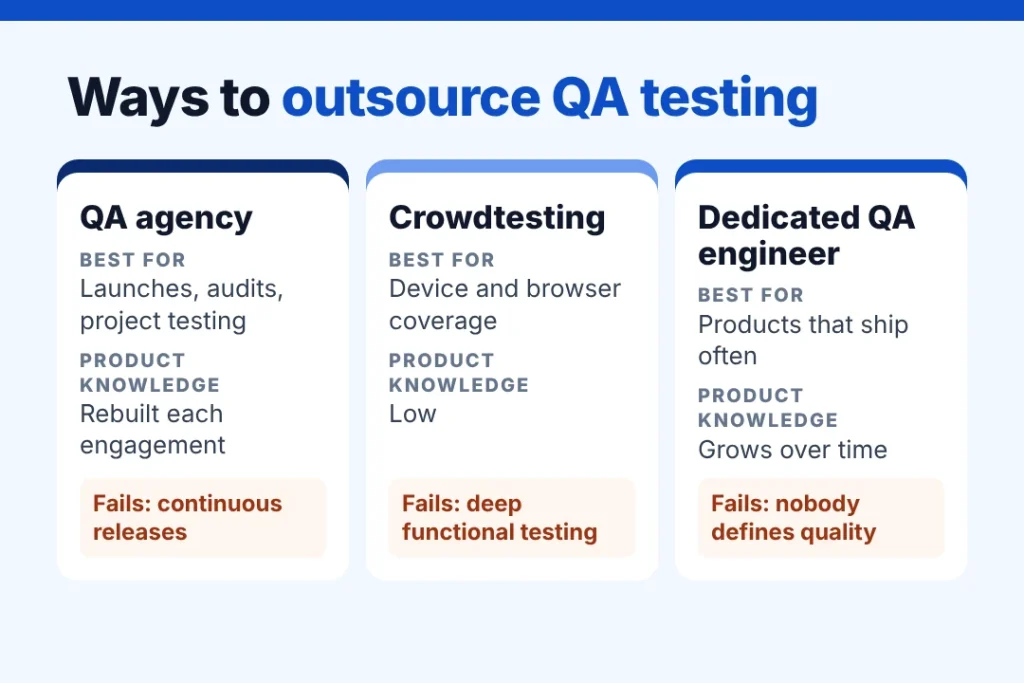
| QA agency | Crowdtesting | Dedicated QA engineer | |
|---|---|---|---|
| Best for | Project-based testing, audits, launches | Device and browser coverage at scale | Continuous testing on a product that ships often |
| Product knowledge | Builds per engagement | Low | Grows over time |
| Automation | Varies | Rarely | Builds and maintains the regression suite |
| Fails when | Releases are continuous | You need deep functional testing | Nobody defines what quality means |
For continuous delivery, a dedicated QA engineer who builds the regression suite and learns the product usually beats project-based testing, because the knowledge compounds. Our guide to outsourcing software development covers the broader team structure.
What to Screen For
Ask what they would automate first. Strong answers name the highest-risk, most-repeated flows. Weak answers try to automate everything.
Ask for a bug report they wrote. Good reports have clear steps, expected versus actual results and evidence. Developers fix good reports faster.
Give them a staging build and an hour. What they find, and how they report it, tells you more than any CV.
Pavago places QA engineers through the offshore quality assurance role.
It sits within the wider engineering talent pool.
Placement is 3% of first-year salary, search is free, and messaging and interviews are free. Terms on the pricing page.
You can open QA profiles in the client portal before deciding.
Eversite built a performance-focused engineering team rather than contracting testing per release, and the Eversite case study covers the structure.
For the infrastructure side of release quality, our guide to hiring a DevOps engineer covers deployment pipelines.
When Not to Separate QA Yet
- Infrequent releases and few user-found bugs. Basic automated checks are enough.
- No definition of done. A QA hire cannot enforce a standard nobody wrote down.
- A one-off launch. Buy a project-based test pass.
What a QA Engineer Does in the First Month
A good QA hire does not start by testing everything. They start by understanding where risk sits. In the first weeks they learn the product, read recent bug reports, talk to developers about which areas break most often, and map the flows that matter most to users and revenue. Only then do they decide what to test manually, what to automate first, and what to leave alone.
By the end of the first month you should have a written view of the riskiest parts of the product, a first set of regression checks on the most critical flows, and a clear bug reporting format the developers agree with.
Manual and Automated Testing: Where Each Belongs
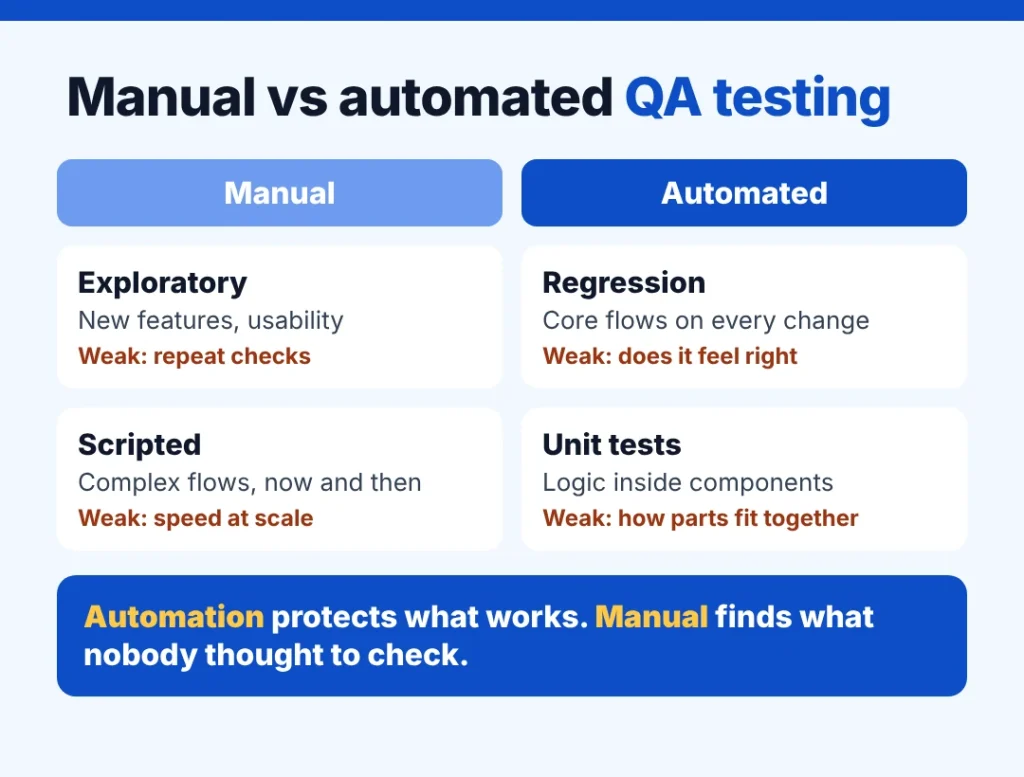
| Testing type | Best for | Weak at |
|---|---|---|
| Manual exploratory | New features, usability, unexpected behaviour | Repeating the same checks every release |
| Manual scripted | Complex flows checked occasionally | Speed and consistency at scale |
| Automated regression | Core flows checked on every change | Judging whether something feels right |
| Automated unit tests | Logic inside individual components | How components behave together |
Most teams need a mix. Automation protects what already works; manual testing finds what nobody thought to check. A QA engineer’s judgement is in deciding the balance for your product.
Building a Regression Suite That Lasts
Many teams start automating, write hundreds of brittle tests, and abandon the suite within a year because it breaks every time the interface changes. A lasting suite starts small with the flows that would cost the most if they failed, such as sign-up, checkout and payment. It is reviewed whenever features change, and failing tests are fixed or removed promptly rather than ignored. A small suite everyone trusts is worth far more than a large one nobody believes.
How to Tell Whether QA Is Working
Fewer bugs reported by users. The clearest signal that testing is catching problems before release.
Faster, calmer releases. Teams that trust their testing ship more often, not less.
Fewer hotfixes. Emergency patches after a release should become rare.
Better bug reports. Developers should spend less time reproducing problems.
Questions to Ask Before Hiring QA
Which flows would hurt most if they broke? These become the first priority.
Who decides whether a release goes out? QA needs a clear role in that decision.
What does done mean for a feature? Without a definition, testing has nothing to test against.
More on how hiring works is on the Pavago homepage.
Common QA Mistakes
Testing only at the end. When QA sees features only days before release, problems are found too late to fix calmly. Involve testing from the moment a feature is defined.
Automating everything at once. Large suites written quickly tend to be brittle and get abandoned. Start with the most critical flows and grow steadily.
Treating QA as a gate rather than a partner. The goal is shipping good software faster, not blocking releases. QA engineers who work closely with developers prevent bugs rather than just reporting them.
No owner for test environments. Unreliable staging environments produce false failures and waste everyone’s time. Someone has to own them.
Agency Testing or a Dedicated QA Engineer
A testing agency can be effective for a launch, an audit, or a burst of device coverage. The limitation for products that ship continuously is that knowledge resets with every engagement, and the regression suite often belongs to the agency rather than to you. A dedicated QA engineer working inside your tools builds a suite you own and knowledge that compounds, which is usually the better long-term investment once releases are frequent.
Review these signals monthly for the first quarter after hiring. If none are improving, the issue is usually scope or authority rather than the person: QA that sees work too late, or has no say in release decisions, cannot change outcomes.
Frequently Asked Questions
When should a startup outsource QA testing?
When users start finding bugs after most releases, or when releases slow because people fear breaking things. Team size is a poor trigger; bug escape and release frequency are better ones.
Is outsourced QA as good as in-house?
A dedicated outsourced QA engineer working inside your tools is functionally in-house. Project-based testing from an agency is weaker for continuous delivery because product knowledge resets each engagement.
Manual or automated testing first?
Automate the highest-risk, most-repeated flows first, then keep manual testing for new features and exploratory checks.
Can developers do their own QA?
Early on, yes. As the product grows, developers miss regressions outside the area they changed, which is why bug escape rises even on careful teams.
Can QA testing be done remotely?
Yes. Staging environments, test management tools, and bug trackers are all remote by default. Overlap with release windows matters more than location.
Find out where your bugs are being found
Search the pool for free. Messaging and interviews are free. 3% of first-year salary on placement, 60-day replacement.