

Web App Versus Website
The distinction matters because the economics are completely different.
| Website | Web application | |
|---|---|---|
| Purpose | Present information | Let users do something: log in, transact, manage data |
| Change frequency | Occasional | Continuous |
| Complexity | Templates and content | Logic, data, integrations, security |
| After launch | Mostly maintenance | Ongoing development |
| Cost of being stale | Looks dated | Breaks, loses users, creates security risk |
For the website side of this decision, our guide to outsourcing web development covers the post-launch cost question.
What Outsourcing Web App Development Covers
A full engagement usually runs through discovery, where requirements and user flows are defined; design, covering interface and experience; development of the front end, back end and integrations; quality assurance; deployment to a hosting environment; and ongoing maintenance. Agencies differ widely in which of these they do well. Some are strong builders and weak at discovery, which produces software that works as specified and still misses what users needed.
The Engagement Models
| Model | How it is priced | Best for | Risk |
|---|---|---|---|
| Fixed price | Agreed sum for a defined scope | Small, well-specified builds | Change requests become expensive |
| Time and materials | Hourly or daily rate | Evolving requirements | Costs hard to predict |
| Dedicated team | Monthly rate for assigned people | Ongoing product work through a vendor | Vendor margin on every month |
| In-house | Salaries plus placement fees | An app that is the product | Hiring and management effort |
Fixed price feels safe but suits only projects where the scope genuinely will not move. Most real apps change as users touch them, and every change outside the original scope is priced separately.
Where Outsourcing the Build Works
- Validating an idea. You need a working version to test demand, not a permanent team.
- No technical leadership yet. An agency supplies architecture decisions you cannot make yourself.
- A fixed-scope internal tool. Something with a clear end that will not change much once built.
- Specialist work. A complex integration or a performance problem where expertise matters more than continuity.
Choosing an Agency for the First Build
If outsourcing the first version is the right call, the choice of partner matters more than the price.
Look at how they run discovery. An agency that wants to understand your users before quoting will build the right thing. One that quotes from a feature list will build what you described, which is often not what you needed.
Ask for references from clients with live products. Speak to someone whose app the agency still maintains, not only to someone whose project ended at launch.
Ask who will actually do the work. Named developers who stay on the project produce better results than a rotating pool.
Check how they communicate. Regular demos of working software, not status reports, are the clearest sign of a healthy project.
Confirm ownership terms before signing. Code, hosting and design files should belong to you outright.
Where the Threshold Sits
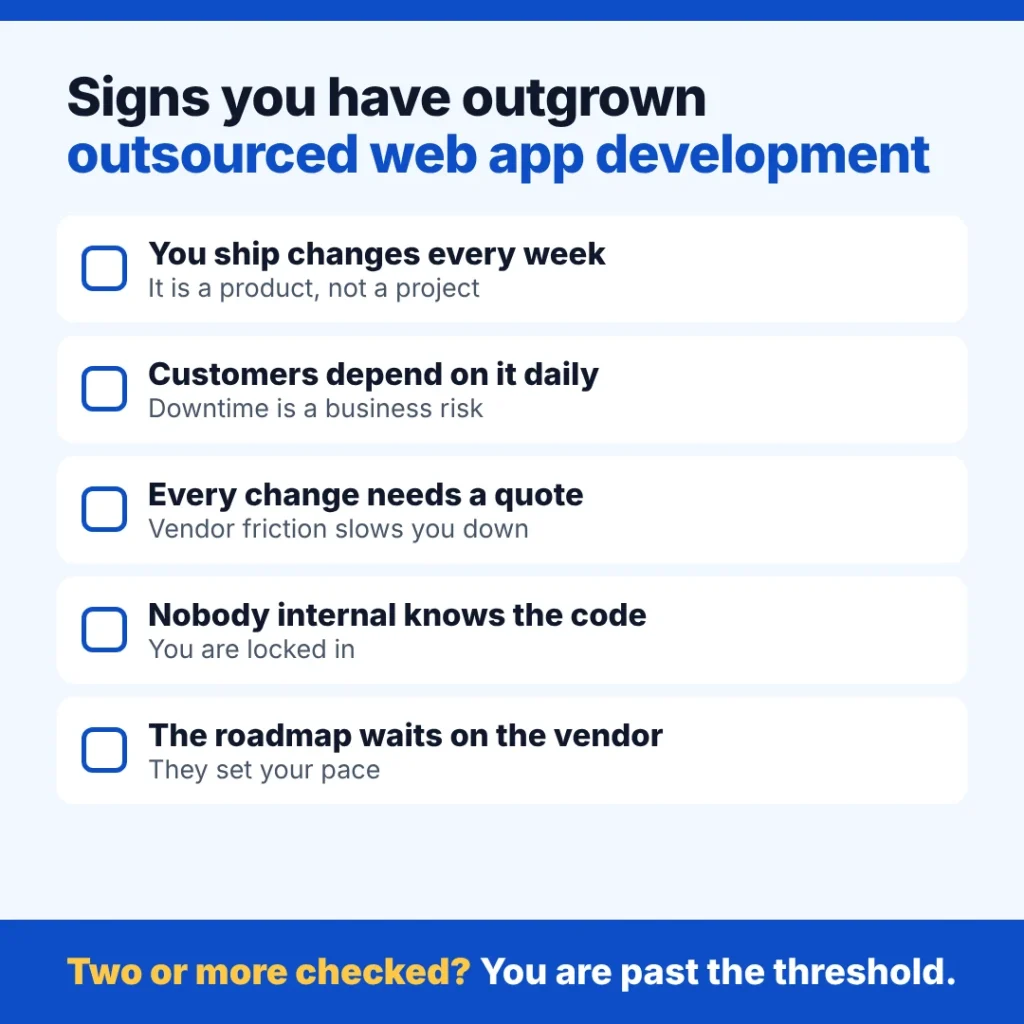
| Signal | What it means |
|---|---|
| You ship changes every week | The app is a product, not a project |
| Customers depend on it daily | Downtime is now a business risk |
| Every change needs a quote | Vendor friction is slowing the business |
| Nobody internal understands the code | You are locked in |
| Roadmap decisions wait on vendor availability | The vendor now sets your pace |
Two or more of these together usually means you are past the threshold. At that point a dedicated developer or a small team working in your own codebase is typically cheaper and faster than continuing to buy changes from a vendor.
The comparison is easier to see over a year than a month. A vendor charges for every change, every month, and the knowledge of your system leaves with each rotating developer. An in-house developer costs a salary, gets faster as they learn the codebase, and keeps that knowledge inside the business.
The Hidden Costs of Staying Outsourced
Change friction
Each small improvement needs a request, an estimate and an approval. Small changes stop being requested, and the product improves more slowly than competitors’ do.
Context that never builds
Vendor developers rotate across clients. The understanding of why the app works the way it does stays with the vendor, not with you.
Dependency drift
Modern apps rely heavily on third-party packages. GitHub’s Octoverse report shows how much of today’s software is built on open source components, which means a live app needs continuous updating whether or not new features are added. On an outsourced contract, that work is easy to deprioritise until something breaks.
Lock-in
If the vendor holds the repository, the hosting accounts or the only working knowledge of the system, leaving becomes a negotiation rather than a decision.
How to Outsource the Build Without Getting Locked In
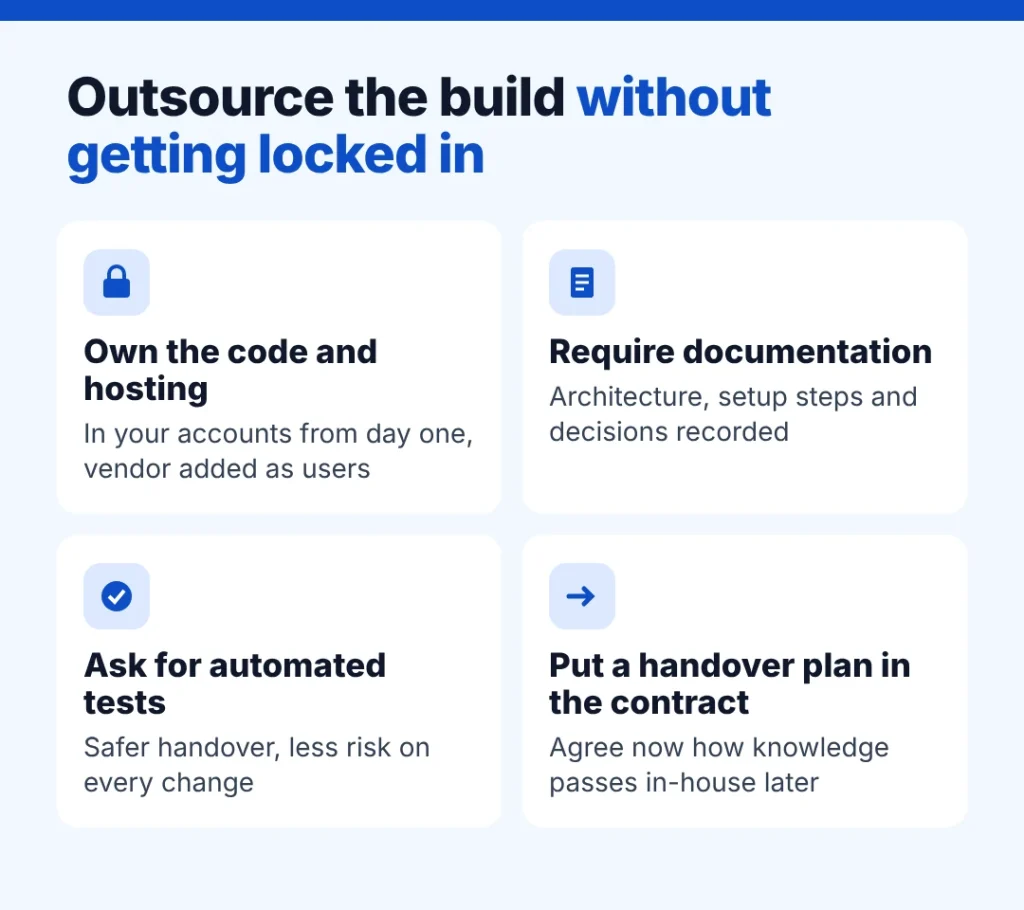
Own the repository and hosting from day one. The code and infrastructure should sit in your accounts, with the vendor added as users.
Require documentation. Architecture notes, setup instructions and decisions recorded, so a new developer can take over.
Ask for automated tests. Tests make handover safer and every future change less risky.
Agree a handover plan in the contract. Decide now how knowledge passes to an in-house developer later.
Planning the Handover
Hire before you end the contract. Overlap of several weeks lets the new developer learn from the people who built it.
Start with small changes. The new developer builds confidence on low-risk work before touching core systems.
Transfer access completely. Every credential, service and account, not just the code.
Keep the vendor for specialist work if useful. A handover does not have to end the relationship entirely.
A Typical Path From Outsourced Build to In-House Team
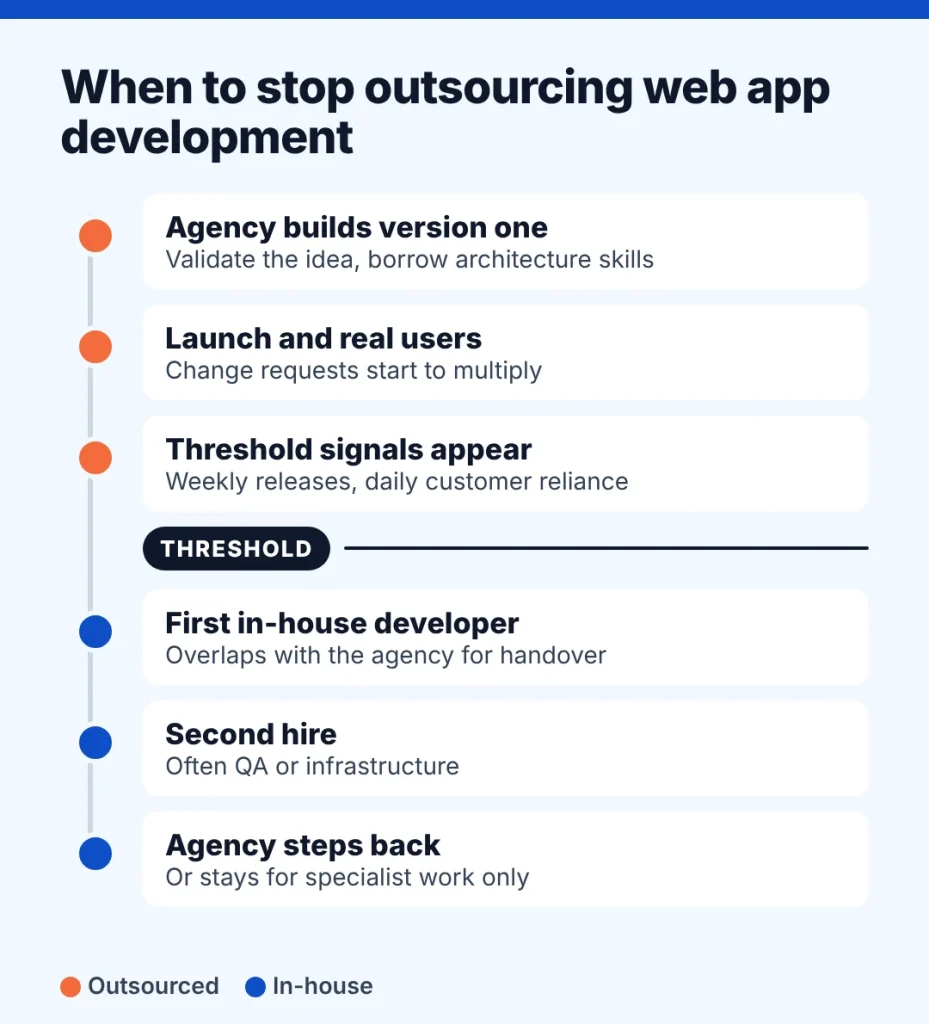
Most successful transitions follow a similar shape. An agency builds the first version over a few months. The product launches and starts to attract real users. Within the following months, change requests multiply and the signals in the threshold table begin to appear. At that point, the company hires its first in-house developer, who overlaps with the agency for a handover period. A second hire, often covering quality assurance or infrastructure, follows as release frequency grows. The agency either steps back entirely or stays on for occasional specialist work.
The companies that struggle are usually the ones that skip the overlap, ending the agency contract the same week the new developer starts, with nobody left who understands why the system was built the way it was.
What It Costs to Get This Wrong
The expensive outcome is not paying an agency a little too long. It is reaching the point where nobody can safely change the app. Code without documentation or tests, held by a vendor you are leaving, sometimes has to be rebuilt rather than maintained. A rebuild means paying for the product twice and pausing feature work while it happens. Owning the code, insisting on documentation, and planning the handover early are cheap compared with that. The same risk applies to native apps, which is why hiring a mobile app developer starts with choosing a platform you can maintain.
Building the In-House Side
Pavago’s placement fee is 3% of first-year salary, with search, messaging and interviews free. The terms are on the pricing page.
You can browse developers in the client portal before deciding.
The offshore full-stack developer role covers developers who work across the app.
Related roles are in the wider engineering talent pool.
As release frequency grows, our guide to outsourcing QA testing covers when testing needs its own owner.
Press Advantage built an in-house technical team rather than relying on vendors, and the Press Advantage case study covers how.
More on how it works is on the Pavago homepage.
Frequently Asked Questions
Should I outsource web app development?
For a first version or a fixed-scope tool, often yes. Once the app becomes your product and changes weekly, a dedicated in-house developer is usually cheaper and faster.
What is the difference between a website and a web app?
A website presents information. A web app lets users do things, such as log in, transact or manage data, and needs continuous development.
How do I avoid vendor lock-in?
Own the repository and hosting, require documentation and automated tests, and agree a handover plan in the contract.
Fixed price or time and materials?
Fixed price for small, well-defined builds. Time and materials when requirements will evolve, which is true of most real applications.
Can web app development be done remotely?
Yes. Code, hosting and collaboration are remote by default. Code ownership and documentation matter more than location.
Build first, then bring it home
Search the pool free. Messaging and interviews are free. 3% of first-year salary on placement, 60-day replacement.