

The Two Gaps
Almost everyone searching for virtual assistant training is in one of two positions, and they need different things.
| Skill gap | Evidence gap | |
|---|---|---|
| The situation | You have not done this kind of work and do not know the tools | You have done equivalent work, but nothing proves it |
| What an employer sees | A profile with no relevant background | A profile that claims things it cannot verify |
| What actually helps | Structured learning, in one narrow area | Free certifications and one piece of real work |
| What paid training does | Genuinely helps, if narrow enough | Nothing. You already have the skill. |
| Typical mistake | Learning twenty tools shallowly | Buying a course to fix a problem it does not address |
Most people are in the second column and buy for the first. That is the entire reason the training market is as large as it is. Someone who has managed a shop’s bookings, handled customer complaints, and kept supplier records already has the skills. What they lack is anything an employer can check in thirty seconds.
How to Tell Which One You Have
Three questions, and they are not subtle.
- Have you ever been responsible for a calendar, an inbox, records, or customers in any job? If yes, you likely have the skill and need evidence.
- Could you learn a new tool from its own help documentation in a week? If yes, a course teaching that tool is selling you time you do not need to buy.
- When you apply, do you get no response, or do you get responses that stop after the test task? No response is an evidence problem. Failing at the test task is a skill problem.
That third question is the most diagnostic, and the one people avoid asking. Silence from employers means you are being filtered before anyone assesses you. Failing after the test task means you reached assessment and did not pass it. Those require completely different responses, and treating the first as the second is how people end up buying courses that change nothing.
If You Have an Evidence Gap
Do not buy training. Build proof, and it takes weeks rather than months.
Free certifications first. QuickBooks ProAdvisor, Xero Advisor, HubSpot Academy, Google Workspace and Analytics, and Shopify partner training are all free. Two completed in a coherent direction beats five scattered across unrelated tools.
Then one real piece of work. Solve one specific problem for a small business, a community organisation, or your own operation, and keep the output. Not ongoing help, one thing with a defined end.
That combination addresses exactly what employers screen on, and it costs nothing. Our guide to building a virtual assistant portfolio covers how to document it so it demonstrates judgement rather than just completion.
If You Genuinely Have a Skill Gap
Training is reasonable, with two constraints that matter more than the choice of provider.
Go narrow. Bookkeeping in QuickBooks, or ecommerce support in Shopify and a helpdesk tool. Not general virtual assistance, which teaches a little of everything and qualifies you for nothing specific.
Prefer free before paid, in every case. The free certifications above cover more ground than most paid programmes and carry more weight, because employers recognise them. Exhaust free options before spending anything.
If a paid programme still looks necessary after that, judge it on one question: does it end with something verifiable? A certificate from the tool vendor is verifiable. A certificate from the course provider is not, because nobody hiring has heard of them.
What to Be Careful Of
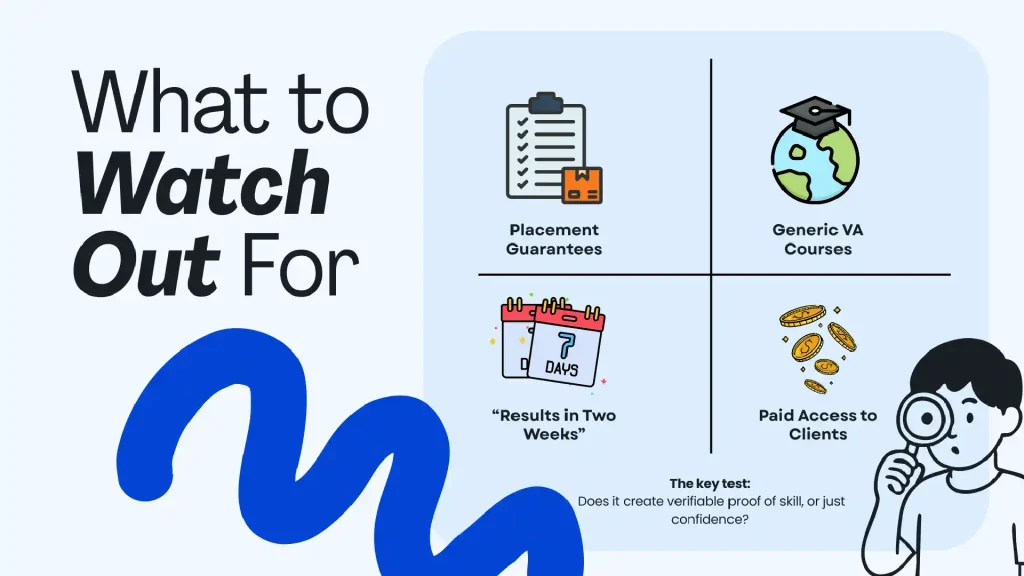
Certain patterns in this market are worth recognising before spending anything.
- Placement guarantees. No training provider controls who employers hire. A guarantee is either meaningless or comes with conditions that make it meaningless.
- Courses that teach general virtual assistance. Breadth without a niche is the position you are already in. Paying to stay there is a poor trade.
- Programmes charging for access to clients. Legitimate platforms do not charge candidates. Any arrangement where you pay to be considered for work deserves scepticism.
- Anything promising results in two weeks. Two to three months from starting to first interviews is realistic if you build evidence properly.
The general test: does the thing being sold produce something an employer can verify, or does it produce confidence? Confidence has value, but it is not what gets you past a filter.
What Employers Screen On, In Order
It is worth knowing what actually happens to an application, because it explains why evidence beats training.
| Stage | What is checked | What passes it |
|---|---|---|
| Filter | Tools and certifications listed | Verifiable certifications, named specifically |
| First read | Your written message | Clarity. Short sentences, answering what was asked. |
| Shortlist | Evidence of real work | One documented piece, not a list of claims |
| Test task | Judgement under an incomplete brief | Asking one clarifying question, flagging uncertainty |
Paid training touches none of these four stages directly. Free certifications touch the first. Real work touches the third. Written communication touches the second and is learnable without paying anyone. The fourth is a habit rather than a skill.
Where this becomes concrete is on platforms where employers search rather than post. There, your profile is being read by someone who already decided to look at you, so verifiable credentials and one real example do most of the work. You can see what that looks like on the candidate portal.
What This Costs Either Way
Free route: two certifications and one real piece of work. Roughly three to four weeks of effort and no money.
Paid route, if you genuinely have a skill gap: a narrow programme in one specialisation, plus the free certifications regardless, plus the real work. The paid element replaces the learning, not the evidence.
Pavago is free for candidates permanently, and you keep your full rate, with nothing deducted from what the company pays you. It’s a self-serve hiring marketplace, so companies search the pool, watch video intros and message candidates directly. Browse open roles to see what employers are actually asking for, or your region: South Asia, the Philippines and Southeast Asia, Africa, LATAM, Europe. You can also search by country: Guatemala, El Salvador, Nicaragua, Paraguay or Venezuela.
Reading current listings is itself the cheapest form of research available, because the required tools are stated explicitly and you can work backwards from them. Our guide to virtual assistant skills covers which of those are verifiable, and our guide to becoming a virtual assistant covers the full sequence.
Frequently Asked Questions
Is virtual assistant training worth it?
It depends on whether your gap is skill or evidence. If you have never handled admin, customers, or records, narrow training in one specialisation helps. If you have done equivalent work and simply cannot prove it, training does not address the problem, and free certifications do.
Do I need a certification to work as a virtual assistant?
Not legally, but certifications function as proof when you have no track record. QuickBooks ProAdvisor, Xero, HubSpot Academy, Google, and Shopify training are free and appear in employer screening filters.
Are paid virtual assistant courses a scam?
Not inherently, but judge them on one question: does it end with something an employer can verify? A certificate from a tool vendor carries weight. A certificate from the course provider does not, because nobody hiring recognises it. Treat placement guarantees as a warning sign.
How long does virtual assistant training take?
Free certifications take days each. Building one real piece of work takes one to two weeks. Two to three months from starting to first interviews is realistic. Anything promising two weeks is selling something.
What should I learn first as a virtual assistant?
The tools used in the niche closest to work you have already done. Bookkeeping support means QuickBooks or Xero. Ecommerce support means Shopify and a helpdesk tool. Learning general virtual assistance qualifies you for nothing in particular.
See what employers are actually asking for
Free for candidates, always. You keep your full rate, with nothing deducted from what the company pays you. Companies search the pool and message you directly.